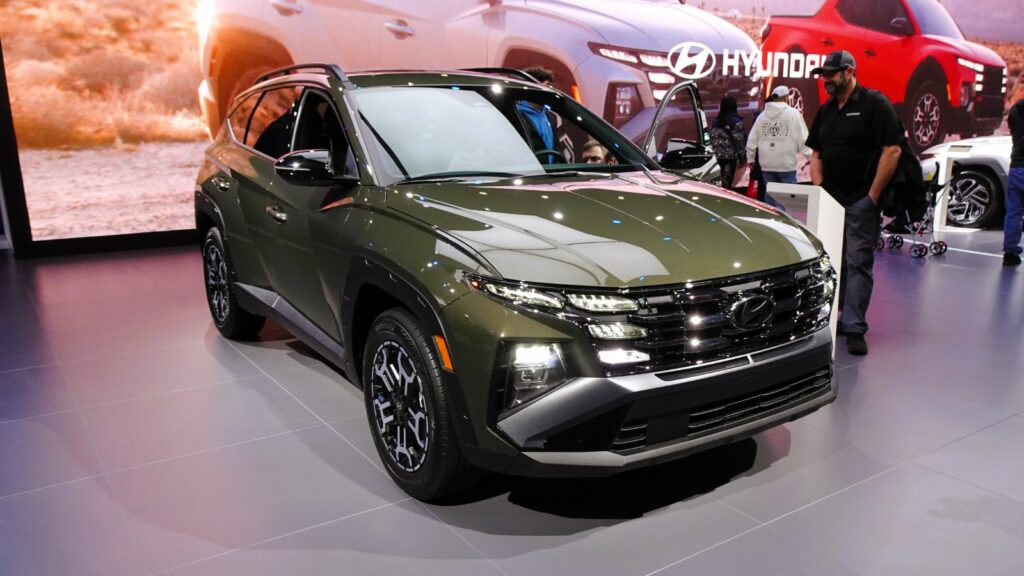
Hyundai is preparing a substantially redesigned Tucson for North America, and two numbers help explain where the compact SUV is headed: a targeted 42 mpg for the most efficient hybrid configuration and a 3,000-pound towing capacity for the all-wheel-drive hybrid. Both represent an effort to broaden the Tucson’s usefulness without abandoning the fuel economy that increasingly attracts buyers to hybrid crossovers.
The fifth-generation Tucson also grows in size, adopts Hyundai’s new Pleos Connect infotainment platform and introduces a more capable XRT Pro version. Hyundai says the new model will reach the United States and Canada in early 2027. Some important details remain preliminary, however. The 42-mpg figure is a manufacturer target rather than a finalized EPA rating, while pricing and some market-specific equipment have yet to be announced.
A Redesign Built Around More Than New Styling
Hyundai unveiled the new Tucson in New York on October 1, presenting the compact SUV as one of the opening moves in a much broader product expansion. The redesign adopts the company’s “Art of Steel” styling direction, replacing much of the previous Tucson’s intricate surfacing with stronger fenders, straighter lines and a more upright appearance. Hyundai has also increased the vehicle’s basic dimensions rather than limiting the redesign to sheet metal and cabin electronics. That matters because the Tucson occupies one of the most fiercely contested parts of the North American vehicle market, where buyers often compare fuel economy, passenger room and cargo capacity almost as closely as price.
There is also a lot riding on the model internally. Hyundai says more than 11.1 million Tucsons have been sold globally since the nameplate arrived in 2004, making it the company’s best-selling SUV worldwide. Roughly 20 percent of those cumulative sales have come from the United States. Hyundai also says hybrids represented 31 percent of U.S. Tucson sales in 2025. That gives the company a strong reason to make the hybrid version central to the new generation rather than treating electrification as a niche alternative.
The 42-MPG Target Comes With an Important Asterisk
The headline efficiency figure belongs to a specific version of the Tucson Hybrid. Hyundai is targeting as much as 42 mpg for the North American front-wheel-drive hybrid when fitted with 17-inch wheels. Its preliminary specification table also lists 40 mpg for other front-drive configurations, while all-wheel-drive hybrids are listed at 40 mpg with 17-inch wheels and 38 mpg in other configurations. Those figures could make the Tucson significantly more competitive with the most efficient compact hybrids if they survive certification largely unchanged.
For now, however, 42 mpg should not be treated as a final EPA rating. Hyundai itself describes the number as targeted fuel economy, and independent reporting notes that the U.S. Environmental Protection Agency has not yet published official 2027 Tucson Hybrid ratings. That distinction is particularly important because wheel size, drivetrain, weather and driving conditions can materially change real-world consumption. For perspective, Hyundai currently advertises the 2026 Tucson Hybrid at as much as 38 mpg combined in the United States. Reaching 42 mpg would therefore represent a meaningful improvement, but the final comparison will have to wait for certified numbers.
The Hybrid System Produces 233 Horsepower
Fuel economy is only part of Hyundai’s hybrid strategy. The new Tucson Hybrid combines a turbocharged 1.6-litre gasoline engine with Hyundai’s next-generation hybrid system for a U.S.-spec combined output of 233 horsepower and approximately 280 pound-feet of torque. Hyundai lists a 1.49-kWh battery and a six-speed automatic transmission. The company is also targeting an 8.5-second run from zero to 60 mph, although that figure, like the economy numbers, comes from Hyundai rather than an independent road test.
The redesign introduces several features intended to make the hybrid system useful beyond the fuel pump. E-Traction can adjust power delivery to help manage wheel slip and vehicle stability during cornering. Hyundai’s HEV Stay Mode is designed to operate functions such as climate control, audio and device charging while the gasoline engine is shut down. An integrated electric water pump is also used in the thermal-management system. None of those technologies turns the Tucson into an EV, but collectively they show how Hyundai is trying to make the electric side of the hybrid powertrain contribute to comfort, handling and efficiency rather than simply boosting the official mileage figure.
The 3,000-Pound Tow Rating Is a Significant Upgrade
Perhaps the most practical change is the new towing capacity. Hyundai says the North American all-wheel-drive Tucson Hybrid will be able to tow as much as 3,000 pounds, or roughly 1,361 kilograms. That represents a 1,000-pound increase compared with the outgoing hybrid. Hyundai’s own U.S. specifications for the 2026 Tucson Hybrid list a maximum of 2,000 pounds when the trailer is equipped with brakes and 1,650 pounds without trailer brakes.
An additional 1,000 pounds can make a meaningful difference for owners who use a compact SUV for more than commuting. A 3,000-pound ceiling creates considerably more room for small recreational trailers, utility trailers and personal watercraft once the weight of the trailer itself and its cargo are calculated. It still does not turn the Tucson into a heavy-duty tow vehicle, and owners will need to pay close attention to the final hitch, tongue-weight, payload and braking requirements published for their exact configuration. Hyundai also currently specifies the 3,000-pound North American figure for the AWD hybrid; a corresponding North American front-wheel-drive tow rating has not been clearly published.
The Gasoline Tucson Gets a Different Engine Strategy
The hybrid may receive much of the attention, but the conventional Tucson changes significantly as well. Hyundai’s U.S. specification calls for a turbocharged 1.6-litre four-cylinder engine producing 184 horsepower. That engine is paired with an eight-speed automatic transmission. Car and Driver notes that this replaces the naturally aspirated 2.5-litre four-cylinder used by the previous U.S. Tucson, shifting the entry-level model from a larger non-turbo engine to a smaller turbocharged design.
The horsepower number does not tell the whole story. The new 1.6-litre is listed at roughly 195 pound-feet of torque, compared with 178 pound-feet cited for the outgoing 2.5-litre engine. Hyundai’s preliminary North American specification table lists fuel economy of 28 mpg for a two-wheel-drive gasoline Tucson and 26 mpg for a four-wheel-drive model, although buyers should wait for certified ratings before making direct operating-cost comparisons. The presence of both gasoline and hybrid versions also gives Hyundai room to separate the lineup by price, capability and efficiency instead of forcing every Tucson buyer into the same powertrain.
A Larger Tucson Creates More Space for Families
The Tucson is becoming physically larger. Hyundai lists the long-wheelbase model at 4,700 millimetres in length, an increase of 60 mm, while width rises 40 mm to 1,905 mm. Height increases 20 mm to 1,685 mm, and the wheelbase grows 30 mm to 2,785 mm. These are relatively modest increases individually, but in a compact SUV they can translate into noticeably different passenger and cargo packaging.
Hyundai lists 1,064 mm of second-row legroom and 41.7 cubic feet of cargo capacity, while the rear doors now open to 83 degrees rather than 73 degrees. That wider opening is the kind of detail that may matter more in daily use than a dramatic dashboard feature. Loading a child seat, helping an older passenger into the rear seat or fitting awkward cargo through the side doors can become easier when the opening itself is larger. Hyundai Canada is already highlighting the Tucson’s 41.7-cubic-foot cargo figure while cautioning that the vehicles currently being shown are international or pre-production models and that Canadian specifications can differ.
XRT Pro Gives the Tucson a More Serious Adventure Variant
Hyundai is also expanding the rugged side of the Tucson family. The new XRT Pro builds on the existing XRT concept with all-wheel drive, all-terrain tires, front recovery hooks and additional lower-body protection. Ground clearance rises from 180 mm on the standard Tucson to 210 mm on the XRT Pro, an increase of 30 mm. That works out to just over eight inches of clearance, giving the vehicle more room underneath when travelling over rough roads, snow or uneven trails.
The technology changes along with the hardware. Hyundai’s Smart Terrain Assist is designed to evaluate traction and wheel-slip conditions and display what the company calls a “stuck score.” Target Speed Control can manage acceleration and braking at low speeds while the driver concentrates on steering. Those systems do not suddenly transform a unibody compact crossover into a specialized rock crawler, but they show that XRT Pro is intended to offer more than darker trim and cosmetic cladding. Pairing the rugged package with the hybrid drivetrain is also notable because it brings Hyundai’s efficiency push and its outdoor-oriented positioning into the same version of the Tucson.
Pleos Connect Is a Major Cabin Technology Reset
The interior introduces one of Hyundai’s biggest technology changes: Pleos Connect. The system is based on Android Automotive OS and can use either a 12.9-inch or available 17-inch primary touchscreen alongside a slim 9.9-inch driver display. Hyundai Canada has already begun promoting the available 17-inch setup for the Canadian-market vehicle, although it warns that final equipment can vary by trim and market.
Pleos Connect also introduces Gleo AI, Hyundai’s conversational in-vehicle assistant. The company says the system is designed to understand more natural requests and use context rather than relying solely on rigid voice commands. Native third-party applications and over-the-air software updates are part of the platform as well. Despite the larger screens, Hyundai has retained physical controls for frequently used climate and audio functions beneath the centre display. The cabin also includes a column-mounted electronic shifter, freeing space on the centre console. Available dual 15-watt wireless charging pads and 100-watt USB-C charging in the seatbacks further reflect how much everyday vehicle design now revolves around phones, tablets and other personal electronics.
Comfort and Driver Assistance Move Further Upmarket
Hyundai is adding several comfort features that would once have been more closely associated with larger or more expensive vehicles. Available Ergo Motion seating uses pneumatic cells for massage and support, while a separate Relaxation Comfort Seat can recline for use during stops. An available three-zone climate system allows separate temperature adjustment for rear passengers, and Hyundai has developed metal-coated heated glass that it says can fully de-ice in about 15 minutes. Hybrid Stay Mode can also keep climate, audio and charging functions operating with the gasoline engine off under appropriate conditions.
Driver-assistance technology expands at the same time. Hyundai describes an in-cabin monitoring unit capable of watching for signs of driver fatigue, along with child-presence and rear-occupant alert functions. Navigation-linked cruise-control functions can anticipate certain curves and road features. The company has also listed ambitious safety goals for the vehicle, including a five-star NHTSA rating and IIHS Top Safety Pick+ status. Those are targets rather than achievements at this stage. The redesigned Tucson has not yet earned those ratings, so independent crash testing will remain an important part of the vehicle’s eventual safety assessment.
Early 2027 Is the Target for North American Buyers
Hyundai says the new Tucson will launch first in Korea before reaching North America and other global markets in 2027. Its U.S. consumer site specifies an early-2027 launch, and Hyundai Canada also says the next-generation Tucson is coming to Canada in early 2027. Canadian material confirms gasoline and next-generation hybrid powertrain options while emphasizing that current preview vehicles are international models and that local specifications may change.
Several pieces of the buying equation are therefore still missing. Hyundai has not finalized North American pricing in its initial launch material, and the 42-mpg figure remains a target until official certification is complete. Trim-specific equipment, Canadian fuel-consumption ratings and the exact availability of some convenience and driver-assistance features also need to be confirmed closer to sale. What is already clear is Hyundai’s direction: the next Tucson is being asked to cover a broader range of jobs. It is larger, more technology-heavy and more capable of towing, while its most efficient hybrid is simultaneously aiming for better mileage. For one of Hyundai’s most important global products, that is an unusually broad set of priorities to balance.
