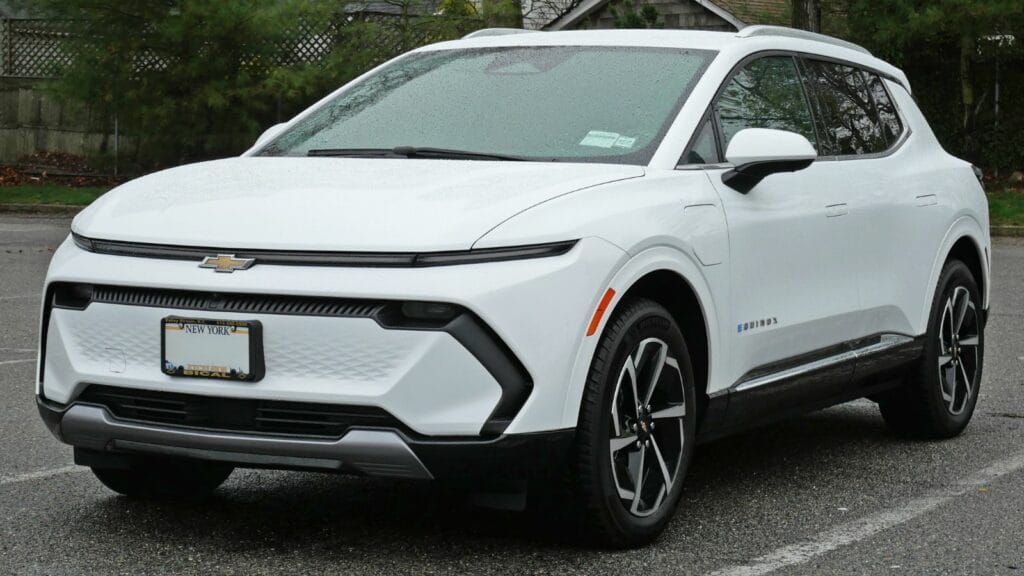
General Motors entered the third quarter of 2026 with one of the broadest electric-vehicle lineups in the United States. It left the quarter with a dramatically smaller EV business. GM delivered 25,473 electric vehicles, down 61.7% from the record 66,501 it sold in the same period a year earlier. The Chevrolet Equinox EV, previously the company’s electric-volume leader, suffered the most striking reversal.
GM sold just 1,905 Equinox EVs in Q3, down 92.4% from 25,085 a year earlier. One distinction matters: that 92.4% decline is year-over-year, not quarter-over-quarter. Compared with Q2 2026, Equinox EV sales fell about 71%. The numbers still point to a major demand reset as GM adjusts to a smaller post-incentive U.S. EV market.
The EV Decline Was Bigger Than GM’s Entire Sales Drop
GM’s overall U.S. performance looks considerably different once electric models are separated from the rest of the portfolio. The company delivered 670,974 vehicles during Q3 2026, down 5.5% from 710,347 in the same quarter of 2025. That represents an overall decline of 39,373 vehicles. Yet GM’s EV deliveries alone declined by 41,028 units, from 66,501 to 25,473. In other words, the loss of EV volume was greater than the automaker’s entire year-over-year sales decline.
The arithmetic highlights how concentrated GM’s weakness was. Removing EVs from both quarters leaves roughly 645,501 non-EV deliveries in Q3 2026 compared with 643,846 a year earlier, an increase of about 0.3%. Electric vehicles consequently represented only about 3.8% of GM’s U.S. quarterly deliveries, down from approximately 9.4% in Q3 2025. Rather than signaling a collapse across GM’s whole showroom, the quarter shows an unusually sharp divergence between its electric lineup and much of its conventional vehicle business.
The Equinox EV’s 92% Drop Needs an Important Clarification
No GM model illustrates the reversal better than the Equinox EV. Chevrolet delivered 25,085 of the electric crossovers during Q3 2025, helping make it the company’s highest-volume EV and, at the time, the best-selling non-Tesla electric vehicle in the United States. One year later, quarterly deliveries had fallen to 1,905. Through the first nine months of 2026, Equinox EV sales stood at 18,154, down 65.6% from 52,834 during the comparable 2025 period.
The decline is not merely an artifact of comparing against last year’s exceptional quarter. GM’s second-quarter data show 6,660 Equinox EV deliveries between April and June 2026. Falling from 6,660 to 1,905 means sales decreased approximately 71.4% sequentially in Q3. Meanwhile, the gasoline-powered Chevrolet Equinox remained a vastly larger business, generating 67,203 deliveries during the quarter. For Chevrolet dealers, the contrast is stark: a familiar compact SUV nameplate continues moving tens of thousands of gasoline vehicles while its battery-powered counterpart has suddenly become a much lower-volume product.
Last Year’s Tax-Credit Rush Created an Extraordinary Benchmark
The comparison with Q3 2025 comes with an unusually important qualification. GM’s 66,501 EV deliveries during that period were a company record, and GM itself said customers were rushing to purchase electric vehicles before the federal incentive disappeared. Eligible new clean vehicles could previously qualify for a federal tax credit worth as much as $7,500. Under legislation enacted in 2025, the credit became unavailable for vehicles acquired after September 30, 2025.
That deadline concentrated demand into precisely the quarter now being used as the year-over-year comparison. The Equinox EV’s 25,085-unit performance was therefore achieved during a buying environment that no longer exists. This does not make the 2026 decline meaningless: the Equinox EV’s steep sequential drop from Q2 demonstrates that its problems extend beyond an unfavorable annual comparison. It does, however, explain why year-over-year percentages across the U.S. EV industry can look exceptionally severe. Q3 2025 effectively pulled some future purchases forward, leaving manufacturers to compete without the same federal purchase incentive afterward.
Weakness Spread Across Almost the Entire GM EV Lineup
The Equinox EV produced the most eye-catching percentage, but it was far from an isolated problem. Chevrolet Blazer EV deliveries dropped 84.4% year-over-year to 1,261 vehicles. The Silverado EV fell 58% to 1,655 units, while Chevrolet’s BrightDrop electric commercial vans declined 43.6% to 1,344. GMC encountered similarly difficult comparisons: Hummer EV sales dropped 72.9% to 1,423 and Sierra EV deliveries fell 50.8% to 1,661.
Cadillac’s EVs generally held up better, although most still declined. Lyriq deliveries fell 50.5% to 3,617, Vistiq sales decreased 34.1% to 2,587, and Escalade IQ/IQL volume dropped 29.2% to 1,604. The Cadillac Optiq was the relative standout, declining just 6.9% to 4,550 vehicles. The new Chevrolet Bolt, which had no comparable Q3 2025 volume in GM’s table, added 3,866 deliveries. The breadth of these declines matters because it suggests GM’s EV contraction cannot be attributed to one ageing model, one price point or one vehicle category.
Cadillac Has Quietly Become GM’s EV Centre of Gravity
One of the quarter’s more surprising developments occurred at Cadillac. Its four electric SUVs—the Optiq, Lyriq, Vistiq and Escalade IQ/IQL—combined for 12,358 deliveries. That works out to roughly 48.5% of all GM electric vehicles sold in the United States during Q3. The Optiq alone, with 4,550 deliveries, was GM’s highest-volume EV during the quarter, overtaking both the Chevrolet Bolt and the formerly dominant Equinox EV.
That shift creates an unusual situation for GM’s electrification strategy. Cadillac is a luxury brand with much lower overall volume than Chevrolet, yet its EV products are carrying nearly half of GM’s current electric sales. About 38% of Cadillac’s 32,560 total Q3 deliveries were electric. GM also said Cadillac’s share of the luxury EV market had increased by 1.3 percentage points year-to-date through August. Still, this was not an uncomplicated success story: Cadillac’s total Q3 sales dropped 30% year-over-year. Its EV portfolio is becoming increasingly important inside the brand even as Cadillac’s overall U.S. volume faces pressure.
The New Bolt Helps, but It Cannot Replace the Lost Equinox Volume
Chevrolet’s revived Bolt provided one of the few positive additions to GM’s EV table. GM delivered 3,866 Bolts in Q3 and 8,090 during the first nine months of 2026. Its relatively low starting price has made the model particularly important as the industry looks for electric vehicles that can compete without a $7,500 federal purchase incentive. Yet even the Bolt’s entire quarterly volume replaced only a fraction of the more than 23,000 Equinox EV deliveries GM lost compared with Q3 2025.
There is also uncertainty about how large the Bolt business will become. Reuters reported in late September that a local United Auto Workers official expected the Kansas City-area assembly plant to produce roughly 35,000 of the current Bolts before production ends in the first quarter of 2027, versus an earlier trajectory of about 150,000. The union official described the reduction as roughly 75%; GM declined to confirm those production figures and said it continually evaluates demand. That distinction is important because the 35,000-unit figure is a union estimate, not an announced GM production target.
Gasoline Trucks and Small SUVs Prevented a Much Deeper GM Decline
GM’s EV numbers look particularly severe alongside several resilient parts of its conventional portfolio. Chevrolet Trax sales increased 16.3% to 57,917 vehicles in Q3, while Trailblazer deliveries jumped 51.1% to 31,075. Buick’s Envista increased 18.4% to 18,094. GM said its group of affordable small SUVs collectively achieved record quarterly sales, rising 27%, demonstrating that consumers were still visiting dealerships and buying high-volume products even while electric demand weakened.
Pickup performance also provided support. Chevrolet sold 100,221 light-duty Silverados, up 13.3% year-over-year, while GMC Sierra light-duty sales increased 2.9% to 56,325. GM ended September with dealer inventory of 568,151 vehicles and continued to describe demand for its core pickups and SUVs as strong. The juxtaposition matters financially and strategically. Electric vehicles may remain important to GM’s longer-term product planning, but the third quarter once again demonstrated how heavily the company currently depends on traditional trucks, SUVs and crossovers to maintain U.S. scale when one emerging powertrain category suddenly loses momentum.
The Entire U.S. EV Market Is Going Through a Post-Credit Reset
GM’s numbers should also be viewed against an electric-vehicle market that was already shrinking before Q3 ended. Kelley Blue Book estimates published by Cox Automotive put second-quarter 2026 U.S. EV sales at 247,226 vehicles, down 20.5% from a year earlier. EVs accounted for about 5.8% of new-vehicle sales during that quarter. That was dramatically below the 10.5% record market share reached in Q3 2025, when American buyers purchased 438,487 EVs while racing to secure expiring incentives.
Industry conditions remained difficult entering the third quarter. Reuters reported that U.S. EV sales were falling substantially after the federal credit disappeared, even as the wider new-vehicle market remained comparatively resilient. That broader distinction is important. GM’s 62% EV decline is substantially more severe than the market contraction already evident earlier in 2026, but the automaker is not operating in isolation. Manufacturers across the industry have been reassessing prices, production volumes and product plans as they discover what underlying EV demand looks like without the federal incentive that previously reduced effective purchase costs.
GM Is Already Rewriting Its Production Strategy
The sales slowdown has moved beyond dealership spreadsheets and into factories and investment decisions. Reuters reported that GM had recorded $10.9 billion in EV-related charges since the second quarter of 2025 as it adjusted to changed demand and policy conditions. The company still manufactures roughly a dozen electric models, but some factories originally intended for greater electric output have been retooled or reassigned to gasoline-powered vehicles as GM tries to align capacity more closely with what consumers are purchasing.
The Kansas City-area Fairfax plant provides a clear example. Alongside the reduced Bolt production described by the local union, GM plans to add production of the gasoline-powered Chevrolet Equinox, which is currently built in Mexico, and move Buick Envision production from China to the U.S. facility. Such moves do not amount to an abandonment of electric vehicles; GM still maintains a large EV portfolio spanning Chevrolet, GMC and Cadillac. They do show, however, that the company is treating today’s weaker demand as something substantial enough to influence capital allocation, factory schedules, employment and future product volume.
The Next Few Quarters Will Reveal How Much of the Drop Is Structural
The third-quarter figures support two conclusions at the same time. First, the year-over-year comparisons are unusually harsh because Q3 2025 was distorted upward by buyers racing to use an expiring federal incentive. Second, GM’s weakness cannot be dismissed entirely as a statistical base effect. The Equinox EV fell from 6,660 deliveries in Q2 2026 to 1,905 in Q3, while numerous other GM electric models also recorded steep declines. There is clearly a real demand adjustment occurring beneath the headline comparison.
Upcoming quarters should produce more informative comparisons. Q4 2025 was the first full quarter after the federal clean-vehicle purchase credit ended, meaning Q4 2026 results will compare one post-credit period with another rather than against the final incentive rush. The key numbers will be straightforward: whether Equinox EV volume stabilizes, how much demand the affordable Bolt attracts, whether Cadillac can sustain its unexpectedly large contribution, and whether GM’s total EV share begins recovering. For now, the 62% decline marks one of the sharpest reversals yet in GM’s electric expansion.
