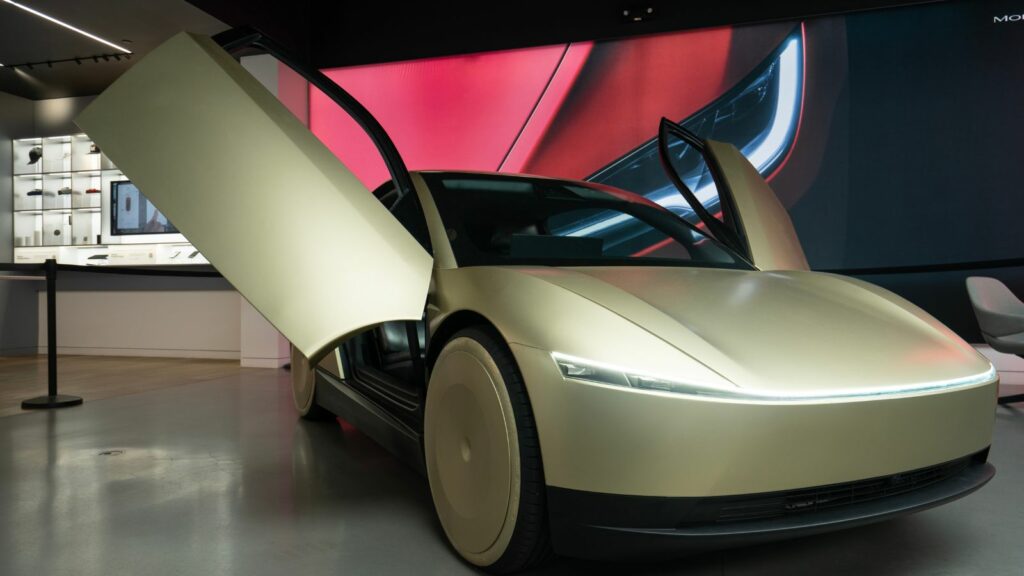
Tesla says its purpose-built Cybercab fleet has crossed an important early milestone in Austin, with more than 300 vehicles now serving the Texas capital and the operating fleet growing roughly eightfold over a 30-day period. The announcement comes only weeks after paying passengers began riding in the two-seat autonomous vehicles.
Texas registration data broadly supports the scale of the expansion, with 319 Cybercabs listed under Tesla Robotaxi’s state authorization. But the numbers require an important distinction: registration does not prove that every vehicle is carrying passengers at any particular moment. Even with that caveat, Tesla has moved from deploying Cybercabs by the dozen to managing them by the hundreds remarkably quickly.
Tesla Says Its Austin Cybercab Fleet Is Now Eight Times Larger
Tesla put a number on its Cybercab expansion on October 10, saying more than 300 of the purpose-built robotaxis were now serving Austin. The company’s Robotaxi account described that as an eightfold expansion over 30 days. Taken literally, an eight-times increase to slightly more than 300 vehicles implies that Tesla was operating only around 38 to 40 Cybercabs under the same definition a month earlier. That makes the latest milestone significant because the rollout has moved beyond a small demonstration fleet.
The wording deserves some precision. Tesla described the announcement as coming “one month after launch,” although public Cybercab deployment began in early September, making the calendar interval slightly longer than 30 days. The eight-times figure specifically refers to Tesla’s stated 30-day comparison. For people encountering the gold, two-seat vehicles around Austin, the difference between dozens and hundreds is potentially substantial: a larger fleet can shorten waits, expand availability and create far more real-world driving data. Tesla, however, has not disclosed how many passenger trips those 300-plus vehicles complete each day.
Texas Records Show 319 Cybercabs on Tesla’s Authorization
The strongest outside check on Tesla’s announcement comes from Texas. The state’s automated-vehicle records showed 319 Cybercabs assigned to Tesla Robotaxi’s authorization in early October, along with 420 Model Y vehicles. That put Tesla’s listed Texas autonomous fleet at 739 vehicles and meant Cybercabs represented approximately 43% of it. Only a week earlier, reports based on the same public registry counted 169 Cybercabs, meaning 150 additional vehicles appeared in a single large batch.
That figure is strikingly close to Tesla’s statement that more than 300 Cybercabs are serving Austin, but the two measurements are not interchangeable. Texas requires commercial autonomous-vehicle operators to maintain a list of active vehicles connected to their authorization. A vehicle appearing there could be carrying passengers, undergoing maintenance, charging, being cleaned or waiting for deployment. The registry also covers Texas rather than reporting a live Austin fleet count. It therefore corroborates that Tesla has prepared more than 300 Cybercabs for authorized operation in the state, but Tesla’s own announcement remains the source for the claim that 300-plus are actually serving Austin.
The Public Rollout Started With Only About 45 Cybercabs
The pace becomes clearer when compared with September. When Tesla launched commercial Cybercab operations in Austin, Texas records showed only about 45 of the purpose-built vehicles among roughly 420 Tesla autonomous vehicles registered in the state. Most of the fleet consisted of Model Ys. Reuters reported at the time that Tesla was initially offering Cybercab rides in limited portions of Austin, with the company planning to add vehicles and locations gradually rather than switching immediately to a citywide service.
A little over a month later, the registered Cybercab count has risen from 45 to 319. That is an increase of 274 vehicles, or more than seven times the launch-era registration number. For comparison, 45 Cybercabs represented only about 11% of Tesla’s Texas autonomous-vehicle roster at launch; 319 now represent roughly 43% of the current 739-vehicle list. The shift illustrates why the latest development matters beyond the headline number. Tesla is not simply adding more robotaxis. It is beginning to replace the conventional Model Y as the physical foundation of its autonomous ride-hailing operation with a vehicle designed specifically for that job.
Cybercab Is Starting to Replace the Model Y as Tesla’s Robotaxi Workhorse
Tesla built its earliest Robotaxi service around the Model Y because the crossover was already being produced at enormous scale. The Cybercab changes that equation. It has only two passenger seats, no steering wheel and no pedals, and was designed from the beginning for autonomous transportation rather than private ownership with autonomous capability added later. Tesla itself has described the Cybercab as the future “workhorse” of its Robotaxi fleet.
The latest Texas numbers show the transition beginning in measurable form. While the registered Cybercab fleet climbed to 319, the Model Y count was reported at 420. The addition of 150 Cybercabs in the latest large batch occurred without a comparable increase in Model Ys. If that pattern continues, Cybercab could eventually become the majority vehicle in Tesla’s Texas Robotaxi operation. The two-seat configuration does create trade-offs: it is less useful for larger groups than a Model Y, but carrying fewer unused seats can potentially reduce vehicle size, weight and operating cost on the many ride-hailing trips involving only one or two people. Tesla’s challenge is proving those theoretical efficiencies in everyday commercial service.
Production Had Already Started at Gigafactory Texas
The rapid increase did not appear from nowhere. Tesla disclosed in its second-quarter 2026 financial update that Cybercab production had already begun at Gigafactory Texas. The company also said production-model vehicles were undergoing engineering drives on public roads during the quarter and that employees began taking Cybercab rides at the Texas factory campus in July. Those steps provided Tesla with several months to manufacture vehicles, collect data and prepare operations before the September passenger rollout.
Tesla’s Q2 manufacturing table listed Cybercab with more than 125,000 units of installed annual manufacturing capacity in Texas. That figure should not be mistaken for an actual production rate of 125,000 vehicles a year. Tesla explicitly warns that installed capacity is different from current output and that production depends on equipment uptime, components, regulatory factors and other constraints. The company also said battery-pack supply remained a limiting factor in increasing vehicle production. Even so, moving a few hundred Cybercabs into an authorized fleet is still tiny relative to the nominal factory capacity Tesla has installed, leaving considerable room for further expansion if manufacturing and autonomous-service deployment can grow together.
Federal Regulators Are Still Scrutinizing the Cybercab
Scaling the fleet does not eliminate one of Cybercab’s most unusual complications: it has been designed without the controls normally expected in a passenger vehicle. On September 4, the National Highway Traffic Safety Administration opened an Audit Query examining Tesla’s certification that Cybercab complies with applicable Federal Motor Vehicle Safety Standards. The agency said its review followed the vehicle’s commercial deployment in Austin and involved Tesla’s certification of as many as 1,000 Cybercabs.
That investigation is particularly important because U.S. automotive regulation historically assumes that vehicles have equipment intended for human drivers. Cybercab intentionally removes the steering wheel and pedals, forcing regulators and manufacturers to determine which standards apply to a machine that is never meant to be manually driven. NHTSA has simultaneously been working to modernize rules for automated vehicles, but it emphasized that manufacturers remain responsible for complying with standards currently in force. For an Austin passenger, those legal mechanics may be invisible when the doors close and the vehicle pulls away. For Tesla, however, the ability to move from hundreds of Cybercabs to tens of thousands depends not only on manufacturing and software but also on maintaining regulatory acceptance.
Tesla Is Finally Delivering on Part of Its 2024 Cybercab Timeline
The timing of the 300-plus announcement carries symbolic weight. Tesla unveiled Cybercab on October 10, 2024, exactly two years before the latest fleet update. At the Hollywood “We, Robot” event, Elon Musk said the vehicle would enter production in 2026 and eventually cost less than US$30,000. He presented a two-seat vehicle with butterfly-style doors, no traditional driving controls and inductive charging, arguing that autonomous transportation could dramatically reduce the cost of moving people.
Tesla has a long history of autonomy timelines stretching beyond Musk’s original forecasts, which is why the 2026 Cybercab production milestone has attracted attention. In this case, Tesla did begin manufacturing the vehicle during the year it originally targeted and put vehicles into commercial service before the end of 2026. That does not mean every original promise has been fulfilled. The company has not established a public retail price below US$30,000, nor has it demonstrated nationwide Cybercab availability. Still, progressing from a stage prototype in October 2024 to more than 300 company-reported vehicles serving Austin two years later represents a concrete outcome rather than another future launch date.
Waymo Shows How Much Larger the Robotaxi Market Can Become
More than 300 Cybercabs in one city is meaningful for Tesla, but the broader autonomous-taxi industry provides perspective. Alphabet’s Waymo has already moved into a much larger commercial phase. TechCrunch reported in September that Waymo was averaging approximately 500,000 paid robotaxi rides per week and offering service in about 15 U.S. cities. Separate reporting has placed Waymo’s active vehicle fleet above 4,000 vehicles, several times larger than Tesla’s entire Texas authorized autonomous fleet.
Waymo also reported that its autonomous system had accumulated more than 270 million fully autonomous miles through June 2026 across several major metropolitan areas. The comparison is not perfectly symmetrical. Tesla’s strategy relies heavily on cameras, neural-network software and potentially lower-cost vehicle hardware, while Waymo uses a different sensor and deployment architecture. Their fleet definitions can also vary. Still, Waymo establishes an important benchmark: hundreds of vehicles are enough to operate a visible city service, but a national robotaxi network requires thousands of vehicles, enormous maintenance infrastructure and consistently high utilization. Tesla’s Austin expansion therefore looks more like the beginning of a scaling test than the completion of one.
Dallas Could Be the Cybercab’s Next Expansion Test
Austin may not remain the only city where passengers encounter Cybercabs. Shortly after Tesla announced the 300-plus milestone, Tesla AI executive Ashok Elluswamy pointed toward Dallas, writing that Cybercabs were becoming commonplace in Austin and adding that Dallas was coming “soon.” He did not provide a launch date, number of vehicles or planned service boundaries, so the statement should be treated as an expansion signal rather than a formal timetable.
Tesla already operates Robotaxi services beyond Austin, and its second-quarter update listed Dallas among markets where unsupervised Robotaxi operations were ramping. The important change would therefore be the arrival of the purpose-built Cybercab rather than the first Tesla robotaxi ride in Dallas. Operating in another Texas metro could test whether Tesla can reproduce Austin’s deployment process without months of city-specific preparation. It would also spread Cybercabs across the state’s registration total, making the distinction between statewide authorized vehicles and Austin’s actual working fleet increasingly important. If Tesla can move hundreds of Cybercabs into several cities rather than concentrating them in one showcase market, the program would begin looking considerably more like a repeatable transportation network.
The Bigger Test Is How Intensively Those 300 Vehicles Are Used
Fleet size is one of the easiest robotaxi numbers to understand, but it is not necessarily the most important. A network with 300 vehicles could be commercially impressive if each car completes frequent paid trips for much of the day. The same 300 vehicles would mean far less if large numbers spend significant time parked, charging or waiting for demand. Tesla has not accompanied its latest announcement with detailed Cybercab-specific figures for daily rides, paid passenger miles, utilization rates, remote interventions or revenue per vehicle.
Those metrics will become increasingly important as the fleet grows. Tesla has told investors that it ultimately expects AI, software and fleet-based profits to become a larger part of its business. Cybercab is the hardware through which that strategy becomes measurable. Manufacturing 319 authorized vehicles proves that Tesla can build and deploy more than a demonstration batch; saying 300-plus are serving Austin indicates that the company believes it has reached genuine fleet scale. The next milestone will be harder to communicate with a single photograph or registration count. Tesla must show that hundreds of autonomous vehicles can operate safely, remain busy, generate repeat rides and eventually produce attractive economics. That is the difference between a fast fleet ramp and a sustainable robotaxi business.
