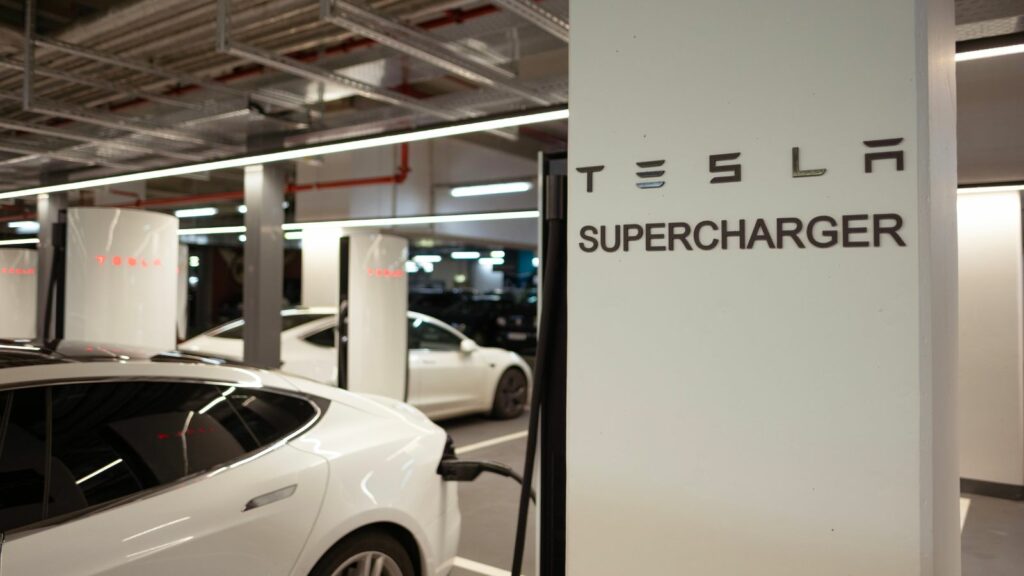
Tesla has moved beyond simply operating charging stations in Canada and is now inviting Canadian businesses to own the same kind of high-power hardware that underpins its charging network. The company’s Supercharger for Business program, launched in Canada on October 23, 2026, gives commercial site owners access to V4 charging posts rated at up to 500 kW for passenger vehicles. At the same time, Tesla is marketing dedicated charging hardware for heavy trucks, including a Megacharger rated at up to 1.2 MW and a slower Basecharger for depot use.
The change matters because it opens Tesla’s charging technology to retailers, fleet operators, parking operators and other businesses that want to build charging into their own properties rather than wait for Tesla to develop a site itself. It also arrives as Canadian EV registrations rebound and commercial fleets test increasingly powerful charging systems.
Tesla Is Selling the Charging Stack, Not Just a Place on Its Network
The Canadian rollout turns Tesla from a charging-network operator into a direct equipment and service supplier for businesses. Under Supercharger for Business, a Canadian host can purchase V4 posts for its own property, with a minimum order of four charging posts. Tesla describes the units as white-labelled and usable by compatible EVs, meaning the charging experience does not have to be limited to Tesla vehicles or presented as a Tesla-owned station. That makes the offer relevant to businesses ranging from shopping centres and hotels to parking operators, municipalities and corporate fleets.
The sale also includes more than a physical charger. Tesla says customers can work with their own installer while receiving guidance from a Tesla Design Engineer. Once a site is operating, the owner can monitor utilization, change pricing and track financial performance through Tesla’s management portal, while Tesla handles required equipment servicing. Tesla does not publish a standard Canadian price for the package; prospective buyers are directed to request a quote based on the site and project.
A 500-kW Rating Leaves Room for the Next Generation of EVs
The headline figure on Tesla’s V4 hardware is 500 kW per passenger-vehicle post, but that number is the charger’s maximum capability rather than a promise that every plugged-in vehicle will receive 500 kW. Tesla’s own support material illustrates the gap between charger capacity and vehicle capability: Model S, Model 3, Model X and Model Y are currently listed at up to 250 kW on North American V4 Superchargers, while Cybertruck can reach up to 325 kW at V4 locations. Actual charging power also changes with battery temperature, state of charge and vehicle design.
The higher ceiling is important because Tesla’s V4 cabinet supports vehicle architectures from roughly 400 to 1,000 volts, giving site owners room to serve higher-voltage EVs as the market evolves. Tesla lists a maximum cabinet output of 1.2 MW shared across as many as eight V4 posts and says power sharing allows the system to serve normal charging demand without provisioning 500 kW continuously to every stall. For a business, that can mean buying hardware with more future headroom than today’s average vehicle can use.
Universal Access Is Central to the Commercial Pitch
Tesla is pitching the business product as infrastructure for the wider EV market, not just an extension of Tesla-only charging. The company says its white-labelled Superchargers are compatible with suitable EVs and can support multiple charging standards, while its communications stack includes open protocols such as ISO 15118-2 and OCPI capability. Payment terminals are optional, and Tesla says drivers can use compatible charging apps and payment methods. That flexibility matters for a commercial property whose value comes from serving a broad mix of customers rather than a single vehicle brand.
There is also a visibility advantage. Tesla says business-owned sites can offer live station information that includes stall availability, wait times and, where available, 3-D site maps. For the site operator, the portal provides utilization and financial tracking along with pricing controls. The result is closer to buying a managed charging platform than purchasing a standalone electrical appliance. A restaurant or hotel, for example, may care as much about charger reliability, discoverability and payment handling as it does about the raw kilowatt rating printed on the cabinet.
Canada’s EV Base Is Large Enough to Make Private Charging More Attractive
Tesla’s Canadian expansion is arriving as the country’s EV market shows fresh growth after a volatile 2025. Statistics Canada reported 58,811 new zero-emission vehicle registrations in the second quarter of 2026, up 26.7% from the same quarter a year earlier. ZEVs accounted for 10.7% of all new motor-vehicle registrations in that quarter, compared with 8.6% a year earlier. Battery-electric registrations alone rose 37.4% year over year in the quarter, while plug-in hybrids increased 8.0%.
The installed vehicle base is also becoming harder for commercial property owners to ignore. In 2025, Canada had 623,481 registered battery-electric light-duty vehicles and 251,520 plug-in hybrids, according to Statistics Canada. The agency reported that BEV registrations grew 27.9% during 2025 despite a slowdown in new-vehicle ZEV sales earlier that year. That growing installed base helps explain why charging is increasingly treated as an amenity, a fleet tool and a potential revenue stream rather than a niche addition. More plug-in vehicles on the road create more opportunities for charging at destinations where drivers already spend time.
The Truck Offer Jumps From Kilowatts to Megawatts
Tesla’s Semi Charging for Business program operates at a very different power level. The Megacharger post is rated at up to 1.2 MW, with a continuous-current specification of 1,500 amps and an operating range up to 1,000 volts. Tesla’s business ordering material lists a minimum purchase of two truck-charging posts. A Megacharger cabinet can provide up to 1.2 MW of DC output shared across two posts, and Tesla says the system can restore up to 60% of a Semi’s range in about 30 minutes under suitable conditions.
For trucks that remain parked for longer periods, Tesla also offers a 120-kW Basecharger. On the Canadian Semi page, Tesla says that unit can add up to 60% of the Long Range Semi’s range in roughly four hours, making it more appropriate for depots or overnight stops. Both products use the MCS 3.2 charging interface. CharIN, the industry group behind the Megawatt Charging System, has developed MCS as a common high-power solution for heavy-duty electric vehicles, with the broader system designed for substantially higher voltage and current limits than conventional passenger-car fast charging.
The Charger Launch Lines Up With Tesla’s Semi Ramp
Tesla is pairing the charging offer with a more concrete Canadian pitch for the Semi itself. The company’s Canadian Semi page lists two configurations: a Standard Range model with an estimated 500 kilometres of range and a Long Range model with an estimated 750 kilometres. Tesla quotes energy consumption of about 1.1 kWh per kilometre and a gross combination weight of 40 tonnes for both. It also lists drive power of up to 800 kW, with curb weight below 9,100 kilograms for the Standard Range version and 10,500 kilograms for the Long Range truck.
The timing is significant. Tesla’s Canadian site says Semi deliveries start in 2026, while the company’s third-quarter 2026 update says volume production of the Class 8 truck has begun at its Nevada facility. That report lists installed annual Semi manufacturing capacity of 25,000 units in Nevada. Charging infrastructure has long been one of the more complicated parts of electrifying regional and long-haul trucking. Selling fleet-owned Megachargers gives operators a way to plan the energy side of a project alongside vehicle procurement instead of treating charging as a separate afterthought.
A British Columbia Fleet Shows What Megawatt Charging Could Change
R.R. Plett Trucking offers an early Canadian example of why a fleet might want megawatt charging on its own property. The British Columbia carrier told Electric Autonomy that it planned Tesla MCS installations at its Langley headquarters and Kamloops facility ahead of 12 Tesla Semi deliveries expected in June 2027. The company already operates eight Class 8 Volvo electric trucks on drayage work from the Port of Vancouver, giving it real-world experience with charging schedules and the operational limits of its existing equipment.
The attraction is not simply faster charging for its own sake. Chief operating officer Trevor Plett said the company’s existing electric trucks can take about three hours to recharge, while the planned MCS system could cut that turnaround to roughly 30 minutes and make double-shift operation practical. He also said BC Hydro is involved in providing the electrical capacity required for the high-power sites. The company has discussed eventually opening the chargers to other fleets and extending electrified operations toward Golden, British Columbia, and Calgary. That could gradually turn private depot charging into part of a larger regional trucking corridor.
The Grid Connection May Be as Important as the Charger
A 500-kW passenger stall or 1.2-MW truck post is only useful if the site can supply the power. Tesla’s V4 architecture is designed around shared capacity: one V4 cabinet can deliver up to 1.2 MW across as many as eight passenger posts, rather than requiring 500 kW of dedicated upstream power for every stall. Tesla says its typical configuration can require less than 1 MW across eight posts while still delivering maximum vehicle power in 99% of charging situations. That approach can reduce required site capacity, but large projects may still involve utility coordination, transformers and extensive electrical work.
Canada’s public-policy environment recognizes that infrastructure cost remains a barrier. Natural Resources Canada’s Zero Emission Vehicle Infrastructure Program has supported charging at public places, workplaces and fleet facilities, although its current owner-operator intake is closed. For large private-sector developments, the Canada Infrastructure Bank maintains a Charging and Hydrogen Refuelling Infrastructure Initiative with at least $500 million dedicated to qualifying projects. The R.R. Plett example shows why those financing questions matter: at megawatt scale, buying the charging post is only one component of a much larger infrastructure project.
Tesla Is Trying to Scale Charging Through Other People’s Capital
The Canadian launch fits a broader Tesla strategy of expanding charging without owning every location itself. In its third-quarter 2026 update, Tesla said its Supercharger for Business program had grown to more than 600 customer-owned stalls. The company described those installations as a way to scale the charging network while maintaining Tesla performance and service standards. During the same quarter, Tesla reported 8,904 Supercharger stations and 84,465 Supercharger connectors globally, underscoring the scale of the operating platform behind the commercial product.
For Canadian businesses, the proposition is straightforward but not risk-free. Tesla supplies recognizable fast-charging hardware, software controls, engineering support and servicing; the host supplies the property, capital and local electrical connection. Whether a particular project delivers an attractive return will still depend on utilization, electricity costs, construction expenses and the availability of sufficient grid capacity. Yet the strategic shift is clear: Supercharging is becoming technology that third parties can purchase, not only a network Tesla builds itself. In Canada, that could put powerful chargers at more commercial destinations while giving electric-truck fleets greater control over where and when their vehicles can operate.
