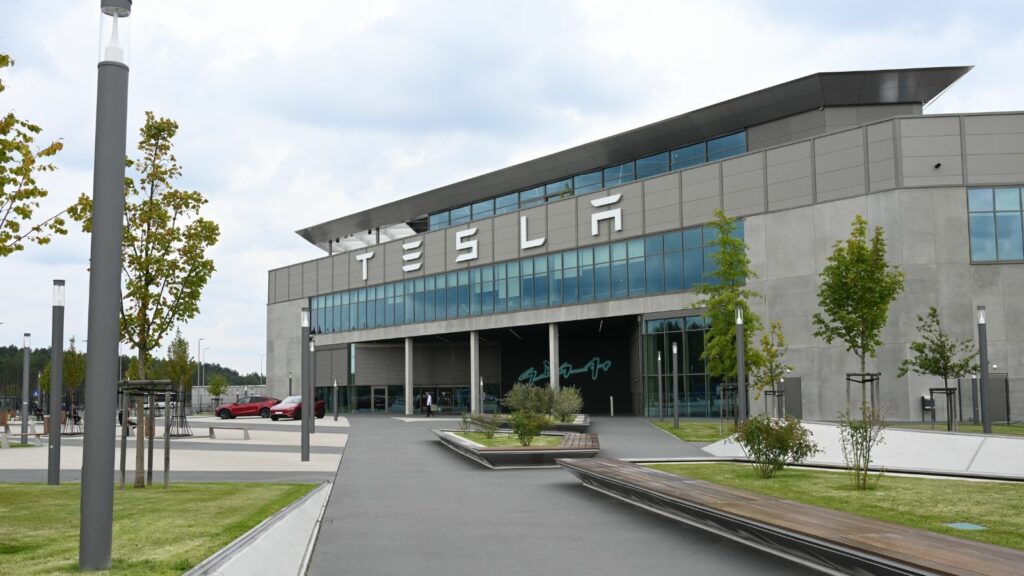
Tesla’s German factory has crossed another production threshold at a moment when its output matters far beyond Europe. On October 23, 2026, Tesla said its Gigafactory Berlin-Brandenburg had produced 7,000 Model Ys in a single week, bringing the plant closer to a production target the company laid out earlier this year.
For Canadian customers, the milestone carries unusual weight. Canada began receiving German-built Model Ys in 2025 after tariffs disrupted Tesla’s previous North American sourcing strategy. That transformed a factory outside Berlin into an important part of Tesla’s Canadian supply chain. Higher German production could help ease pressure on Canadian deliveries, but the connection also leaves buyers exposed to transatlantic shipping schedules, competing demand from Europe and other export markets, and the broader uncertainty surrounding global auto trade.
Berlin’s 7,000-Unit Week Marks a New Production High
Tesla described the 7,000-vehicle week as the latest milestone in Berlin’s continuing ramp-up. If that pace were sustained for a full 52 weeks, it would translate into roughly 364,000 Model Ys annually. That calculation is useful for showing the factory’s scale, although a record week should not be treated as a guarantee that production will remain at exactly the same level throughout the year.
Tesla’s latest manufacturing disclosure lists Berlin’s installed annual Model Y capacity at more than 375,000 vehicles. That puts the new weekly milestone close to the run rate implied by the company’s officially stated capacity. For Canadian customers, however, the important number is not simply how many vehicles Berlin can build. It is how many of those vehicles Tesla chooses to allocate to Canada. The plant supplies customers across numerous markets, meaning every increase in output potentially creates more flexibility without guaranteeing that all incremental production will head across the Atlantic.
Tesla Has Been Pushing Berlin Harder Throughout 2026
The 7,000-unit milestone did not arrive unexpectedly. In April, Tesla announced plans to add roughly 1,000 jobs at Grünheide as it prepared to increase weekly Model Y production by about 20%. Two months later, the company announced another expansion, saying output was expected to reach approximately 7,500 vehicles per week beginning in October. Another 1,000 workers were tied to that phase of the ramp.
The factory had already passed another symbolic threshold in May, when Tesla announced that more than 750,000 vehicles had been produced there since operations began in 2022. Taken together, the milestones show how quickly Grünheide has grown from Tesla’s new European outpost into one of its most important vehicle plants. The company said its 2026 vehicle-production and battery-manufacturing plans would create approximately 3,500 additional jobs in the short and medium term. Reaching 7,000 vehicles in one week suggests that those investments are beginning to translate into materially higher physical output.
Tariffs Turned Germany Into an Important Source for Canada
Canada did not always depend on Germany for the Model Y. Tesla historically supplied Canadian customers from North American factories and, for a period, from its Shanghai operation. That calculation changed dramatically during the trade disputes of 2024 and 2025. Canada initially imposed a 100% surtax on Chinese-made EVs and then, beginning in April 2025, imposed a 25% counter-tariff on qualifying U.S.-origin automobiles in response to U.S. measures against Canada’s auto sector.
Moving Canadian Model Y supply to Germany gave Tesla a way around the U.S.-origin tariff problem. The policy picture has since evolved: Canada removed its 100% Chinese EV surtax on March 1, 2026 and replaced it with an initial annual quota of 49,000 Chinese EVs subject to the normal 6.1% most-favoured-nation tariff. Canada’s counter-tariffs on U.S. automobiles, however, remain in place. Berlin therefore continues to occupy a strategically useful position in Tesla’s Canadian supply network even as Ottawa’s China policy has changed.
Halifax Became the Gateway for German-Built Model Ys
The supply-chain shift became visible in September 2025, when several hundred German-built Model Ys were reported being unloaded at the Dartmouth Autoport in the Halifax area. It was the first direct shipment of Berlin-built Model Ys for Canadian customers and marked a major logistical change: instead of bringing SUVs across the U.S. border, Tesla was now moving them by ship from Europe.
A second batch arrived in Halifax in October, with reporting estimating roughly 300 to 400 vehicles in that shipment. Those vehicles helped expand deliveries beyond Ontario and Quebec. Cars intended for western customers then had to make another long journey across Canada, including rail transportation to British Columbia. By early November 2025, Berlin-built vehicles had reached Tesla’s Coquitlam location. The route illustrates the trade-off created by Tesla’s tariff workaround. Germany solved a costly import problem, but replacing relatively short North American transportation with an ocean crossing and cross-country distribution added more moving parts to every Canadian delivery.
Higher Berlin Output Matters Because Canadian Waits Have Stretched
The consequences of that longer supply chain became particularly obvious during 2026. By late July, Tesla’s Canadian configurator was reported as showing December 2026 to January 2027 delivery estimates for the rear-wheel-drive Model Y and Model Y Performance, while the all-wheel-drive version was listed for December. Subsequent reporting indicated that the Premium AWD estimate also stretched toward the December-to-January period.
Those dates are estimates rather than guaranteed appointments, and individual orders can move earlier when matching inventory becomes available or another customer cancels. Even so, the pattern demonstrates why a production increase in Brandenburg can matter to someone waiting in Toronto, Calgary or Vancouver. Canadian Model Ys cannot simply be pulled from a nearby U.S. plant without exposing Tesla to the tariff structure that encouraged the German switch in the first place. When supply is coming from Europe, every shipment must be built, allocated, loaded onto a vessel, cleared into Canada and distributed inland before a delivery centre can hand over the keys.
Canadian Pricing Shows Why the European Route Was Worth the Complexity
The economics of the sourcing change became apparent before the first German vehicles were delivered. In July 2025, Tesla cut the Canadian price of the then-current Model Y Long Range AWD by C$20,000, from C$84,990 to C$64,990. The reduction occurred as evidence mounted that Canadian Model Y supply was shifting toward Berlin, allowing Tesla to avoid the tariff burden attached to U.S.-origin vehicles.
The Canadian lineup has since broadened. Tesla currently lists the Model Y Rear-Wheel Drive at an MSRP of C$49,990 and the Model Y Premium All-Wheel Drive at C$64,990. Tesla’s Canadian website also advertises up to C$5,000 through the federal EVAP incentive for eligible purchases. Those figures make the supply-chain decision more tangible. Importing from Germany requires considerably more logistics than moving vehicles north from an American plant, yet it helped Tesla retain pricing that would have been much harder to sustain if every Canadian Model Y remained exposed to the U.S. automobile counter-tariff.
Canada’s EV Market Is Large Enough to Make More Supply Valuable
Tesla is increasing German production while Canada’s broader electric-vehicle market is again showing meaningful growth. Statistics Canada recorded 58,811 new zero-emission vehicle registrations during the second quarter of 2026, up 26.7% from the same quarter in 2025. ZEVs accounted for 10.7% of all new Canadian vehicle registrations, while registrations of battery-electric vehicles alone increased 37.4% year over year.
Momentum continued later in the summer. Statistics Canada reported 22,716 zero-emission vehicles sold in August, a 55.1% increase from August 2025. ZEVs represented 13% of all new vehicle sales that month. European production is already a noticeable piece of that market: 18.1% of the zero-emission vehicles registered in Canada during the second quarter were assembled in Europe. Tesla is only one manufacturer within those totals, but the figures help explain why additional German Model Y capacity can find a receptive market rather than simply creating excess inventory on the Canadian side of the Atlantic.
Canadian Buyers Are Competing With More Than 30 Other Markets for Berlin Output
Canada is important to Grünheide, but it is far from the factory’s only destination. In March 2026, plant manager André Thierig said Berlin-made vehicles had been shipped to 36 of Tesla’s 54 served markets. Tesla has also described Grünheide as its only Gigafactory in Europe, making it the company’s central manufacturing base for serving the region as well as a growing collection of export destinations.
Demand within Europe can therefore directly influence how much flexibility Tesla has for Canada. Preliminary Dataforce figures reported in October showed the Model Y leading European new-car registrations in September 2026 with roughly 40,971 units, while the Model 3 ranked second. Strong European demand is good news for utilization at the German factory, but it also means Canada cannot assume every additional vehicle produced during the ramp will become Canadian inventory. Tesla must continually balance production among domestic German buyers, other European countries and export markets. Canada benefits from Berlin’s expansion, but it remains one customer among many.
Seven Thousand a Week Helps, but It Does Not Eliminate Canada’s Supply Risk
Reaching 7,000 Model Ys in a week puts Tesla much closer to the 7,500-a-week objective announced for October. If the factory can sustain production near that level, Tesla gains considerably more freedom to address backlogs, replenish inventories and increase export allocations. For Canadian buyers who have watched delivery estimates stretch across several months, that is a meaningful improvement in the underlying supply picture.
It is not the same as eliminating risk. Tesla itself warns investors that production depends on factors including supplier performance, component availability, labour, factory upgrades, trade policy and other events outside the company’s control. Canadian Model Ys also still need ocean transportation and inland distribution after leaving Brandenburg. Perhaps most importantly, Canada does not have a dedicated share of Berlin’s entire production increase. The 7,000-unit week is therefore best viewed as increased breathing room rather than a guarantee of immediate Canadian availability. Germany has become the solution to Tesla’s Canadian tariff problem, but that solution has also made Canadian buyers unusually dependent on a factory thousands of kilometres away.
