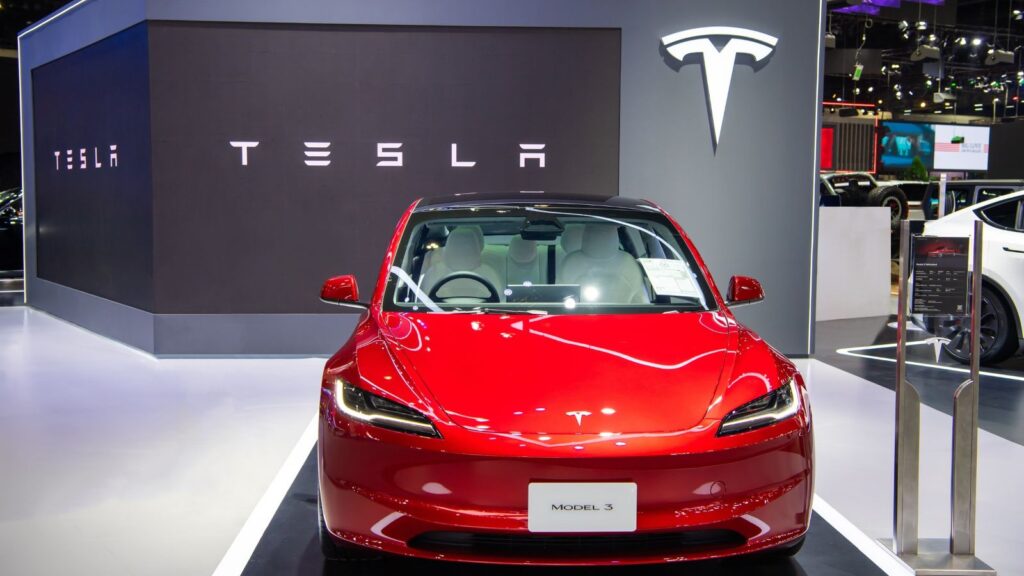
Canada’s used electric vehicle market is opening a door that once seemed firmly closed to budget-conscious drivers. A nationwide AutoTrader.ca search on November 7, 2026, showed 497 used Tesla Model 3 listings priced at or below $30,000, bringing one of the country’s most recognizable electric cars within reach of buyers who previously considered Tesla ownership too expensive.
The growing selection comes as used EV prices face pressure and Canadian households look for more affordable transportation. Some Model 3s are being advertised for barely more than $20,000, although their age, mileage and condition vary considerably. For drivers interested in escaping gasoline costs without paying new-vehicle prices, the opportunities are becoming harder to ignore. However, understanding what sits behind those attractive listings is essential before making a purchase.
Nearly 500 Used Model 3 Listings Are Competing for Buyers
AutoTrader.ca’s nationwide inventory search returned 497 used Tesla Model 3 listings with an asking-price ceiling of $30,000. Ontario alone accounted for 228 results, reflecting the substantial selection available in Canada’s largest provincial automobile market. The listings cover multiple model years, trim levels and mileage ranges, giving buyers more choices than a single advertised bargain might suggest. Importantly, these figures represent vehicles advertised for sale, not completed transactions. Inventory changes as dealerships add vehicles, adjust prices or remove cars that have been sold.
For Canadian consumers, the significance extends beyond the number itself. A larger pool of vehicles makes it easier to compare prices, vehicle histories and equipment without immediately exceeding a predetermined budget. Some examples sit in the low-$20,000 range, while others approach the $30,000 limit. Differences in battery configuration, drivetrain and kilometres travelled help explain the variation. The growing selection does not mean every used Tesla represents exceptional value, but it does provide more opportunities for buyers to find an electric car that fits their financial circumstances.
Some Model 3s Are Selling for Surprisingly Low Asking Prices
The cheapest listings demonstrate how dramatically prices can differ between individual vehicles. One advertised 2023 Model 3 was marked down to approximately $20,980 despite having travelled more than 186,000 kilometres. Another listing showed a 2019 Long Range all-wheel-drive version priced at $28,900 with approximately 74,000 kilometres. In Ontario, a 2021 Standard Range Plus was advertised for $25,995 with just over 62,000 kilometres, although its dealer disclosed a separate certification charge. These examples illustrate why the model year printed on a listing cannot determine whether a car represents good value.
Broader dealer inventory data reinforce that point. AutoDeal Canada’s November 7 market snapshot showed a median asking price of approximately $28,200 for 2021 Model 3s in its tracked sample, compared with about $32,200 for 2023 vehicles. Those are sample-specific figures rather than national transaction averages. Standard Range, rear-wheel-drive, Long Range and Performance versions also offer different capabilities. A driver facing snowy rural roads might prioritize all-wheel drive, while someone commuting a modest distance through a city may find a less expensive rear-wheel-drive version perfectly suitable.
Used Electric Vehicle Prices Are Facing Pressure Across Canada
The increasing availability of affordable Model 3s fits a broader shift in Canada’s used-vehicle market. CARFAX Canada’s October 2026 market report found that used electric-vehicle asking prices had fallen 1.8% month over month and 5.4% year over year in August. Used EV inventory also reached its highest level of 2026 at that point. Tesla accounted for approximately 64% of used EV listings in the report’s dataset, demonstrating the company’s substantial presence in the pre-owned electric-vehicle market and helping explain the number of Model 3s available to shoppers.
The wider automotive market provides additional context. CARFAX reported that average used-vehicle asking prices stood at $30,776 in August, while inventory increased 18.9% from July and transactions declined 6.9%. However, the picture is not entirely one-sided. Clutch reported that comparable used-EV transaction prices were actually 1.2% higher year over year in August, highlighting differences between asking-price and transaction-price measures. The evidence does not establish a universal collapse in electric-vehicle values. Instead, it points to a changing market where growing inventory, uneven demand and significant differences between individual vehicles are creating new opportunities for careful buyers.
A Used Tesla Can Cost Thousands Less Than a New Model 3
Tesla’s Canadian pricing shows why secondhand vehicles are attracting attention. The manufacturer lists a starting MSRP of $39,490 for its Model 3 Premium Rear-Wheel Drive, excluding delivery-related charges and applicable taxes. An online pricing example showed an estimated purchase price of approximately $42,136 after several additional charges, before sales tax and licensing. Compared with those figures, a used Model 3 advertised for $22,000 or $26,000 offers considerably lower upfront costs. That gap can make electric ownership more realistic for households that cannot justify spending more than $40,000 on a vehicle.
Government incentives introduce another consideration. Canada’s Electric Vehicle Affordability Program offers financial assistance for qualifying new electric vehicles, but used vehicles are not eligible. Tesla also states that new Model 3 vehicles are currently excluded from the federal program. Quebec, meanwhile, offers a $1,000 rebate for certain qualifying used EVs, including eligible Model 3 versions, provided specific purchasing and registration conditions are satisfied. Consequently, the financial advantage depends on the actual purchase price, applicable taxes, available incentives and vehicle condition. A lower asking price is appealing, but buyers still need to determine what they will ultimately pay.
Battery Warranty Coverage Can Make or Break a Used Tesla Deal
Battery warranty protection is one of the most important considerations when evaluating a used Model 3. Tesla’s Canadian warranty information lists eight years of battery and drive-unit coverage, with kilometre limits that depend on the vehicle configuration. Current specifications provide 160,000 kilometres for the Model 3 Premium rear-wheel-drive version and 192,000 kilometres for all-wheel-drive variants, along with a minimum 70% battery-capacity retention guarantee during the warranty period. Because warranty terms can differ by model year, buyers should verify the original coverage associated with the specific vehicle rather than relying solely on current specifications.
This becomes particularly important when examining older or higher-mileage examples. A 2019 Model 3 could be approaching the end of its original eight-year coverage period, while a heavily driven newer vehicle might already have exceeded its kilometre limit. Tesla allows owners to view warranty information through its app and offers battery-health assessment features on equipped vehicles. Its additional one-year or 20,000-kilometre pre-owned warranty applies to vehicles purchased directly from Tesla, not automatically to independent dealership sales. For buyers considering long-term ownership, verified battery condition and remaining warranty protection may matter considerably more than saving another $1,000 on the purchase price.
Canadian Winters Remain an Important Test for Affordable EVs
Cold-weather performance remains a major consideration for anyone purchasing an electric vehicle in Canada. In February 2025, the Canadian Automobile Association conducted a real-world winter test involving several EV models. The Tesla Model 3 tested travelled approximately 410 kilometres compared with its official Natural Resources Canada range rating of 584 kilometres, representing a 30% reduction. Across the tested vehicles, winter driving ranges were between 14% and 39% below their published ratings. These findings illustrate why buyers should avoid assuming that a vehicle’s advertised range will be available during freezing temperatures.
Actual performance depends on several factors, including weather, driving speed, battery condition and heating requirements. Tesla recommends preconditioning the battery and cabin while the vehicle remains plugged in to help preserve available driving energy. Certain Model 3 versions also feature heat-pump systems designed to improve heating efficiency. However, equipment varies between model years, and the CAA test results should not be treated as representative of every used Model 3. A commuter travelling 30 kilometres to work has substantially different requirements from someone regularly driving between Toronto and Ottawa. Assessing winter range against ordinary travel habits is essential to determining whether a discounted electric vehicle remains practical throughout the year.
Home Charging Could Determine Whether the Savings Add Up
Charging arrangements can have a major influence on the financial benefits of owning a used Tesla. Natural Resources Canada identifies residential charging as a generally economical option for EV drivers, particularly compared with purchasing gasoline. Tesla offers several home-charging solutions, including equipment that connects to ordinary household outlets and more powerful systems using 240-volt connections. According to the manufacturer, a standard 120-volt outlet can provide approximately 4.8 kilometres of range per hour under suitable conditions, while faster charging equipment can replenish significantly more range over the same period.
However, installing dedicated charging equipment may require an additional investment. Tesla estimates that a typical installation of its Wall Connector can cost between $1,000 and $2,000, excluding the purchase of the equipment itself, although existing electrical infrastructure can reduce expenses. Apartment residents and drivers without dedicated parking face different challenges. They may need to rely on workplace charging or public stations, where pricing and availability vary. CAA’s 2026 EV charging research also demonstrated substantial differences in public fast-charging costs. For a household with an accessible driveway and affordable overnight electricity, a used Model 3 could offer meaningful operating savings. Without convenient charging, the ownership experience may be considerably less attractive.
Insurance, Financing and Additional Fees Can Change the Final Price
A Tesla advertised below $30,000 will not necessarily cost that amount once the purchase is completed. Taxes, licensing, financing expenses and optional products can increase the final bill. In Ontario, registered dealers must follow all-in pricing rules that generally require mandatory dealer charges to be included in advertised prices, with HST and licensing permitted as additional costs when properly disclosed. Special exceptions apply to vehicles explicitly advertised as unfit or sold as-is. Some Model 3 listings also distinguish between cash and financing prices, making it important to establish which figure actually applies to the intended purchase.
Insurance deserves similar attention. Premiums depend on factors such as location, driving history, coverage and the specific vehicle being insured, so shoppers should obtain quotes before committing. Financing terms also matter because a lower monthly payment does not necessarily mean a lower total purchase cost, especially when loans extend over several years. Used vehicles may additionally require replacement tires, brake servicing or other maintenance that is not obvious in photographs. Someone purchasing a $24,000 Model 3 could find the eventual ownership cost substantially different from the advertised price after accounting for taxes, interest, insurance and immediate repairs. Comparing complete ownership expenses remains more useful than focusing exclusively on the sticker price.
A Vehicle History Report and Inspection Are Still Essential
Electric vehicles eliminate some traditional maintenance requirements, but they are not immune to accidents, wear or mechanical problems. CARFAX Canada recommends examining accident and damage records, verifying vehicle history and arranging an independent pre-purchase inspection. For a used Model 3, that assessment should include tires, suspension components, brakes, charging equipment, body repairs and available battery diagnostics. A clean vehicle-history report is useful, but it cannot establish that an automobile has never been damaged because not every incident is reported. Buyers should also confirm that the vehicle’s identification number matches the documentation provided by the seller.
Recalls and software features require additional attention. Transport Canada documented a 2026 recall affecting certain Model 3 vehicles because a software issue could delay the rearview camera display; Tesla issued a software update to address the problem. Buyers can check the relevant vehicle identification number for outstanding recalls. Tesla also requires ownership to be transferred through its app to provide full access to vehicle functions and services. Optional software upgrades and subscriptions should be verified rather than assumed to accompany the car. A seemingly inexpensive Model 3 can remain a sensible purchase, but a thorough inspection and clear documentation are important safeguards against unexpected expenses or disappointing features.
Affordable Used Teslas Could Bring More Canadians Into the EV Market
The expanding selection of lower-priced Model 3s arrives as Canadian interest in electric vehicles shows signs of improvement. J.D. Power’s 2026 Canada Electric Vehicle Consideration Study found that 34% of new-vehicle shoppers were likely to consider an EV, compared with 28% the previous year. Meanwhile, an October 2026 Clean Energy Canada report found that 34% of used EV listings examined during June and July were priced below $30,000. The report also found that 60% of Canadians inclined to buy a used vehicle would consider going electric. Those figures suggest affordability could play an important role in attracting new customers beyond traditional EV enthusiasts.
Geography remains a significant limitation. Clean Energy Canada’s analysis found that 92% of used EV listings were concentrated in Ontario, Quebec and British Columbia, meaning buyers elsewhere often face more limited selection. Nevertheless, Canada’s electric-vehicle market continues to develop. Statistics Canada reported 58,811 new zero-emission vehicle registrations in the second quarter of 2026, up 26.7% from the same period a year earlier. As additional electric vehicles move from their original owners into the used market, consumers may gain more affordable choices. The nearly 500 Model 3 listings below the $30,000 threshold illustrate that opportunity, even if the best purchase still depends on condition, charging access, driving requirements and the buyer’s overall budget.
