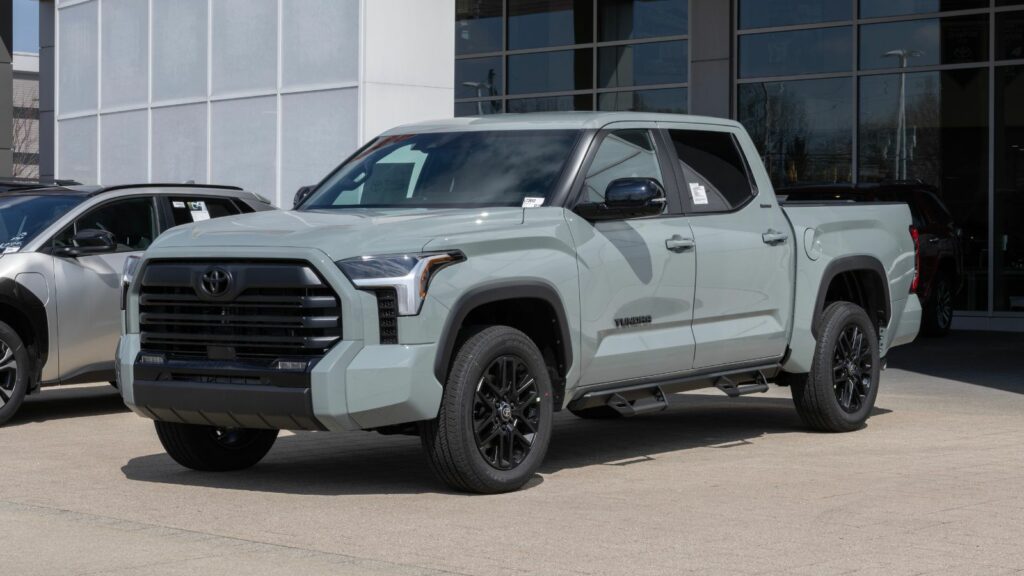
A full-size pickup can be a workhorse, a family vehicle or an expensive passport to the backcountry. Toyota’s updated 2027 Tundra is trying to cover all three roles, and Canadian buyers now know what that versatility will cost. The lineup starts at $61,340 before additional charges, while the new Trailhunter, equipped for more demanding off-road travel, carries a $72,675 starting price.
Announced by Toyota Canada on November 5, 2026, the updated truck also brings revised styling, more towing assistance, a standard 14-inch touchscreen and expanded off-road equipment. The biggest question is not simply how much the Tundra costs, but what each step up the range delivers for the money.
The 2027 Tundra Starts at $61,340, but the Actual Price Is Higher
Toyota Canada has set the entry price for its 2027 Tundra at $61,340. That figure applies to the i-FORCE-powered SR with a CrewMax cab, a 5.5-foot bed and standard four-wheel drive. It is a straightforward starting point for a truck that can become more expensive as buyers move into equipment and finishes. Even the least expensive version is no bare-bones, two-wheel-drive configuration built to advertise a low price.
The distinction is between the manufacturer’s suggested retail price and the amount shown on a dealer quote. Toyota lists an estimated vehicle price of $64,998 for the entry SR once freight, preparation, air-conditioning charges and maximum fees are included. Sales taxes, licensing, registration and insurance remain extra. For a household replacing a pickup, that difference matters before financing costs enter the conversation. Comparing trucks using MSRPs alone can make competing offers look closer, or further apart, than they are in the showroom.
The New Trailhunter Lands at $72,675, Just Above the TRD Off-Road
The attention-grabbing addition is the SR5 Trailhunter, priced from $72,675 in Canada, with Toyota estimating $76,333 after the charges included in its vehicle-price calculation. Rather than placing the new off-road model near the top of the Tundra range, Toyota has positioned it just above the SR5 TRD Off-Road. That existing grade starts at $68,495, making the Trailhunter’s extra cost $4,180 at the MSRP level.
The comparison gives shoppers a decision to make. Someone whose weekends involve gravel roads, boat ramps and winter cottage access may find the TRD Off-Road sufficient. A buyer planning longer trips on rougher trails might place greater value on the Trailhunter’s specialized hardware. The new model also sits $3,400 below the gas-powered Limited at $76,075. In other words, Toyota is asking customers to choose between equipment aimed at exploring remote places and a collection of everyday comfort features, rather than assuming the costlier truck suits everyone.
Trailhunter Brings Serious Off-Road Equipment Straight From the Factory
Trailhunter is more than an appearance package. Toyota builds the Canadian version on the SR5 TRD Off-Road and adds Old Man Emu shock absorbers, aluminum skid plates and two front recovery hooks. Its 18-inch bronze-finished wheels wear 33-inch all-terrain tires, while RIGID dual-colour fog lamps provide another distinctive touch. The base equipment already includes four-wheel drive, a locking rear differential, Crawl Control and Multi-Terrain Select, so the package adds to an established off-road foundation.
That equipment matters when a route turns rocky. Skid plates help shield components; recovery points provide attachment locations when a truck gets stuck. Neither eliminates the need for safe recovery or careful route planning. Trailhunter also receives upholstery and badging. Buyers can choose Celestial Silver Metallic, Midnight Black Metallic or Lunar Rock, but it comes only with the CrewMax cab and 5.5-foot bed. This is an overlanding-focused configuration, not a substitute for every hauling or worksite requirement.
Canadian Buyers Get 31 Configurations and Standard Four-Wheel Drive
The Canadian Tundra catalogue contains 31 configurations, built from two powertrains, two cab styles and three bed lengths. Every 2027 model comes with four-wheel drive, a benefit for buyers in regions where winter roads and unpaved access routes are part of ordinary life. The CrewMax offers the larger passenger-focused cab, while the Double Cab gives customers another way to balance seating space with a longer cargo bed.
There is a price wrinkle worth noticing. A Double Cab SR5 with a 6.5-foot bed starts at $65,915, less than the $67,850 CrewMax SR5 with a 5.5-foot bed. Toyota also lists a Double Cab SR5 with an 8.1-foot bed at $65,790, appealing to people who move long tools or building materials. For families carrying passengers every day, cabin room may outweigh the loading length. The correct choice depends less on the number of versions Toyota offers than on what goes into the truck.
Toyota Keeps Its Twin-Turbo V6 and Powerful Hybrid Options
Toyota is keeping two distinct powertrain approaches in the Canadian lineup. The gasoline i-FORCE twin-turbo V6 produces 358 horsepower in the entry SR and 389 horsepower in the SR5. That stronger gas configuration powers the Trailhunter, making the new model an off-road alternative rather than a hybrid-only flagship. A driver interested in purchase price, towing equipment and conventional pickup duties has configurations available without moving to the electrified engine.
The i-FORCE MAX hybrid combines its twin-turbo V6 with electric assistance for 437 net horsepower and 583 lb-ft of torque. Hybrid pricing begins at $80,000 for a Limited CrewMax, or an estimated $83,658 with Toyota’s listed charges. The hybrid is therefore a separate budget decision, not an entry-truck option. Its extra torque may appeal to owners who tow frequently, but fuel consumption and ownership costs should be compared using the trim and driving pattern, rather than assuming every hybrid saves money.
Towing Capacity Reaches 11,200 Pounds, but the Exact Model Matters
Toyota advertises a Canadian maximum towing capacity of up to 5,080 kilograms, or 11,200 pounds, for the 2027 Tundra lineup. That headline figure does not apply to every version. The entry SR CrewMax, for example, is rated to tow 8,289 pounds, while Toyota gives the gas-powered SR5 CrewMax with the shorter bed an 11,155-pound rating. The spread makes engine, cab and equipment selection important for anyone buying a truck specifically to pull a trailer.
A family hauling a trailer should look beyond the brochure’s biggest number. Passengers, luggage, tongue weight and cargo in the bed count toward limits. Ontario’s driver handbook advises checking vehicle, trailer and hitch ratings before towing and securing loads correctly. The Tundra comes with a hitch and trailer connector, but the truck’s specification must match the actual load. Extra capability on paper helps only when the combination remains within its ratings. Check all loaded weights carefully.
New Trailer Technology Could Make Towing Less Intimidating
Several important 2027 changes address towing challenges rather than engine output. Toyota introduces Trailer Advanced Driver Assistance Systems, including automated trailer detection that uses cameras and rear radar to identify a connected trailer’s dimensions. The redesigned Trailer Garage appears on the central screen. Trailer Blind Spot Monitor can extend its detection area along the trailer, an especially useful idea when changing lanes with a camper or enclosed utility trailer behind the truck.
There is also Trailer Lane Trace Assist, which can provide steering support under appropriate conditions, and an upgraded Trailer Backup Guide with dynamic guidelines and semi-automated steering help. Backing a boat trailer down a narrow ramp can be stressful. Other boaters may be waiting in line nearby. These aids are not a replacement for checking mirrors, judging clearance or taking responsibility for the manoeuvre. Equipment varies by trim and package, so buyers should verify what their truck includes.
A Standard 14-Inch Screen Brings More Technology to Every Tundra
Inside, Toyota makes the 14-inch multimedia touchscreen standard throughout the 2027 Tundra range, rather than reserving it for higher-priced versions. The system has a customizable home screen and a shortcut menu for commonly used functions. A 12.3-inch digital instrument display is also standard. These changes matter during ordinary routines: adjusting settings on a cold commute, checking vehicle information or navigating after a long shift can involve fewer searches through unfamiliar menus.
A standard Drive Recorder captures 20-second camera clips for playback on the touchscreen. Enhanced Digital Key functionality can work through compatible smartphone wallets, subject to connected-service access. Service terms deserve attention: Toyota lists a 10-year trial for Remote Connect, Safety Connect and Service Connect, plus a three-month Drive Connect trial. Services require activation and depend on the 5G network. A large screen may attract attention in the showroom, but access terms deserve the same attention as the display itself.
Toyota Safety Sense 4.0 Becomes Standard Across the Lineup
The 2027 Tundra updates more than its grille. Toyota says Safety Sense 4.0 is standard, bringing updated detection hardware and driver-assistance functions. The package includes a pre-collision system with pedestrian detection, full-speed adaptive cruise control, lane departure assistance, automatic high beams and road sign recognition. An Emergency Drive Stop System can bring the truck to a stop in certain circumstances when Lane Tracing Assist is active and the system determines the driver is inattentive. Proactive Driving Assist and Lane Tracing Assist are included.
For a truck used for school runs and trailer hauling, those safeguards matter. They remain assistance systems, however, and cannot prevent every collision or replace a focused driver. Toyota has also revised the front-end styling, added a new steering wheel design and sharpened the truck’s appearance. The changes affect daily use, not just appearances at dealerships. Choosing the right visibility and safety equipment still matters during winter.
Higher Trims Approach $100,000 as the 2027 Tundra Arrives in Canada
The Trailhunter may be the newest name, but it is far from the most expensive Tundra. The gas-powered Platinum CrewMax starts at $86,800, while the hybrid Capstone begins at $97,730, with Toyota estimating $101,388 after listed charges but before taxes. At that level, features such as premium upholstery, upgraded suspension and cabin technology become central to the buying decision. Full-size pickups now cover a price range that can rival well-equipped luxury vehicles.
Off-road buyers can also move beyond Trailhunter to the hybrid TRD Pro at $94,553. Its new FOX QS3 shocks and red recovery hooks target rough-road use, while an additional Performance Package lifts output to 469 horsepower and MSRP to $99,446. Toyota expects Canadian deliveries in fall 2026; dealership availability may vary. The choice is not necessarily to spend more. Trailhunter may offer a particularly practical middle ground for Canadian buyers between everyday pickup utility and pricier specialty trucks.
