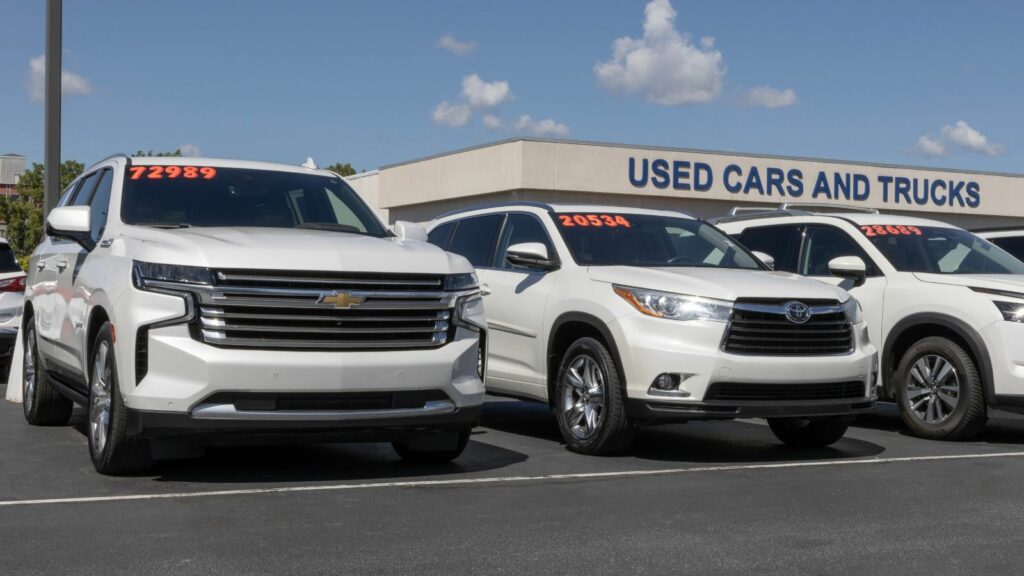
Tariffs have made cross-border automotive trade more complicated, but they have not stopped Canadian used vehicles from heading south. Even as dealerships across Canada struggle to secure desirable inventory, American buyers continue to draw vehicles out of the Canadian market.
New findings from DesRosiers Automotive Consultants reveal that U.S. imports of used vehicles remained surprisingly resilient in 2025, with volumes largely unchanged from 2024 despite President Donald Trump’s tariffs and ongoing trade uncertainty. The situation is particularly significant because Canada’s used-vehicle market was already dealing with reduced lease returns, uneven inventory availability, and affordability challenges. Although some market indicators have improved in 2026, the continued movement of vehicles into the United States raises questions about domestic supply, pricing, and what Canadian consumers can expect.
Tariffs Have Not Shut Down the Southbound Pipeline
DesRosiers Automotive Consultants found that U.S. imports of used vehicles in 2025 remained broadly in line with 2024 despite tariffs and trade uncertainty. That is a striking result for a year when automotive businesses were recalculating the cost of crossing the border. The research describes a trade channel that persisted under pressure, not a sudden surge in exports. Its public summary does not provide an exact Canadian export count, and U.S. import totals should not be mistaken for a Canada-only tally.
The implications are easy to see on a dealership lot. A late-model vehicle desired by a family in Ontario might also attract a buyer or wholesaler in the United States. Once that vehicle is exported, it is unavailable to a Canadian customer. Dealers must replace it through trade-ins, direct purchases or auctions, often competing with other retailers for appealing inventory. The outflow adds pressure even when demand is softer.
Younger Cars Account for a Remarkable Share of the Trade
Age is among the most revealing details in the DesRosiers findings. Vehicles from the 2023 model year represented 20.7 per cent of all U.S. used-vehicle imports in 2025, the largest model-year share. The 2024 and 2022 model years were also prominent. Research on 2024 flows showed a preference for youth: 40.1 per cent of imported used vehicles were no more than two years old, while another 34.7 per cent were three to five years old. These are different reporting categories, but both point to demand for fresh vehicles.
That is the inventory many Canadian shoppers hope to find. A two- or three-year-old car can offer modern safety equipment and remaining useful life without the price of a factory-new model. For a buyer trying to balance a manageable payment with reliability, those vehicles occupy an attractive middle ground. Their movement south narrows the choices available at home.
Pickups, Luxury Vehicles and Lease Returns Stand Out
The cross-border market does not treat every used vehicle equally. DesRosiers’ profile of 2024 imports found that off-lease vehicles, luxury models and pickup trucks were disproportionately represented. Its newer review of 2025 found that import volumes differed sharply from one manufacturer to another, even though the overall market appeared stable. That means the headline total can conceal more dramatic changes within particular brands. The published summary does not identify a ranking of Canadian models, so conclusions about specific nameplates would be premature.
This distinction matters for dealerships and customers alike. A dealer specializing in family sedans may experience a different sourcing environment from a retailer seeking pickups or premium SUVs. Lease returns are important because they tend to arrive with a known age and a documented ownership history. When those vehicles draw bids across the border, Canadian dealers can face sharper competition for the exact units their customers are requesting.
Dealer Inventory Is Still Hard to Replace
Export sales also leave dealers searching for replacement inventory. In a DesRosiers and Used Car Dealers Association survey published in February 2026, 52 per cent of franchised dealers and 48.2 per cent of independent dealers said used-vehicle sourcing had become harder over the previous six months. The study showed why. Franchised retailers obtained 65.4 per cent of their used vehicles directly from consumers, while auctions supplied 50.6 per cent of inventory for independent dealers.
Imagine a small independent dealership that needs five crossovers to replace vehicles sold over the weekend. It cannot order identical used cars from a factory. Each replacement must be found, evaluated, purchased and prepared for resale. When U.S. demand adds another bidder to the supply chain, the cost and uncertainty of acquiring desirable vehicles can increase. That squeeze is not uniform, but it can turn routine inventory planning into a daily headache.
The Shortage Began Years Before the Latest Tariffs
Today’s inventory problem did not begin with the 2025 trade dispute. DesRosiers traced part of the shortage to weaker new-vehicle sales during 2020 through 2023 and fewer vehicles returning from leases. Before the pandemic, leases accounted for more than 35 per cent of Canadian new-vehicle sales; that share later fell to just above 20 per cent. In 2024, the firm warned that reduced lease maturities would constrain supplies of younger used vehicles through 2027. The effects arrive years after the sale.
Consider a driver whose lease is ending and who wants another three-year-old SUV rather than a new one. That replacement depends on vehicles other people leased or purchased years earlier. When fewer entered the fleet, fewer can return today. Exports did not create this earlier shortfall, but they can magnify it by removing vehicles from a limited pool. A tariff change alone cannot instantly produce the missing lease returns.
The Canadian Dollar Keeps Cross-Border Bidding Relevant
Exchange rates help explain why a vehicle can attract attention on both sides of the border, even when tariffs raise costs. On November 6, 2026, the Bank of Canada rate put one Canadian dollar at about 70.86 U.S. cents. At that rate, a vehicle offered for C$30,000 carries a currency equivalent of US$21,260 before transport, compliance expenses, duties or dealer margins. That arithmetic is illustrative, not proof that any export would be profitable.
For Canadian sellers, bids funded in U.S. dollars can look attractive when the Canadian dollar is weak. For American importers, the benefit depends on a vehicle’s purchase price, condition, origin and total landed cost. One fee or an unfavourable tariff classification can wipe out an apparent bargain. Still, exchange rates provide a reason to keep studying cross-border opportunities rather than assuming tariffs have eliminated them. The decision rests on vehicle-by-vehicle economics.
A 25 Per Cent Tariff Is Not a Border Ban
Washington’s automotive tariff regime is an obstacle, but its details matter. The Government of Canada’s Trade Commissioner Service says the United States maintains a 25 per cent Section 232 tariff on imported automobiles and trucks. For vehicles qualifying under the Canada–United States–Mexico Agreement, the value of U.S. content is excluded from that levy. A vehicle’s country of sale is not necessarily its country of manufacture, and qualifying treatment requires more than a Canadian registration certificate. The distinction can change whether a transaction makes financial sense.
Importers must also account for customs classification, supporting paperwork, and American safety and emissions requirements. U.S. authorities require import documentation, while vehicles less than 25 years old generally must meet applicable federal motor vehicle safety standards. These obligations can make some transactions uneconomic while leaving others possible. The relevant question is not whether every Canadian used vehicle faces an identical tariff bill, but what an individual unit costs to acquire, import and legally resell.
Dealers Saw a More Uneven Picture in 2026
Steady U.S. imports in 2025 do not mean exports remained strong throughout 2026. In a DesRosiers and Used Car Dealers Association survey covering the first half of 2026, 69.7 per cent of franchised dealers and 50 per cent of independent used-vehicle dealers reported decreased exports to the United States. Those figures describe dealer observations, not a national shipment total. They also cover a later period than the 2025 import figures, so both findings can be true without contradicting each other.
The same survey showed that sourcing pressures had not disappeared. Some 52.1 per cent of independent dealers said finding used vehicles had become harder, while 48.6 per cent of franchised dealers reported worsening conditions. Independent retailers reported some easing for vehicles aged one to seven years, highlighting how experiences vary across businesses. Slowing exports may help domestic availability, but they cannot immediately repair shortages left by earlier vehicle sales and lease cycles.
More Listings Have Not Eliminated the Supply Problem
Used-vehicle supply is moving in different directions. CARFAX Canada reported 228,788 used listings in August 2026, up 18.9 per cent from July but still 4.6 per cent below August 2025. Its average asking price was C$30,776, down 0.3 per cent month over month and 2.7 per cent from a year earlier. Transactions fell 6.6 per cent year over year. More advertised vehicles and softer demand suggest that at least some Canadian buyers are gaining negotiating room.
Yet more listings do not guarantee an abundance of affordable, low-mileage vehicles in every category. CARFAX found that SUVs represented 56 per cent of inventory, a reminder that the composition of supply matters as much as the total. A buyer searching for a modestly priced sedan may encounter a different market from someone comparing premium pickups. The figures also describe asking prices, not final transaction prices. Exports are one influence among several, rather than a complete explanation for retail pricing.
What the Latest Prices Mean for Canadian Buyers
Wholesale figures show that exports are not keeping every vehicle expensive. Canadian Black Book reported that used wholesale values fell 0.32 per cent in the week ending October 31, 2026, after a 0.40 per cent decline the week before. Car values slipped 0.33 per cent, while truck and SUV values dropped 0.31 per cent. Its 14-day average listing price was C$37,900, based on approximately 165,000 dealer listings. That measure covers a different vehicle pool from CARFAX Canada’s broader figures, explaining why their averages should not be directly compared.
Canadian Black Book also reported that demand for high-quality vehicles remained strong on both sides of the border. For shoppers, the practical lesson is that lower wholesale prices and tight supplies of desirable models can coexist. Sellers may negotiate more readily on slow-moving stock, while clean, well-equipped used vehicles remain competitive. Future prices will depend on consumer demand, lease returns, exchange rates and tariff rules, rather than exports alone.
