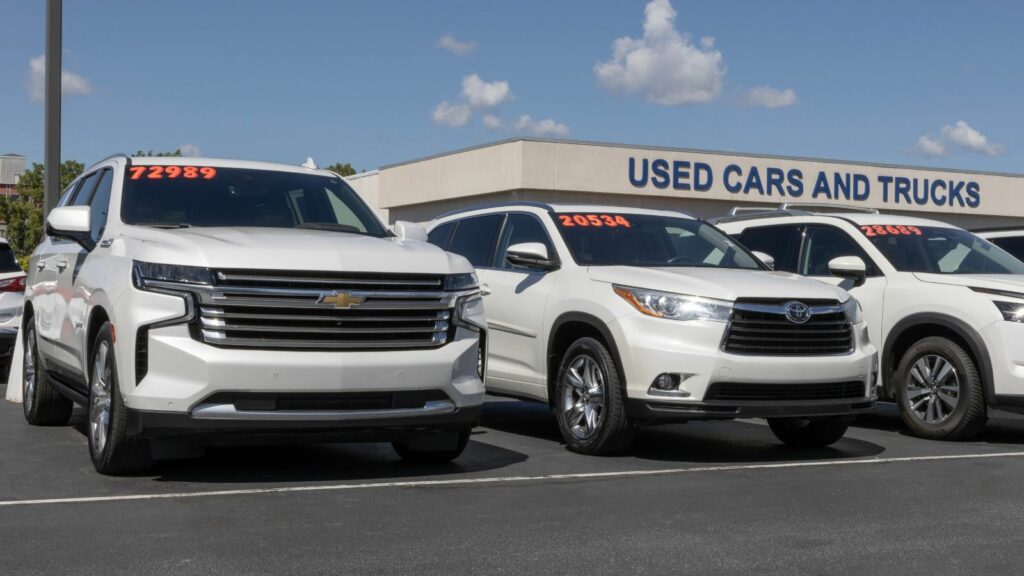
Canada’s used-vehicle market is showing stronger signs of price weakness as wholesale values decline at a faster pace heading into late November. According to Canadian Black Book, wholesale used-vehicle prices fell 0.54% during the week ending November 14, 2026, accelerating from a 0.36% decline the previous week. Passenger cars experienced particularly sharp losses, while SUVs, crossovers, and vans also faced mounting pressure.
The latest figures suggest that depreciation is spreading across the market, creating new challenges for dealerships and potentially improving conditions for used-vehicle buyers. However, with retail prices adjusting more gradually and demand for desirable vehicles remaining firm, the implications extend beyond a simple drop in advertised prices.
Wholesale Used-Car Prices Are Falling Faster Than Normal
Canadian Black Book’s November 17 market report confirmed that wholesale used-vehicle values declined 0.54% during the week ending November 14, compared with a 0.36% decrease the previous week. That represents a notable acceleration in depreciation, with the latest weekly decline 50% larger than the preceding one. The drop also exceeded the historical average of 0.30% recorded for the equivalent week between 2017 and 2019, suggesting that the current market is weakening faster than its typical pre-pandemic seasonal pattern.
Autumn usually brings some depreciation as vehicle demand shifts and dealerships adjust their inventories ahead of winter. However, the latest numbers suggest that this seasonal adjustment has become more pronounced. A hypothetical vehicle valued at $30,000 in the wholesale market would lose approximately $162 if its value moved precisely in line with the weekly average. While individual vehicles rarely follow the market perfectly, even relatively small percentage changes can have meaningful financial consequences for dealerships holding dozens or hundreds of vehicles.
Compact and Mid-Size Cars Experience Particularly Sharp Declines
Passenger cars are experiencing some of the most significant depreciation in Canada’s wholesale vehicle market. Canadian Black Book reported that overall car values declined 0.63% during the week ending November 14, compared with a 0.39% decrease in the preceding week. Compact cars recorded an even sharper 1.03% decline, making them the weakest-performing passenger-car category identified in the report’s headline findings. Mid-size cars followed with a decrease of 0.81%, while every reporting passenger-car segment experienced negative price movement.
These declines are particularly relevant because compact and mid-size cars serve buyers seeking practical transportation without the higher purchase costs associated with many larger vehicles. A commuter considering a used compact sedan, for example, may eventually benefit if lower wholesale acquisition costs translate into more competitive dealership pricing. However, there is no guarantee that retail prices will immediately reflect the latest changes. Dealers must still consider vehicle condition, mileage, reconditioning expenses, and local competition. The figures nevertheless suggest that the pricing environment for traditional passenger cars is becoming increasingly favourable to buyers.
SUVs, Crossovers, and Vans Are Also Losing Value
The weakness is no longer confined to conventional passenger cars. Canadian Black Book reported that wholesale values across the truck and SUV category declined 0.48% during the week ending November 14, accelerating from a 0.35% drop the previous week. Compact vans experienced one of the sharpest individual declines, losing 1.23% of their wholesale value. Compact crossovers and SUVs fell 0.92%, while minivans declined 0.91%. These differences show that depreciation is affecting several vehicle categories at rates considerably higher than the broader truck-and-SUV average.
For Canadian families and small businesses, the changing market could eventually create opportunities. A family looking for a used minivan may encounter more competitive pricing as dealerships adjust to falling wholesale values, while a business shopping for a compact cargo van could benefit from weaker prices in that category. However, popular models with low mileage, clean accident histories, and desirable equipment may continue commanding stronger prices. The growing variation between vehicle categories makes individual model research especially important, since a broad market decline does not automatically translate into identical savings across every dealership or vehicle type.
More Vehicle Categories Are Experiencing Significant Price Changes
One of the clearest indicators of growing market instability is the number of vehicle categories experiencing meaningful changes in value. Canadian Black Book found that slightly less than 82% of market segments recorded average value movements exceeding $100 in either direction during the latest reporting week. That compares with slightly less than 64% during the preceding week. Importantly, this does not mean that 82% of segments lost more than $100; the measurement includes both upward and downward movements. Nevertheless, the accompanying broad declines suggest that pricing adjustments are becoming more widespread.
For dealerships, this development matters because wholesale values influence decisions about how much to pay for vehicles entering inventory. A dealer purchasing several used cars at auction may need to reassess bids more frequently when market values are moving quickly. The same situation affects existing inventory, particularly vehicles that have remained unsold for extended periods. A $100 or $200 adjustment might seem modest on a single vehicle, but repeated across a large dealership inventory, those changes can materially affect inventory valuations and potential profit margins.
Auction Inventories Remain Elevated Despite Strong Demand for Quality Vehicles
Vehicle availability is another important factor influencing wholesale prices. Canadian Black Book reported that auction inventories remained at normal to high levels during the week ending November 14, although upstream sales channels continued receiving priority access to available vehicles. The company also noted that demand for high-quality used vehicles remained strong in both Canada and the United States. This combination suggests that the market is not experiencing a uniform decline in interest, even as average wholesale values weaken.
Earlier research from DesRosiers Automotive Consultants and the Used Car Dealers Association reinforces that distinction. Their first-half 2026 findings showed that 48.6% of surveyed franchised dealers and 52.1% of independent dealers reported worsening used-vehicle sourcing conditions. Lower new-vehicle sales between 2021 and 2024 have also reduced the supply of vehicles returning from leases. Consequently, dealerships can face higher auction availability while still struggling to obtain the specific models, ages, and conditions customers want. For shoppers seeking dependable used transportation, this means more vehicles entering the market will not necessarily eliminate competition for well-maintained examples.
Average Retail Listing Prices Have Slipped to $37,100
The impact of weakening wholesale values is beginning to appear in retail listing data, although the movement is more gradual. Canadian Black Book reported that the average advertised price of used vehicles on Canadian dealership lots declined to approximately $37,100, measured using a 14-day moving average. The calculation included roughly 180,000 listed vehicles nationwide. In the previous report, the comparable average stood at approximately $37,300, based on about 175,000 listings. That represents a $200 reduction in the reported average alongside an increase in advertised inventory.
However, wholesale and retail prices measure different stages of the vehicle market. Wholesale figures reflect the values dealerships encounter when acquiring or disposing of vehicles, while retail asking prices incorporate preparation expenses, potential warranty costs, business overhead, and dealer margins. The mix of vehicles included in the average can also change from week to week. A dealership may purchase replacement inventory at lower prices without immediately reducing every advertised vehicle. Buyers should therefore interpret the $37,100 figure as a broad market indicator rather than a prediction of what any particular vehicle will cost.
Canada’s Used-Vehicle Market Is Adjusting, Not Collapsing
Although wholesale depreciation has accelerated, broader industry data suggests that Canada’s used-vehicle market is undergoing a gradual adjustment rather than an outright collapse. AutoTrader’s third-quarter 2026 Price Index placed the average used-vehicle price at $36,549, representing a 1.0% decline from the same period in 2025. By comparison, the average new-vehicle price stood at $62,176. These figures come from a different reporting period and measurement system than Canadian Black Book’s November data, but they demonstrate that used vehicles remain a significant household expense despite recent declines.
The changes have also been uneven across vehicle types. AutoTrader reported that used SUV prices fell 2.8% year over year during the third quarter, while used sedan prices increased 1.3% and used minivan prices rose 2.4%. These longer-term retail trends do not contradict the more recent weekly wholesale declines because the measurements cover different periods. They highlight how vehicle availability and demand can produce different pricing outcomes. AutoTrader also expects used-vehicle inventory to remain relatively constrained into 2027, potentially limiting the extent of future price reductions even if wholesale depreciation continues.
Falling Wholesale Prices Could Reduce Vehicle Trade-In Values
While falling used-car prices may benefit buyers, they can create challenges for Canadians planning to trade in their existing vehicles. Dealerships generally base trade-in offers on wholesale valuations rather than the higher prices advertised to retail customers. Ontario’s Motor Vehicle Industry Council explains that factors including mileage, condition, popularity, location, and seasonal demand influence the amount a dealer offers. A hypothetical vehicle carrying a $25,000 wholesale valuation would experience a $135 reduction if its value declined by exactly 0.54%. However, the national average does not determine individual trade-in offers.
For vehicle owners, this creates an important consideration when deciding whether to sell, trade, or keep their current vehicle. A dealership may adjust its appraisal based on recent auction activity even before similar vehicles receive lower advertised retail prices. Obtaining multiple appraisals and consulting Canadian Black Book’s valuation service can help owners establish realistic expectations. Trade-ins can also offer tax advantages in some provinces. In Ontario, for example, an eligible trade-in generally reduces the amount subject to HST on the replacement vehicle. Consequently, comparing a private-sale price with a dealership trade-in requires examining the complete financial transaction rather than simply choosing the highest initial offer.
Economic Uncertainty Is Adding Pressure to Used-Car Affordability
The changing automotive market is unfolding against a challenging economic backdrop for many Canadian households. Statistics Canada reported that the national unemployment rate increased to 6.7% in October 2026, up from 6.5% in September. Employment was little changed during the month, declining by an estimated 4,700 positions. At the same time, AutoTrader’s third-quarter research showed that average monthly payments for used vehicles increased 1.8% year over year to $638, even as average used-vehicle prices declined. This demonstrates why lower purchase prices do not automatically translate into more affordable vehicle ownership.
Financing costs, insurance premiums, maintenance requirements, and household income all influence whether a used vehicle fits within a family’s budget. Someone replacing an aging vehicle may welcome a lower advertised price but still face substantial monthly financing commitments. Loan duration, interest rates, and the amount borrowed can outweigh the benefit of a relatively small price reduction. For dealerships, this creates pressure to balance competitive pricing with realistic financing options. For consumers, it reinforces the importance of evaluating the total cost of ownership, including independent vehicle inspections and potential repair expenses, rather than concentrating exclusively on the sticker price.
The Coming Weeks Will Show Whether Prices Continue Falling
The next several weeks will help determine whether Canada’s accelerating wholesale depreciation represents a temporary seasonal adjustment or the beginning of a more sustained period of weakness. Canadian Black Book’s latest 0.54% decline is substantially steeper than the 0.30% historical average for the equivalent week. Continued reductions of that magnitude could place additional pressure on dealership inventories and advertised prices. However, strong demand for desirable vehicles, limited availability in certain categories, and ongoing supply constraints could prevent a uniform decline across the market.
Trade uncertainty adds another layer of complexity. AutoTrader’s September 2026 research, involving 1,167 Canadian vehicle shoppers, found that 73% expected used-vehicle prices to increase because of trade negotiations, even as current market data showed signs of softening. Nearly half of prospective shoppers had delayed a planned purchase, although 65% expected to buy within the next 12 months. Those expectations are not guarantees that prices will rise. For now, Canada’s used-vehicle market is providing clearer evidence of downward wholesale pressure, but the eventual impact on retail prices will depend on inventory availability, consumer demand, financing conditions, and broader economic developments.
