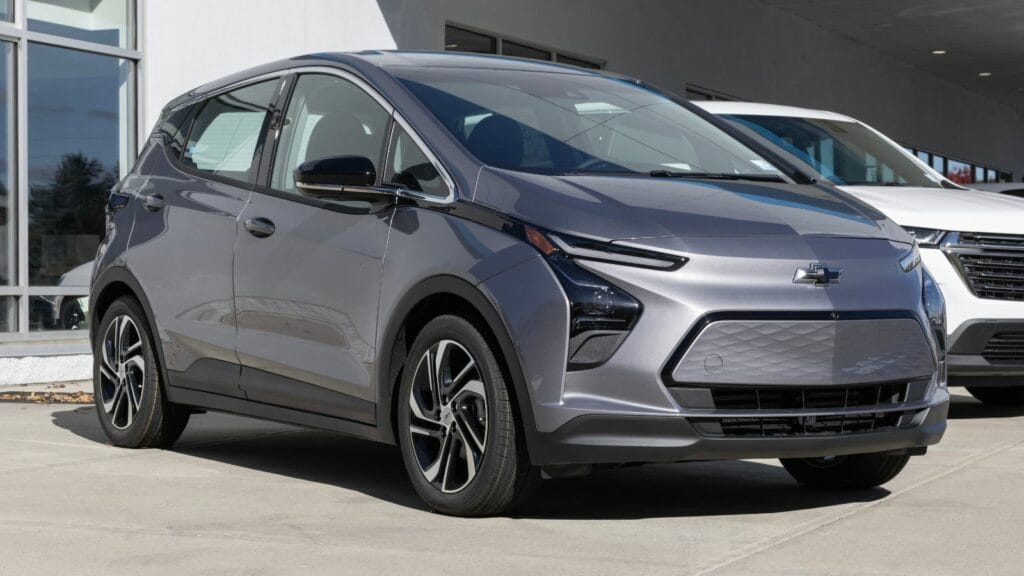
Canada’s electric vehicle market is revealing a surprising divide between national buying patterns and Ontario’s preferences. New federal rebate figures for October 2026 show the Chevrolet Bolt leading the country with 2,420 incentive requests, comfortably ahead of the Tesla Model Y’s 1,834. Yet Ontario tells a different story, with Tesla’s electric SUV attracting more than twice as many requests as Chevrolet’s affordable hatchback.
The figures, released by Transport Canada on November 16, highlight how vehicle prices, regional preferences, and government incentives are shaping Canada’s transition to electric transportation. With federal rebates scheduled to decrease in January 2027, the results also raise important questions about affordability, consumer priorities, and which automakers are best positioned to attract Canadian EV buyers.
Chevrolet Bolt Takes the National Lead in Federal EV Rebates
The Chevrolet Bolt emerged as Canada’s most-requested electric vehicle under the federal Electric Vehicle Affordability Program (EVAP) in October 2026. Transport Canada recorded 2,420 requests for the Bolt, compared with 1,834 for the Tesla Model Y. That gave Chevrolet a lead of 586 requests, approximately 32% more than Tesla’s total for the month. The Bolt alone represented roughly 16.3% of all federal EV rebate requests submitted nationwide.
Across Canada, the program recorded 14,878 requests during October, including 12,664 for fully electric vehicles and 2,214 for plug-in hybrids. Battery-electric vehicles therefore accounted for approximately 85% of the month’s activity. The results suggest that Chevrolet’s lower-priced electric model is attracting considerable interest among customers seeking government-supported purchases. However, the figures measure incentive requests rather than confirmed vehicle deliveries, making them an important indicator of purchasing activity without representing the entire Canadian EV market.
Ontario Buyers Show a Strong Preference for the Tesla Model Y
Ontario produced a dramatically different result, with the Tesla Model Y attracting 1,194 federal rebate requests during October. That represented approximately 31% of the province’s 3,860 requests. The Chevrolet Bolt finished considerably behind with 537, meaning the Model Y generated more than twice as many requests. Other competitors were even further back, including the Toyota bZ with 239 requests and the Chevrolet Equinox EV with 233.
The concentration of Tesla requests in Ontario is particularly notable. Approximately 65% of all Model Y rebate requests across Canada originated from Ontario recipients, demonstrating the province’s importance to Tesla’s federally incentivized sales activity. Ontario also has no separate provincial EV purchase rebate, making the federal incentive especially relevant when comparing eligible models. Although the statistics do not establish why individual customers selected Tesla, they reveal a clear regional distinction: the Bolt leads nationally, while Ontario’s federally supported EV market continues to favour the Model Y.
Quebec’s Influence Helps Explain the Different National Rankings
Quebec plays an important role in shaping Canada’s electric vehicle market, and its purchasing patterns differ considerably from Ontario’s. During the third quarter of 2026, Quebec accounted for 18,115 of the country’s 34,486 federal EV rebate requests, representing approximately 52.5% of the total. Ontario followed with 7,356 requests, while British Columbia recorded 6,022. The Chevrolet Bolt also led nationally during that quarter, generating 5,637 requests compared with 3,336 for the Tesla Model Y.
Provincial incentives create another important distinction. Quebec’s Roulez vert program offers up to $2,000 toward eligible new electric vehicles registered in 2026. Combined with the federal incentive of up to $5,000, qualifying purchasers can potentially receive $7,000 in government assistance. Ontario buyers do not have access to a comparable provincial purchase rebate. These differences help explain why EV purchasing conditions vary across Canada, although they do not establish that government incentives alone determine which vehicles consumers choose.
Chevrolet Bolt’s Lower Price Makes It an Attractive Alternative
Affordability is one of the Chevrolet Bolt’s strongest selling points, particularly as Canadians compare the cost of switching from gasoline-powered vehicles to electric transportation. The redesigned 2027 Chevrolet Bolt LT carries a starting manufacturer’s suggested retail price of $39,999 in Canada. By comparison, the Tesla Model Y Rear-Wheel Drive starts at $49,990. That represents a difference of nearly $10,000 before additional charges and available incentives, potentially making the Bolt more accessible to households concerned about monthly payments.
Chevrolet has also improved the Bolt’s technology and charging capabilities. The new model offers up to 422 kilometres of GM-estimated electric range and can recharge from 10% to 80% in as little as 25 minutes using suitable high-powered DC charging equipment. It also introduces a native North American Charging Standard port and offers available Super Cruise hands-free driving assistance on compatible highways. For drivers primarily travelling between home, work, shopping centres, and nearby communities, these improvements provide a practical combination of affordability, convenience, and everyday electric driving capability.
Tesla Model Y Remains Competitive Despite Its Higher Starting Price
The Tesla Model Y offers a different proposition for Canadian EV buyers, combining crossover practicality with electric range and access to Tesla’s established charging network. The Rear-Wheel Drive version currently lists for $49,990 before additional charges and offers an EPA-estimated range of 463 kilometres with its standard 18-inch wheels. Its five-seat configuration and crossover body style may appeal to households seeking more flexibility for passengers, luggage, and longer trips. These characteristics provide useful context for Tesla’s Ontario performance, although the rebate statistics cannot confirm individual purchasing motivations.
Federal eligibility rules are particularly important for Tesla. Under EVAP, qualifying vehicles manufactured outside Canada generally must have a final transaction value of $50,000 or less and be built in a country with which Canada has a free-trade agreement. The Model Y’s starting price leaves very little room for optional equipment that counts toward that limit. More expensive configurations, including the Premium All-Wheel Drive version listed at $64,990, sit well above the usual threshold. Consequently, Tesla’s rebate activity reflects a narrower selection of configurations than its broader vehicle lineup.
Chevrolet’s Expanding EV Lineup Strengthens Its National Position
Chevrolet’s strong performance extends beyond the Bolt, with the Equinox EV also attracting substantial interest across Canada. During October, the Equinox EV generated 1,321 federal rebate requests, placing third nationally behind the Bolt and Tesla Model Y. Together, Chevrolet’s two electric models accounted for 3,741 requests, representing approximately 25% of the national total. The Ford Mustang Mach-E finished fourth with 1,034 requests, followed by the Kia Niro EV with 942. The results demonstrate how competition among eligible electric vehicles has expanded beyond Tesla and a handful of early EV manufacturers.
Chevrolet’s advantage includes offering different vehicle sizes and configurations. The Bolt targets customers seeking an affordable, compact electric vehicle, while the larger Equinox EV provides more passenger and cargo flexibility, with up to 513 kilometres of GM-estimated range in its front-wheel-drive configuration. This variety allows customers with different budgets and practical requirements to consider Chevrolet without abandoning the brand’s electric lineup. Tesla faces a different situation under EVAP, with its Model 3 currently ineligible for federal incentives. Consequently, the number of qualifying models offered by each manufacturer can influence comparisons of rebate activity.
Tesla’s Ontario Growth Contrasts With Falling Requests Elsewhere
Although the Tesla Model Y remained Ontario’s leading vehicle for federal rebate requests, its national performance weakened between September and October. According to Transport Canada’s updated statistics, Model Y requests declined from 2,376 in September to 1,834 in October, representing a decrease of approximately 23%. Ontario moved in the opposite direction, with Model Y requests increasing from 862 to 1,194 over the same period. The provincial increase of 332 requests demonstrated that Tesla’s Ontario activity remained strong despite its weaker national total.
British Columbia experienced a much sharper change. Model Y requests in the province declined from 1,026 in September to just 201 in October, while Quebec’s figure increased slightly from 281 to 303. Meanwhile, total federal EV rebate requests across all eligible models rose from a revised 14,151 in September to 14,878 in October. Such differences highlight how uneven monthly EV purchasing activity can be across Canadian provinces. Inventory availability, delivery schedules, financing offers, and dealership submission timing may all influence the numbers, but Transport Canada’s public statistics do not establish which factors caused these particular changes.
Federal Rebate Requests Do Not Tell the Entire EV Sales Story
While federal rebate statistics provide valuable information about Canada’s electric vehicle market, they have important limitations. Transport Canada’s dataset records requests submitted through the Electric Vehicle Affordability Program rather than providing a comprehensive account of vehicle registrations or manufacturer deliveries. Some vehicles do not qualify because of pricing, manufacturing origin, or other eligibility requirements. Used vehicles are generally excluded, and dealerships must participate in the program to submit requests on behalf of customers. Consequently, a model’s rebate ranking does not necessarily match its position in the broader market.
The program also treats different purchase arrangements differently. Eligible customers purchasing a battery-electric vehicle can receive the full available incentive, while qualifying leases shorter than 48 months receive prorated amounts. Individuals are generally limited to one EVAP incentive during the program’s five-year duration. These conditions shape which transactions appear in the statistics and how much financial assistance is available. For a complete assessment of Canadian EV demand, rebate requests must be considered alongside vehicle registrations, manufacturer deliveries, pricing data, and inventory information. That distinction is particularly important when comparing brands competing across different price segments.
Federal EV Rebates Are About to Become Less Generous
Canada’s federal electric vehicle incentive program is approaching a significant change that could influence purchasing decisions heading into 2027. Under the current schedule, the maximum incentive for eligible battery-electric vehicles will decrease from $5,000 in 2026 to $4,000 on January 1, 2027. Plug-in hybrid incentives will also decline, from $2,500 to $2,000. The reduction means qualifying customers purchasing vehicles such as the Chevrolet Bolt or Tesla Model Y could receive $1,000 less in federal assistance, depending on when their eligibility assessment is submitted.
Importantly, Transport Canada bases the incentive amount on the date a dealership submits the eligibility assessment, not simply when the vehicle is delivered. Approved assessments remain valid for 90 days, making delivery schedules particularly important for customers ordering vehicles near the end of the year. Quebec’s government-funded Roulez vert purchase incentives are also scheduled to end on December 31, 2026. As of November 1, Transport Canada reported approximately $1.87 billion remaining from EVAP’s original $2.275-billion allocation. The competition between Chevrolet and Tesla will therefore continue under changing financial conditions, making upcoming rebate figures an important indicator of how Canadian EV purchasing patterns evolve.
