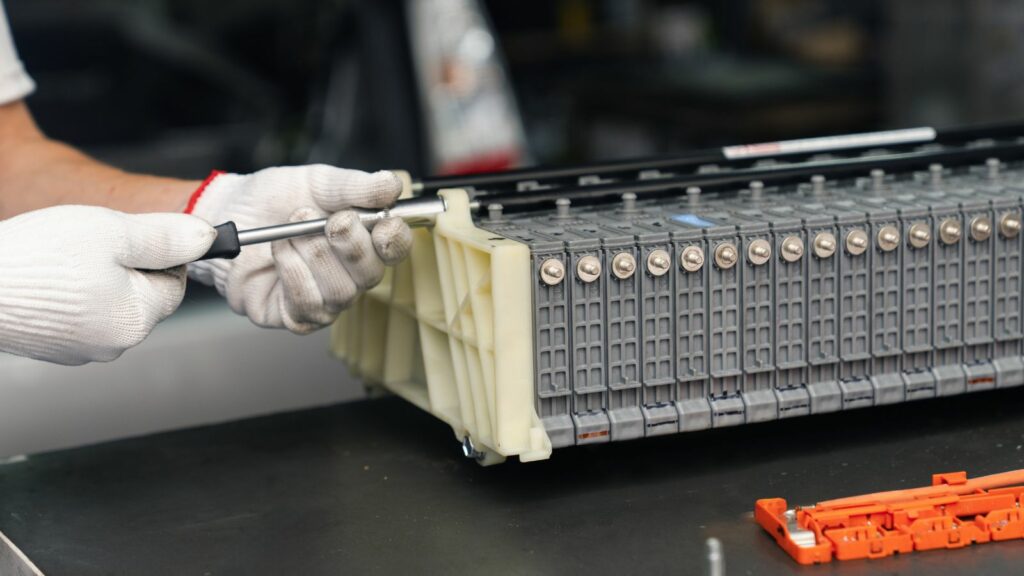
Canadian battery-materials company Nano One Materials is positioning itself for a much larger role in the lithium iron phosphate supply chain as governments and manufacturers look for alternatives to China-dominated production. The Vancouver-based company estimates that the addressable LFP market outside China is already worth roughly $8 billion to $10 billion annually in 2026 and could expand substantially over the next decade.
The opportunity is being driven by more than electric vehicles. LFP has become the dominant chemistry in stationary battery storage, while its share of the global EV market has also climbed sharply. For Nano One, the challenge is turning that industry momentum into commercial contracts. Its strategy centres on a proprietary manufacturing process, an expanding demonstration facility in Quebec and a licensing model intended to let partners build production capacity without forcing Nano One to finance every factory itself.
The $8–10 Billion Figure Is an Addressable Market, Not a Revenue Forecast
Nano One’s headline number needs an important qualification. The company is not forecasting $8 billion to $10 billion in its own sales. Rather, it estimates that the annual market for LFP cathode active material outside China that could potentially be addressed by suppliers and technology providers is currently in that range. Nano One says that market could reach approximately $40 billion annually by 2035. It also cites industry forecasts suggesting annual LFP battery demand outside China could rise to 2.1 terawatt-hours by that point.
The scale becomes easier to understand when translated into factories. Nano One says meeting the projected 2035 demand outside China would be equivalent to roughly 168 LFP cathode plants producing 25,000 tonnes a year each. Those plants would not necessarily use Nano One technology, and many will be built by competing producers. Still, the estimate illustrates the industrial buildout that would be required if North America, Europe and other markets genuinely want significant battery-material production outside China rather than simply assembling imported cells.
LFP Has Moved From the Budget Option to the Battery Mainstream
Lithium iron phosphate once carried a reputation as the less glamorous alternative to nickel-rich battery chemistries. Its lower energy density can be a disadvantage where weight and maximum driving range matter, but the chemistry brings other attractive characteristics, including relatively low raw-material costs. The International Energy Agency says LFP batteries accounted for more than 55% of EV batteries deployed globally in 2025, up from nearly half a year earlier. That makes LFP a mainstream technology rather than a niche chemistry concentrated in inexpensive vehicles.
Cost helps explain the shift. IEA analysis found that LFP battery packs were more than 40% cheaper on average in 2025 than nickel-manganese-cobalt alternatives on a per-kilowatt-hour basis. The chemistry also avoids nickel and cobalt, two materials that have historically added both cost and supply-chain complexity. The result is an increasingly important trade-off for automakers: some vehicles may benefit from the higher energy density of nickel-rich chemistry, while many mass-market models can prioritize affordability, durability and sufficient range instead.
Grid Storage Has Created a Second Major Growth Engine
Cars are only part of the LFP story. Battery storage for electrical grids, renewable-energy projects and large commercial facilities has expanded quickly, creating a market where extreme energy density is less important than price, durability and repeated cycling. The IEA says 108 gigawatts of new battery storage capacity were installed worldwide during 2025, roughly 40% more than a year earlier. Total installed capacity was about 11 times its 2021 level, demonstrating how quickly storage has moved from a supplementary technology toward a major piece of electricity infrastructure.
LFP captured about 90% of global stationary battery-storage deployments in 2025. That dominance matters for a company such as Nano One because it broadens the potential customer base beyond automakers. Utilities, data-centre operators, renewable developers and defence users can all have different battery requirements and procurement considerations. Nano One has specifically identified energy storage and defence alongside EVs as target markets. A diversified customer base could be valuable if electric-vehicle demand grows unevenly, although rapid storage growth does not guarantee that individual suppliers will secure profitable contracts.
China’s Lead Has Become an Economic and Security Concern
The biggest contradiction in Western battery policy is increasingly clear: governments want more domestically produced batteries, but crucial stages of the supply chain remain concentrated in China. The IEA says production of LFP cathode materials and their precursors is still almost entirely concentrated there. China combines huge manufacturing capacity with accumulated technical expertise, supplier networks and economies of scale that newer Western projects must somehow match. In 2025, average battery-pack prices in China were about 30% below those in North America and 35% below European prices.
Governments are responding with industrial policy rather than assuming market forces alone will close the gap. G7 leaders agreed in 2025 to encourage diversification and, where possible, the onshoring of critical-mineral mining, processing, manufacturing and recycling. A subsequent G7 roadmap contemplated tools including procurement policies, tax incentives, trade measures and financial support to reduce dependence on supply chains shaped by non-market practices. U.S. tax policy also supports domestic battery manufacturing, while foreign-entity restrictions are making the origin of components and materials increasingly important for some American incentives and procurement decisions.
Nano One Is Selling a Manufacturing Process as Much as a Material
Nano One’s strategy differs from the straightforward model of raising billions of dollars and building enormous company-owned cathode factories. Its central technology is called the One-Pot process, which is designed to produce cathode active material through a simplified manufacturing route using different types of regional feedstock. Nano One argues that its process can reduce manufacturing steps and dependence on precursor supply chains that are heavily concentrated in China. That proposition becomes more valuable if customers increasingly need to document where materials, technology and equipment originate.
The company is pairing that technology with what it calls a “Design One Build Many” approach. In June, Nano One and engineering partner Worley Chemetics completed a commercial-ready LFP cathode package that combines a technology licence, process design and qualified equipment. Equipment options sourced from North America, Europe and South Africa are part of that offering. Nano One also plans to use development companies, or DevCos, to bring together its technology with regional investors, customers and project partners. In theory, that could allow multiple plants to advance without Nano One supplying all the construction capital itself.
Candiac Is the Crucial Bridge Between Technology and Commercial Scale
The practical test is taking place in Candiac, Quebec. Nano One’s existing pilot line has capacity of roughly 200 tonnes per year and is being used for customer sampling and qualification. The company is expanding the facility toward total annual capacity of approximately 800 tonnes, with commissioning targeted for the first half of 2027. Detailed engineering was 85% complete by mid-July. Nano One says about 95% of the expansion equipment by value, including all equipment considered sensitive to its intellectual property, is being sourced from Canada, the United States and the European Union.
Government support has helped finance that transition. Natural Resources Canada announced $4.3 million for scaling Nano One’s LFP process in April 2026, building on a previous $5-million contribution. Nano One reported $19.3 million in cash at the end of June and said it had secured more than $63 million in non-dilutive capital since the start of 2024, including grants, loans and asset transactions. The expanded facility remains far smaller than a full commercial-scale cathode plant, but that is partly the point: Candiac is intended to prove production, qualify material and support larger licensing decisions.
The Real Test Is Converting Policy Momentum Into Paying Customers
The strongest part of Nano One’s case is that several trends are moving in the same direction. LFP demand is growing, stationary storage is booming, Western governments are worried about concentrated battery supply chains, and public funding is being directed toward domestic or allied production. Nano One says it is already discussing small-volume commercial supply with defence and energy-storage customers and is targeting initial commercial agreements by the end of 2026. Those milestones could help demonstrate that its technology has value beyond pilot projects, engineering packages and government-supported development.
But the competitive hurdle is formidable. The IEA has warned that cathode producers are operating in an environment of excess capacity and intense price competition, with some manufacturers currently producing at a loss. Chinese battery makers retain enormous scale advantages, while rival suppliers in South Korea, Japan, Europe and elsewhere are also investing in LFP. Nano One itself classifies its commercialization timelines, demand forecasts and future licensing revenues as forward-looking information. The $8–10 billion opportunity is therefore best viewed as the market the company hopes to penetrate—not evidence that the commercial outcome has already been secured.
