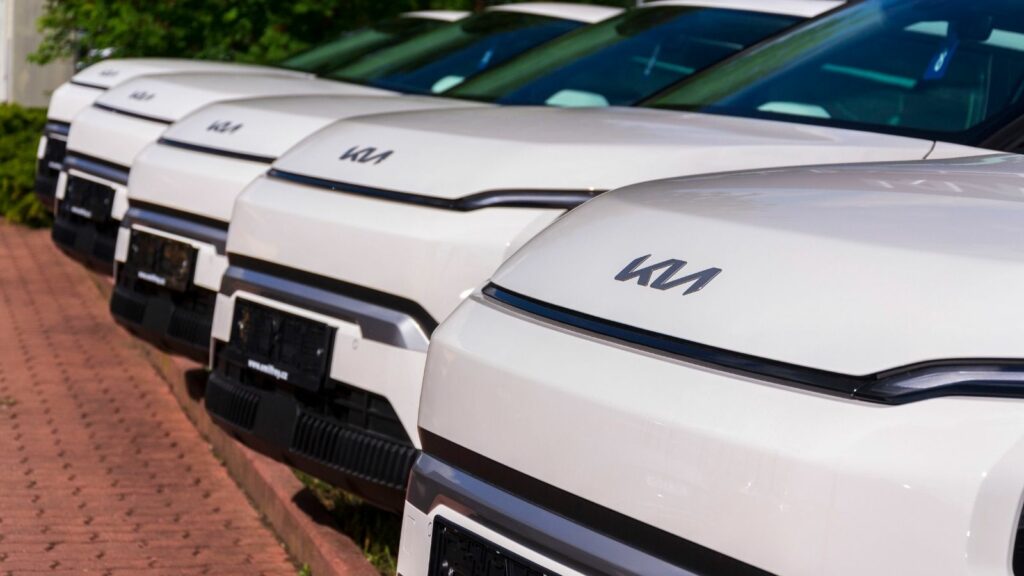
]A new low-priced electric crossover is reaching Canadian dealerships at exactly the moment federal incentives are becoming more complicated to explain. Kia has priced the 2027 EV3 from $36,995 before incentives, putting it among the least expensive new battery-electric vehicles in the country. Yet the familiar question—“Does it get the $5,000 rebate?”—does not always have a one-line answer.
Canada’s new Electric Vehicle Affordability Program judges most non-Canadian-made EVs by a $50,000 final transaction value, a calculation that treats freight, dealer fees, options and discounts differently. That creates little uncertainty on lower EV3 trims but a genuine grey zone near the top of the federally listed lineup. With inventory now appearing at dealerships and provincial incentives varying sharply, buyers face a new kind of EV math: the sticker price is only the starting point.
A $36,995 EV Arrives at a Sensitive Moment
Kia’s 2027 EV3 enters Canada with a $36,995 MSRP for the Light FWD, while Kia lists a national all-in price of $39,744 before incentives and sales tax. That figure includes $2,185 in freight plus up to $564 in other fees, levies and duties. The timing matters because affordability has become one of the biggest barriers separating EV curiosity from an actual purchase, particularly for shoppers who have watched several electric models migrate toward luxury-car pricing.
The EV3 is no longer just a future product on an auto-show stand. Kia said deliveries would begin across Canada in late August, and dealership inventory pages in Quebec were already showing new 2027 EV3 units in stock by the end of the month. That makes the rebate question immediate rather than theoretical. For a household comparing monthly payments, the difference between receiving the full $5,000 federal incentive and missing it can materially change whether the EV3 looks like an inexpensive electric crossover or simply another new vehicle with a complicated final bill.
The Federal Rebate Is Back, but the Rules Changed
Canada’s Electric Vehicle Affordability Program, or EVAP, restored a federal purchase incentive in 2026 after the previous iZEV program ended. Battery-electric and hydrogen fuel-cell vehicles can receive up to $5,000 in 2026, while qualifying plug-in hybrids can receive up to $2,500. The program applies to eligible transactions dated February 16, 2026 or later and is scheduled to run through March 31, 2031, unless its funding is exhausted first.
The new structure is deliberately more focused on lower-priced vehicles. For most EVs not made in Canada, the final transaction value must be $50,000 or less, and the vehicle must meet other program rules, including country-of-origin requirements. Transport Canada says EVAP received $2.275 billion over five years, with $2.05 billion remaining as of August 1. The headline $5,000 also will not last indefinitely: incentive levels are designed to decline over the program’s life, making purchase timing part of the affordability calculation.
MSRP Alone Does Not Decide Whether an EV3 Qualifies
The source of much of the confusion is that EVAP does not use a simple MSRP ceiling at the cash register. Transport Canada says the decisive number is the “final transaction value.” That calculation includes the vehicle’s MSRP, accessories, optional packages, paint and protection products, dealer documentation or administration fees, market adjustments and similar vehicle-related charges. Manufacturer and dealer discounts work in the opposite direction and reduce the value used for the test.
Several familiar line items are excluded. Freight and pre-delivery inspection do not count, nor do sales taxes, registration and licensing fees, winter tires, extended warranties, insurance products or eligible provincial rebates. That distinction is important for the EV3 because Kia’s advertised all-in figures include freight and certain fees. An all-in price slightly above $50,000 therefore does not automatically mean a shopper has lost the federal incentive. Conversely, a trim with an MSRP just under $50,000 can become ineligible if enough counted options and dealer fees are added without offsetting discounts.
The EV3 Price Ladder Creates a Rebate Grey Zone
Transport Canada’s current EVAP vehicle list includes eight 2027 EV3 configurations: Light FWD, Wind FWD and AWD, Land FWD and AWD, GT-Line FWD and AWD, and GT-Line Limited FWD. Kia’s MSRP ladder places those models between $36,995 and $49,995. The higher-priced GT-Line Limited AWD at $52,495 and GT AWD at $55,995 are not shown on the federal list, although Transport Canada stresses that the list itself is informational rather than the final legal test for a transaction.
The most revealing examples sit near the cutoff. Kia lists the GT-Line AWD at $48,495 MSRP and $51,244 all-in, yet Transport Canada still lists that configuration as potentially eligible because excluded charges such as freight do not determine EVAP value. The GT-Line Limited FWD sits at $49,995 MSRP, leaving almost no room for counted dealer fees, accessories or optional treatments unless a discount offsets them. Two buyers choosing the same trim could therefore see different federal-rebate outcomes depending on the final itemized deal.
Dealer Paperwork Can Matter as Much as the Sticker
EVAP is administered through participating dealerships rather than through a cheque application submitted later by the buyer. Before delivery, the dealer must submit an eligibility assessment through Transport Canada’s portal, including the vehicle identification number and final transaction value. Once approved, the eligibility validation is generally valid for 90 days, and the incentive is applied directly to the purchase or lease agreement. Transport Canada also states that dealerships cannot charge consumers a special fee simply for using EVAP.
There is another wrinkle: dealer participation is voluntary. A vehicle can satisfy the federal rules while a particular retailer chooses not to participate, and consumers cannot submit EVAP claims on their own. Leasing also changes the amount. A purchase or lease of at least 48 months can receive the full 2026 battery-electric incentive, while leases from 12 to 47 months receive a prorated amount. For EV3 shoppers, confirming the pre-approval before delivery is therefore as important as confirming the advertised price.
Provincial Programs Make the Same EV3 Worth Different Amounts
Federal eligibility is only one layer of the purchase equation. Provincial programs remain uneven, meaning an identical EV3 can carry a different effective cost depending on where it is registered. Quebec’s Roulez vert program provides up to $2,000 in 2026 for an eligible new battery-electric vehicle, and the province says the registration date—not the order date or deposit date—determines the applicable amount. The program is scheduled to end on December 31, 2026, with no new-vehicle rebate in 2027.
British Columbia offers a sharp contrast. Its CleanBC Go Electric passenger-vehicle rebate has remained paused, even though separate commercial zero-emission vehicle support has resumed. That patchwork can be confusing for shoppers accustomed to seeing a single incentive number in advertising. It also makes delivery timing consequential in Quebec: an EV3 ordered in 2026 but registered after the program ends would not receive the same provincial assistance. Federal and provincial rules can stack, but they do not share identical deadlines, price tests or administration.
Range and Charging Give the Low Price More Context
The EV3 is not positioned as a short-range compliance vehicle. Kia’s latest Canadian specifications pair the Light trim with a 58.3-kWh battery and an estimated 356 kilometres of range in ideal conditions. Long-range front-wheel-drive versions use an 81.4-kWh battery and are rated by Kia at up to 517 kilometres, while long-range all-wheel-drive versions are estimated at up to 451 kilometres. Those numbers place a meaningful gap between the entry model and the longer-range configurations even before equipment differences are considered.
Kia also gives the EV3 a native North American Charging Standard port. The company estimates a 10-to-80 per cent DC fast charge in roughly 31 minutes for the larger battery under ideal conditions using a sufficiently powerful charger. Cold weather, battery temperature, charger performance and other conditions can extend that time. For Canadian shoppers, that means the rebate decision should not be separated from use case: paying more for range or AWD may make practical sense, but pushing a transaction over EVAP’s $50,000 calculation can erase part of the intended value.
Rebates Are Already Influencing the Market Again
The renewed federal incentive arrived as Canada’s EV market was trying to regain momentum. Statistics Canada recorded 43,113 new zero-emission vehicle registrations in the first quarter of 2026, representing 10.8 per cent of all new registrations and a 15.8 per cent increase from a year earlier. It was the first year-over-year increase in ZEV registrations since the fourth quarter of 2024. By June, monthly ZEV sales had climbed 56.1 per cent year over year to 21,876 units, equal to an 11.5 per cent market share.
The EV3 enters that recovery with a price designed to attract buyers who may have previously ruled out a new electric crossover. But its arrival also illustrates why shoppers need more than an MSRP and a rebate logo. The practical question is the EVAP-calculated final transaction value shown by the dealer before delivery. An itemized quote, confirmed federal pre-approval and a check of provincial rules can turn rebate confusion into a straightforward comparison—and prevent a few hundred dollars in extras from unexpectedly costing thousands in assistance.
