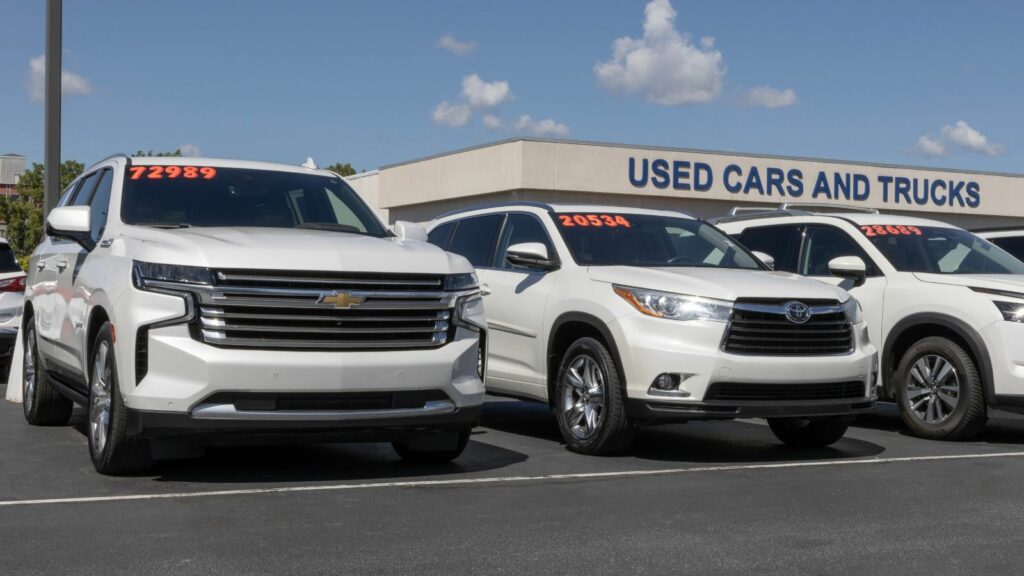
Canada’s used-vehicle market is experiencing a sharper downturn than the usual late-autumn slowdown, with trucks and SUVs leading the decline. New figures from Canadian Black Book reveal that wholesale values for these vehicles dropped 0.68% during the week ending November 21, 2026, four times the historical seasonal average of 0.17%.
The decline is raising questions about what comes next for dealerships, consumers and Canadians planning to sell or trade in their vehicles. Although wholesale prices are not the same as retail asking prices, the pace of depreciation offers an important glimpse into changing market conditions. With auction inventories remaining elevated and several vehicle categories recording substantial losses, the latest figures suggest that the balance between buyers and sellers is shifting as the year draws to a close.
The Fourfold Figure Measures a Single Week
The headline number comes from Canadian Black Book’s report for the week ending November 21, 2026. It found that wholesale truck and SUV values fell 0.68%, compared with an average decline of just 0.17% for the corresponding week in 2017, 2018 and 2019. That is a fourfold difference in the rate of depreciation, or a gap of 0.51 percentage points. The benchmark helps establish how unusual the latest move was for late November, without implying that every vehicle lost an identical amount of value.
For illustration, a vehicle with a hypothetical $30,000 wholesale value would lose about $204 at a 0.68% weekly rate, compared with $51 at the historical rate. That is a $153 difference in one week, not a prediction of what happens next. Dealers price individual vehicles according to model, age, mileage, condition and demand, so a market-wide average cannot determine a particular truck’s appraisal. It also says nothing directly about how quickly retail sticker prices will change.
The Rest of the Used Market Is Slipping, Too
The weakness extends well beyond pickup trucks and family SUVs. Canadian Black Book measured a 0.61% decline across the entire wholesale used-vehicle market in the week ending November 21, after a 0.54% decline the week before. The historical average for the same late-November week was just 0.27%, making the overall drop more than twice its usual size. Cars also lost value, falling 0.52% against a historical benchmark of 0.38%. Their decline was less severe than the previous week’s 0.63%, but it was still unusually steep for the season.
The breadth of the movement is striking. Canadian Black Book reported that more than 81% of market segments experienced average dollar-value changes exceeding $100 in absolute terms. Among cars, compact models fell 0.96% and mid-size models dropped 0.92%. Neither figure means every vehicle in those categories will receive an identical price reduction at a dealership. Rather, the figures describe changes in wholesale valuations. For a dealer carrying a mixture of pickups, sedans and crossovers, the report signals pricing pressure across a large share of inventory, even though some categories are weakening much faster than others.
Minivans and Smaller Crossovers Lead the Declines
The steepest percentage losses were not in the biggest, most expensive SUVs. Minivans led the truck and SUV category with a 1.53% weekly decline, equivalent to an average value decrease of $364 in Canadian Black Book’s breakdown. Subcompact crossovers followed with a 1.40% fall, or approximately $205. For a family planning to trade in a minivan before replacing it with a newer model, the timing of an appraisal could suddenly become more important. Those figures are category averages, however, rather than guaranteed changes in the price of a particular vehicle.
Other popular vehicle types were also under pressure. Mid-size crossovers and SUVs declined 1.18%, with an average dollar decrease of $308, while subcompact luxury crossovers fell 1.37%, or $303. At the other end of the range, full-size luxury crossovers and SUVs lost just 0.11%, averaging $76. The contrast demonstrates why a broad headline about falling SUV values can conceal very different experiences for owners. Vehicle size, equipment, condition and local demand still matter as much as the weekly market direction.
Pickup Trucks Are Losing Value at Different Rates
Pickup trucks remain important to contractors, rural households and drivers who need towing or carrying capacity, making a shift in their resale values particularly noticeable. In the latest weekly breakdown, small pickups declined 1.01%, equivalent to an average loss of $301. Full-size pickups fell a smaller 0.84%, yet their average dollar decline was higher at $331. The difference illustrates an important distinction: a lower percentage loss can still mean more money when the underlying vehicle is worth more. These are wholesale category readings, not individual trade-in quotes.
The same variation appears across other large vehicles. Full-size crossovers and SUVs slipped 0.42%, with an average decrease of $167, while mid-size luxury crossovers and SUVs lost 0.46%, or $191. A dealer assessing a well-maintained pickup with desirable equipment may therefore reach a very different valuation from one assessing a rougher vehicle with high mileage. The market has become softer, but it has not stopped distinguishing between useful, retail-ready inventory and vehicles that may require significant work before resale.
The Decline Has Accelerated Through November
The November reports reveal a meaningful change in momentum. Truck and SUV wholesale values declined 0.35% in the week ending November 7, followed by 0.48% in the week ending November 14 and 0.68% in the week ending November 21. Each successive reading was weaker than the one before. Historical declines for those same calendar weeks averaged 0.30%, 0.27% and 0.17%, respectively. The latest result therefore looks more dramatic not only because depreciation accelerated, but also because the comparable week was normally a relatively gentle one.
The contrast becomes even clearer when looking back to the week ending October 31. At that point, truck and SUV values were down 0.31%, exactly matching the historical average of 0.31% for that week. Three weeks later, the sector was falling four times faster than its comparable benchmark. Weekly figures can fluctuate with auction mix and buyer activity, so the pattern does not establish a permanent trend. It does show that the market’s late-autumn softness has intensified in a relatively short period.
Seasonal Weakness Explains the Timing, Not the Entire Drop
Used-vehicle prices often soften as the year approaches its end, but the size of the decline matters as much as the direction. A November analysis by Canadian market intelligence firm TradeBasis, using Canadian Black Book figures, estimated that overall wholesale values fell about 1.69% across the five weeks ending November 7. That was only modestly worse than the 1.49% average for those same weeks in 2017–2019. The much steeper readings in the next two weekly reports suggest the market was moving beyond a fairly ordinary seasonal slowdown.
The historical comparison also requires care. Canadian Black Book uses the 2017–2019 period as its pre-pandemic reference, allowing a cleaner look at what typically happened at this time of year. But a single week’s fourfold ratio is not evidence that trucks have lost four times as much value over the entire fall, or that retail prices will collapse at the same pace. Seasonal benchmarks change from week to week. The useful signal is that depreciation is now running noticeably ahead of the normal pattern, not that one week determines the winter’s outcome.
Auction Supply Is Healthy, but Buyers Remain Selective
Canadian Black Book described auction inventory as being at normal to high levels in its latest report. It also noted that vehicles offered through upstream sales channels continued to receive priority access, meaning not every potentially available used vehicle necessarily reaches an open auction first. That combination matters for dealerships. With a choice of vehicles to acquire, buyers can be less willing to stretch on a unit that needs repairs, carries an unpopular configuration or might remain unsold for weeks. The report does not, however, show that auctions are overwhelmed with unwanted vehicles.
There is an important counterweight to the weak pricing figures: Canadian Black Book said demand for high-quality vehicles remained strong on both sides of the Canada–U.S. border. A clean, desirable SUV with credible maintenance records may still attract serious bids even while the broader category is losing value. For dealers, the challenge is distinguishing stock likely to move quickly from stock that could become expensive to hold. For shoppers, it helps explain why a sharp market decline may coexist with stubborn prices on the best examples.
Retail Asking Prices Are Moving More Gradually
Wholesale weakness does not immediately translate into an equivalent discount on a dealership windshield. Canadian Black Book put the average Canadian used-vehicle retail listing price at $37,100 in its latest report, using a 14-day moving average based on approximately 180,000 dealer listings. Earlier in November, its report for the week ending November 7 showed an average asking price of $37,300 across approximately 175,000 listings. The change points to slightly softer retail pricing and a larger pool of advertised vehicles, although it is not a direct measure of completed sale prices.
The distinction is fundamental. Wholesale benchmarks describe values in dealer acquisition and resale channels; retail listings reflect asking prices after dealers consider preparation, operating costs and expected margins. Some inventory was purchased before the latest wholesale declines, and dealers may adjust those asking prices unevenly. Changes in which vehicles are listed can also affect the overall average. A shopper seeing a $37,100 market average should not assume a particular pickup has dropped 0.68% on a dealership website. The two measures answer different questions.
New-Vehicle Sales Could Influence the Used Supply Pipeline
The used market does not operate separately from new-vehicle showrooms. Statistics Canada reported that 180,457 new motor vehicles were sold in September 2026, up 7.0% from the same month a year earlier. Sales of new trucks, a statistical category that includes many utility vehicles, increased 5.9%. When drivers replace existing vehicles, some of their former cars, trucks and SUVs are traded in and may eventually be retailed or sent into wholesale channels. Growing new-vehicle sales can therefore affect used supply, although the September figures alone do not establish the cause of November’s price declines.
The pricing gap between new and used vehicles adds another dimension. AutoTrader’s third-quarter index put the average advertised new-vehicle price at $62,176 and the used-vehicle average at $36,549. These are figures from the same quarterly report, not directly comparable with Canadian Black Book’s later weekly wholesale readings. They underline why used vehicles remain an essential option for households unwilling to take on the cost of something new. Even so, affordability does not guarantee that every used truck will find a buyer quickly.
Trade-In Offers May React Before Showroom Prices
For a Canadian planning to trade an SUV toward another vehicle, the most immediate consequence of falling wholesale values may be a lower appraisal. Dealers need to estimate what they can eventually sell a trade-in for, then account for inspections, repairs, preparation and the risk of holding it. As wholesale benchmarks move down, an offer that looked reasonable several weeks earlier may become difficult to justify. A seller comparing an online retail listing with a dealership’s trade-in figure is comparing two different transactions, not necessarily uncovering an unfair price.
Condition is especially important in an unsettled market. Canadian Black Book’s finding that demand remains strong for high-quality units suggests a well-documented vehicle can still stand apart. Owners preparing to sell can gather service records, check the vehicle’s history and compare valuations rather than relying on a single verbal offer. The federal Office of Consumer Affairs recommends vehicle-history checks and independent inspections when buying used vehicles. Those same records can help a seller explain the condition of a truck or SUV, though they cannot guarantee a particular offer.
Lower Prices Do Not Automatically Make Vehicles Affordable
The pressure on used-vehicle prices is unfolding while Canadian households continue to face other costs. Statistics Canada reported annual inflation of 3.1% in October 2026, with gasoline prices 30.9% above their year-earlier level. AutoTrader’s third-quarter report, drawing on Dealertrack data, put average monthly payments for used vehicles at $638 in September, approximately 1.8% higher than a year earlier. Those measures capture different parts of household spending, but together they show why a cheaper wholesale truck may not immediately feel affordable to someone calculating a monthly budget.
Financing can also outweigh a modest reduction in the purchase price. The Financial Consumer Agency of Canada provides an example of a $25,000 vehicle financed at 5%: total repayment is approximately $26,974 over 36 months, compared with $29,681 over 84 months. Stretching the loan lowers the payment but raises the amount paid in interest. Insurance, fuel, tires and maintenance add further expenses. A buyer negotiating for a used pickup still needs to compare the full ownership cost rather than judging affordability by a weekly pricing headline.
A Sharper Correction Is Not the Same as a Market Collapse
The latest Canadian Black Book figures establish a pronounced weekly downturn, but they do not prove the entire used-vehicle market is collapsing. AutoTrader’s third-quarter 2026 index found average used-vehicle asking prices were 1.0% lower than a year earlier, at $36,549. That earlier, broader retail measure is different from Canadian Black Book’s November wholesale index, so the percentages should not be treated as interchangeable. It does provide useful context: a dramatic week of wholesale depreciation can occur within a market where retail prices have changed much more gradually over a longer period.
The next few weekly reports will help determine whether November’s acceleration continues or begins to ease. Dealers will be watching auction participation, available inventory and the performance of specific vehicle categories; owners may notice changing trade-in quotes; shoppers may find more room to negotiate on slower-moving stock. None of those outcomes is guaranteed by a single data release. The clearest conclusion for now is that trucks and SUVs are losing wholesale value unusually quickly for the season, while the best vehicles can still attract committed buyers.
