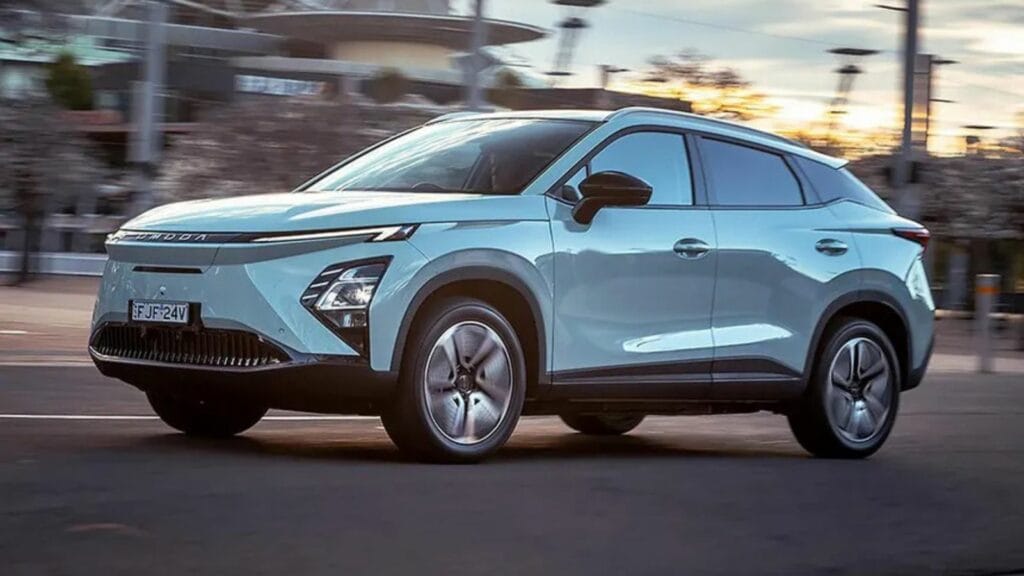
Chery’s newest compact electric vehicle is arriving with the kind of price that helps explain why Chinese automakers are attracting so much attention outside their home market. The Chery Q recently launched in Indonesia at a promotional starting price of Rp239.9 million, a sub-US$15,000-equivalent price point depending on exchange rates, while offering the equipment and usable range expected from a modern urban EV.
The timing matters for Canada. Chery has been meeting Canadian dealers, testing vehicles in Canadian conditions and working toward sales as early as the fourth quarter of 2026. The Chery Q itself has not been confirmed for Canada, but its launch illustrates the affordability and product strategy that Chery could eventually bring to a market where EV pricing remains a major consideration.
The Chery Q Lands With a Headline-Grabbing Price
Chery formally launched the Q at the GAIKINDO Indonesia International Auto Show at the end of July, offering two versions called Pure and Rizz. The Pure received a promotional on-the-road Jakarta price of Rp239.9 million, while the Rizz was offered at Rp259.9 million during the launch campaign. Those temporary prices were below the vehicles’ regular listed prices of Rp249.9 million and Rp269.9 million, respectively. The US$14,300 figure attached to the cheaper model should therefore be viewed as an approximate currency conversion rather than a universal sticker price, since exchange rates can move considerably.
That distinction becomes particularly important when considering Canada. An inexpensive car in Indonesia cannot simply be converted into Canadian dollars and assumed to cost the same in a Canadian showroom. Freight, federal duties, certification work, equipment requirements, distribution and dealer costs all affect the final number. Still, the underlying price demonstrates what Chery can achieve in a highly competitive Asian EV market, and that cost base is precisely what makes Chinese manufacturers increasingly important to watch.
Small EV Pricing Does Not Mean a Bare-Bones Specification
The Q is positioned as a compact electric car, but Chery has avoided treating low price as an excuse for an extremely stripped-down specification. Indonesian-market versions use a 42.7-kWh battery and are rated for up to 400 kilometres under the more generous NEDC testing procedure. Chery also advertises DC charging from 30% to 80% in 16.5 minutes. The Pure version is rear-wheel drive, an unusual configuration in the inexpensive urban hatchback segment, while the vehicle also supports vehicle-to-load functionality rated at 6.6 kW.
The equipment list becomes more ambitious farther up the range. Chery advertises a 15.6-inch infotainment display, a powered front storage compartment on higher versions, six airbags and a body structure containing 82% high-strength steel. The Rizz can be equipped with as many as 20 advanced driver-assistance functions, a 540-degree camera system and autonomous parking assistance. Chery also claims up to 1,520 litres of total cargo capacity depending on configuration. These are specifications Canadians increasingly associate with more expensive vehicles, not entry-level EVs.
Chery Has Global Scale Behind Its Low-Cost EV Strategy
The Q is not an experiment from a small manufacturer trying to establish itself. Chery has developed into one of China’s largest internationally focused automakers and, according to Reuters, is the country’s leading automotive exporter. Chery Group reported worldwide sales of approximately 2.81 million vehicles in 2025, including about 1.34 million exports. The company subsequently set a target of 3.2 million vehicle sales for 2026, roughly 14% above its previous-year result.
That export experience matters because entering Canada requires considerably more than loading inexpensive cars onto a ship. Chery already operates across Europe, Latin America, the Middle East and Asia, giving the company experience adapting vehicles, brands and dealer structures for different regulatory environments. Its portfolio also stretches well beyond small battery-electric cars. Chery sells conventional gasoline vehicles, hybrids and plug-in hybrids and operates multiple brands, including Omoda and Jaecoo. At its 2026 international summit, the company said it intends to launch 13 major new models during 2026 and 2027, covering several powertrain and vehicle categories.
Chery’s Canadian Plans Have Moved Beyond Simple Speculation
Canada is already part of that international expansion effort. Reuters reported in June that Chery began meeting Canadian automobile dealers shortly after Canada announced its new arrangement governing Chinese EV imports. Around 20 Canadian dealership representatives later attended the Beijing auto show and visited Chery’s headquarters in Wuhu, where the automaker discussed its product portfolio and potential Canadian business. Canadian automotive reporting has indicated that Chery could initially concentrate on only one or two models rather than attempting a full-line launch immediately.
More significantly, company officials told Reuters that Chery has been road-testing vehicles in Canada to understand how the country’s cold climate could affect warranty costs. The company was targeting a fourth-quarter 2026 sales launch, although that timetable remains subject to regulatory approvals and other conditions. Canadian winter validation is a practical detail with real consequences. Batteries, heating systems, charging performance and mechanical components face very different conditions in a February morning in Ontario or Quebec than they do in southern China or Indonesia. Chery appears to understand that competing on price will mean little if the ownership experience is not ready for Canada.
Ottawa Has Opened the Door to Chinese EVs — But Only Partway
Chery’s Canadian opportunity changed materially on March 1, 2026. Canada removed the previous 100% surtax on qualifying Chinese electric vehicles and introduced an initial annual quota allowing 49,000 Chinese EVs to enter at the normal 6.1% most-favoured-nation tariff. The federal government says that quota will increase by 6.5% annually. The system represents a significant reopening of the Canadian market, but it is far from unrestricted access for Chinese manufacturers.
There is also an affordability mechanism built into the longer-term framework. Beginning in the second year, a portion of the quota is intended to be reserved for vehicles with a free-on-board value of C$35,000 or less, with that share scheduled to rise to 50% by year five. Free-on-board value is not the same thing as a Canadian retail price, but the policy clearly creates room for lower-cost vehicles. A product developed around Chery Q economics could therefore become strategically interesting. That does not mean the Q will receive Canadian certification or quota allocation; it simply shows why inexpensive Chinese EVs fit closely with the direction of the new trade framework.
Affordable EVs Are Arriving as Canadian Demand Tries to Recover
The affordability question is especially relevant after a difficult year for Canadian electric-vehicle sales. Statistics Canada reported that new zero-emission vehicle registrations fell 34.7% in 2025 compared with 2024. ZEVs represented 9.5% of all new registrations during the year, down sharply from 14.6% in 2024. The agency noted that rebate changes were an important part of the market shift, including the pause in the federal incentive program and changes to provincial support.
There were signs of improvement as 2026 began. In the first quarter, battery-electric vehicle registrations increased 12.9% compared with a year earlier, while plug-in hybrid registrations climbed 22.9%, even as total new-vehicle registrations fell 6.9%. That does not automatically mean Canada is heading toward another EV boom, but it highlights why pricing could become increasingly influential. A Canadian buyer comparing monthly payments may care less about which manufacturer won the global EV sales race than whether a practical electric crossover or hatchback can fit comfortably into the household budget without relying on a large government rebate.
The Biggest Question Is Which Chery Canadians Will Actually Get
For all the attention generated by the Q’s price, there is currently an important dividing line between Chery’s global products and its Canadian plans: the company has not confirmed the Chery Q as a Canadian-market vehicle. Earlier Canadian reporting indicated that Chery was likely to begin with only one or two models from one of its brands. Until the company publishes Canadian specifications, certification, pricing and dealership information, importing the Indonesian-market Q should not be treated as a simple alternative for Canadian consumers.
Transport Canada requires vehicles manufactured or imported for Canadian sale to comply with the Canada Motor Vehicle Safety Standards, and foreign manufacturers must provide certification documentation and demonstrate recall capabilities through the applicable import process. Chery therefore has regulatory work to complete alongside its dealer and service preparations. That makes the next announcements more important than the overseas sticker price alone. Canadians should watch for the identity of Chery’s first models, their official range ratings, charging standards, winter specifications, warranty terms, dealer locations and Canadian MSRP. If Chery can preserve even part of its overseas value advantage after meeting those requirements, its Canadian arrival could become a significant new test for the established auto industry.
