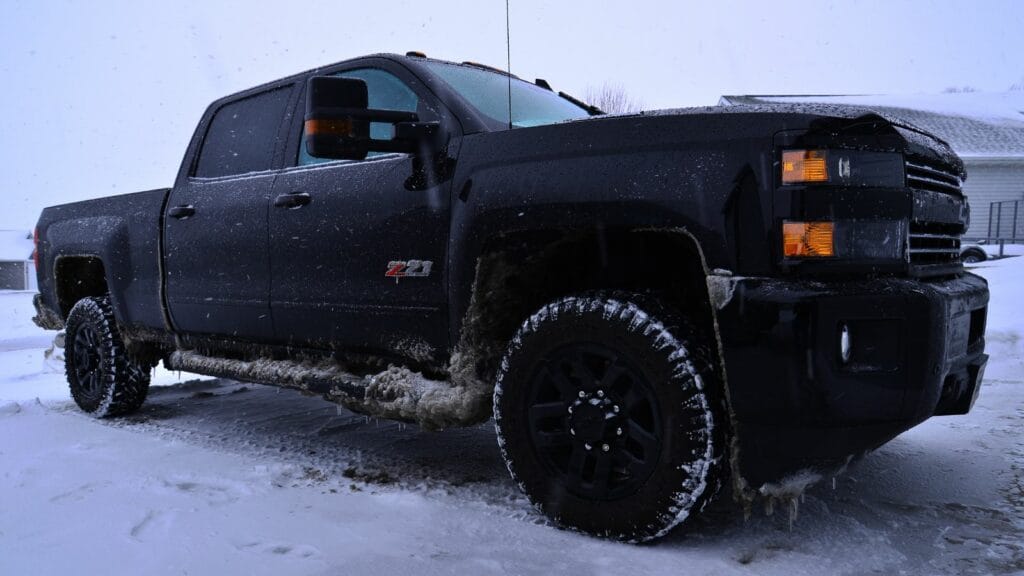
The next Chevrolet Silverado HD is beginning to take shape on the production calendar just as North America’s truck business becomes tangled in another round of trade friction. GM Authority reported on August 23 that production of the 2027 Silverado HD is currently scheduled to begin in November 2026, although the dates remain tentative rather than a formal public commitment from General Motors. The timing matters beyond dealerships and order books. Heavy-duty pickups are built inside a deeply integrated Canada-U.S. manufacturing system that now operates under special American Section 232 tariffs on imported medium- and heavy-duty vehicles. With Washington and Ottawa also escalating a broader tariff confrontation in August, the Silverado HD offers a useful example of how an ordinary model-year transition can become inseparable from trade policy.
A Staggered November Launch Comes Into View
GM Authority reports that General Motors’ current production schedule calls for 2027 Chevrolet Silverado HD ordering to open on September 17, 2026. Production would then begin in stages rather than on a single date. Crew Cab trucks are presently scheduled to reach start of regular production on November 16, Double Cab models on November 23 and Regular Cab versions on November 30. Those dates remain tentative and could change as GM adjusts factory schedules, supplier availability and other production requirements.
That staggered approach matters because Silverado HD serves several very different buyers. Crew Cabs are common among consumers and businesses that need passenger space as well as towing capability, while Regular Cab configurations can be especially important to commercial fleets and upfitters. A week or two in production timing can therefore affect when different customers begin seeing 2027-model trucks move through the distribution pipeline. The schedule also provides dealers with a clearer planning window before year-end. Still, the distinction between a reported production plan and an official GM launch announcement is important: the November calendar represents the best current information, not a guarantee that every configuration will start exactly on those dates.
The 2027 HD Is Not the Silverado Redesign Arriving Beside It
The 2027 model year could create some understandable confusion because Chevrolet’s light-duty and heavy-duty Silverados are not moving through their product cycles at the same pace. General Motors has officially announced an all-new, next-generation 2027 Silverado 1500, with sales expected to begin toward the end of 2026. The light-duty truck receives significant changes, including a new electrical architecture, redesigned styling and new 5.7-litre and 6.6-litre V8 engines as part of GM’s next generation of full-size pickups.
The Silverado HD story is different. GM Authority expects the 2027 heavy-duty model to remain largely a continuation of the existing truck rather than undergo a comparable redesign. The publication currently expects the next-generation Silverado HD to arrive later, for the 2029 model year. That separation is meaningful for buyers who may see “2027 Silverado” announcements and assume every version is being overhauled simultaneously. It also lowers the likelihood that November’s HD transition will require dealers and fleet operators to learn an entirely new truck. Until Chevrolet publishes final 2027 HD specifications, however, the safest description is that a mostly carryover model is expected—not that every feature, trim or powertrain has already been confirmed unchanged.
The Existing Silverado HD Formula Remains Formidable
The current Silverado HD provides a strong indication of the mechanical formula Chevrolet is carrying into this transition. For the 2026 model, the available 6.6-litre Duramax turbo-diesel V8 produces 470 horsepower and 975 lb-ft of torque and is paired with an Allison 10-speed automatic transmission. Properly configured, Chevrolet rates the Silverado HD for maximum available trailering capacity of up to 36,000 pounds. The standard 6.6-litre gasoline V8 produces 401 horsepower and 464 lb-ft of torque, also using a 10-speed Allison transmission, with maximum available towing of more than 19,000 pounds.
Those numbers help explain why an apparently routine model-year production date attracts attention well beyond recreational truck buyers. Silverado HDs are used for construction trailers, farm equipment, commercial hauling, snow-removal work and large recreational trailers, making payload, towing and delivery timing practical business concerns. Chevrolet also offers extensive trailering technology on the current truck, including as many as 14 available camera views using up to eight cameras. None of those 2026 figures should automatically be treated as finalized 2027 specifications, but they establish the performance baseline against which any later changes will be judged.
Flint and Oshawa Put Silverado in the Middle of a Cross-Border Supply Chain
Heavy-duty Silverado production illustrates how difficult it is to divide the North American auto industry neatly along a border. GM’s Flint Assembly plant in Michigan builds Chevrolet Silverado HD and GMC Sierra HD pickups. At the same time, GM’s Oshawa Assembly operation in Ontario produces both light-duty and heavy-duty Chevrolet Silverados, making the Canadian plant an important part of the company’s full-size truck footprint. Oshawa has produced more than 500,000 Silverado pickups since vehicle production restarted there in November 2021.
GM has continued investing in that Canadian footprint rather than treating Oshawa as a temporary source of capacity. In June 2026, the automaker said it was preparing the plant for future next-generation gasoline-powered full-size trucks with a C$343-million investment. GM also said it had invested approximately C$3.3 billion in its Canadian operations since 2020, including about C$1.5 billion at Oshawa. That industrial integration creates the central tariff dilemma: trucks carrying the same Chevrolet badge can emerge from factories on opposite sides of the border, while components and materials may cross the border during production. Trade rules therefore influence costs according to where a vehicle and its content originate, not simply the nationality of the brand on the grille.
Heavy-Duty Pickups Already Face a Special 25 Percent U.S. Tariff Regime
The most important tariff affecting Canadian-built heavy trucks did not begin with the latest August confrontation. Washington imposed a 25 percent Section 232 tariff on imported medium- and heavy-duty vehicles beginning November 1, 2025. The White House defined the affected category broadly enough to include Class 3 through Class 8 vehicles, including large pickup trucks. Canadian government briefing material subsequently confirmed that Canadian-made medium- and heavy-duty vehicles became subject to the U.S. measure.
There is an important qualification. For vehicles that qualify for preferential treatment under the Canada-U.S.-Mexico Agreement, the United States allows the 25 percent tariff to be calculated on the vehicle’s non-U.S. content after the required documentation and approval. Washington also established an import-adjustment offset for manufacturers assembling qualifying medium- and heavy-duty vehicles in the United States, valued at 3.75 percent of the aggregate manufacturer suggested retail price of eligible U.S.-assembled vehicles through October 2030. As a result, describing every Canadian-built heavy truck as simply carrying a 25 percent charge on its entire value can be misleading. Actual exposure depends on origin, qualifying content and the applicable customs treatment.
The New 50 Percent Canada Tariff Is a Separate Fight
Washington’s August 2026 escalation added another layer, but it should not be confused with the heavy-truck tariff. President Donald Trump’s Section 338 action imposed a 50 percent additional duty on specified Canadian goods, with the effective date ultimately moved to August 22. The presidential proclamation, however, explicitly excludes products already subject to Section 232 tariffs. That distinction means a heavy-duty vehicle already covered by the medium- and heavy-truck Section 232 regime is not automatically charged the new 50 percent Section 338 duty on top of its existing vehicle tariff.
The political impact is nevertheless broader than the customs classification of one pickup. Prime Minister Mark Carney said on August 21 that negotiations had been suspended after Washington made what Canada described as last-minute changes to a potential agreement. Ottawa estimated the new U.S. measures would affect roughly C$28 billion of Canadian exports. Canada then announced additional retaliatory tariffs scheduled to take effect September 8, targeting categories including steel, appliances, agricultural equipment, pulp and paper, electronics and other American goods. For manufacturers with factories, suppliers and customers on both sides of the border, escalating measures in adjacent industries can affect investment calculations even when a specific vehicle is governed by a different tariff provision.
GM Is Planning Through a Trade Conflict It Cannot Ignore
General Motors has repeatedly emphasized the importance of an integrated North American market. GM Canada president Jack Uppal said in July that CUSMA remained important to maintaining a stronger, integrated continental auto industry. That position reflects the reality of GM’s manufacturing footprint: vehicles assembled in Ontario and Michigan depend on a production ecosystem that developed around comparatively open cross-border trade rather than isolated national supply chains.
The financial pressure is no longer theoretical. Reuters reported in August that GM expected its 2026 tariff-related expenses to total roughly US$2.5 billion to US$3.5 billion. Before the latest Canada-U.S. negotiations broke down, discussions had reportedly included reducing U.S. tariffs on Canadian-made automobiles from 25 percent to 15 percent, while Canada sought a lower rate and more generous treatment of North American content. Those talks did not produce a final settlement. Against that backdrop, the 2027 Silverado HD production schedule looks less like an isolated factory milestone and more like another planning deadline arriving while the rules governing cross-border manufacturing remain unsettled.
What Dealers and Heavy-Duty Buyers Should Watch Before November
The next meaningful dates are likely to arrive before the first 2027 Silverado HD leaves the production line. If the current schedule holds, order banks are expected to open September 17, giving dealers and customers their first clearer view of available configurations. Final Canadian and U.S. pricing, detailed equipment changes and official 2027 specifications will matter more than assumptions based solely on the outgoing truck. The reported November 16, 23 and 30 production dates should likewise be treated as planning markers until GM confirms or begins executing them.
Trade policy will remain a second variable. A Canadian-built Silverado HD can face a different U.S. tariff calculation from a U.S.-assembled truck because the Section 232 system considers origin and, for qualifying CUSMA vehicles, non-U.S. content. At the same time, the wider Canada-U.S. dispute can influence components, materials, investment and consumer prices beyond the truck-specific duty itself. For fleet operators trying to budget months ahead, that leaves two calendars to follow: Chevrolet’s model-year transition and a political trade timetable that has been changing far faster than the Silverado HD itself.
