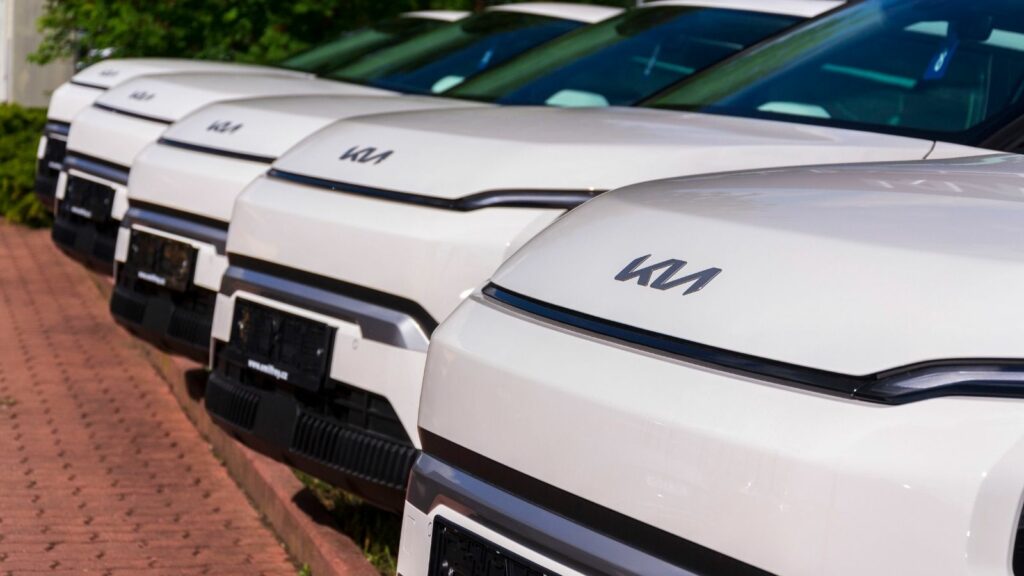
Kia’s electric-vehicle ambitions are moving beyond passenger cars and into a part of the market where practicality matters more than acceleration times or oversized touchscreens. The company has released its first official teaser of the PV7, a larger all-electric van designed to expand its Platform Beyond Vehicle, or PBV, business into heavier-duty commercial and multi-purpose roles.
The PV7 will make its global debut at IAA Transportation in Hannover, Germany, on September 14, 2026. Kia has confirmed that it will be larger and more capable than the existing PV5, but important details—including battery capacity, driving range, payload and pricing—remain under wraps. For Canadian businesses, the reveal is particularly interesting because the smaller PV5 is already scheduled for Canada. So far, however, Kia has made no equivalent Canadian announcement for the PV7.
The PV7 Is Kia’s Next Step Beyond the PV5
Kia describes the PV7 as the second dedicated model in its all-electric PBV family. The teaser released August 31 shows a substantially larger one-box vehicle with a high roofline, upright proportions and a design clearly related to the smaller PV5. Black trim around the hood and pillars provides visual contrast, while distinctive front and rear lighting helps establish a common PBV identity. Kia says the extra size is intended to provide more space and capability for business customers.
That places the PV7 in a strategically important position. The PV5 was created for jobs such as urban deliveries, service businesses and passenger transport, while the PV7 can move Kia into applications requiring more volume, more seats or larger equipment. The company has previously identified logistics companies, shuttle operators, contract drivers and small businesses among the potential customers for the larger platform. Instead of treating vans as a side business, Kia is building them into a dedicated product family.
September’s Debut Should Answer the Biggest Questions
The teaser is deliberately short on technical information. Kia has not yet published the PV7’s battery capacity, motor output, official driving range, charging performance, cargo capacity or payload. Even its final exterior dimensions remain undisclosed. Those omissions matter because commercial operators normally evaluate vans differently from private-car buyers. Every kilogram of payload, kilometre of usable range and minute spent charging can affect whether a vehicle earns or loses money during a working day.
More information should arrive on September 14, when the PV7 makes its world premiere during the press day at IAA Transportation 2026 in Hannover. The public portion of the major commercial-vehicle show runs from September 15 through September 20. Kia also plans to display multiple PV5 derivatives there, emphasizing how one dedicated electric architecture can be adapted for different commercial jobs. Until that presentation, any precise PV7 range, battery or performance number circulating outside Kia should be treated as unconfirmed.
A Dedicated EV Platform Gives Kia More Freedom
Underneath the PV7 is E-GMP.S, Kia’s dedicated architecture for its PBV range. The platform is designed around commercial and specialized vehicles rather than adapting a conventional gasoline van to carry batteries. That distinction can influence everything from floor height and interior packaging to conversion possibilities. Kia’s broader PBV strategy emphasizes modular bodies, flexible configurations and software services that can be tailored to the needs of fleet and business customers.
The approach is already visible in the PV5. Kia has developed Cargo, Passenger and Chassis Cab versions and has outlined specialized conversions ranging from campers and crew vehicles to freezer boxes. At its 2026 Investor Day, the automaker said it ultimately intends to offer more than 40 different PBV body types across the family. The larger PV7 provides another platform on which that strategy can expand, potentially allowing Kia to compete for jobs that simply require more interior volume than the PV5 can provide.
The PV5 Provides a Useful Preview for Canada
Canada will soon get its first real-world look at Kia’s PBV strategy. Kia Canada has confirmed that the 2027 PV5 Cargo is scheduled to arrive during the fourth quarter of 2026, with a starting MSRP of $46,995. The Canadian model uses a 71.2-kWh long-range battery and is advertised with as much as 5,016 litres, or 177 cubic feet, of cargo volume. It also uses the NACS charging connection increasingly common across the North American EV market.
The PV5 therefore becomes more than a new electric van; it effectively serves as Kia’s opening move in the Canadian commercial-vehicle business. Its reception among couriers, contractors, service companies and other fleets could help shape the case for bringing additional PBVs here. The PV7 would logically occupy the next size category, but Kia has not said that a successful PV5 launch automatically guarantees a Canadian PV7. Product planning, pricing and regulatory requirements will still matter.
Kia Is Avoiding Premature Range Claims
One of the most significant things about the PV7 teaser is what Kia has not promised. There is currently no official PV7 range figure, and that prevents meaningful comparisons with existing electric vans. Bigger commercial vehicles require more energy to move, while payload, highway speeds, heating demand and cold weather can all affect day-to-day efficiency. A larger battery can compensate, but it can also increase weight and purchase price.
The PV5 offers a sense of Kia’s current technical baseline without revealing what the PV7 will ultimately deliver. In international specifications, PV5 variants are offered with 51.5-kWh and 71.2-kWh batteries, while long-range versions can achieve more than 400 kilometres under the WLTP testing cycle in certain configurations. Those figures should not simply be transferred to the larger PV7. Kia has designed the new van for a different size class, and the September reveal will be important precisely because commercial buyers need specifications rather than assumptions.
Electric Vans Are Becoming a Much Bigger Market
Kia’s timing is not accidental. Electric light-commercial vehicles remain a smaller market than electric passenger cars, but adoption is accelerating quickly. The International Energy Agency estimates that worldwide electric LCV sales exceeded 430,000 vehicles in 2025, an increase of roughly 45% from the previous year. Europe and China together represented about 80% of global volume, making them especially important battlegrounds for manufacturers developing purpose-built electric vans.
Europe alone recorded almost 200,000 electric LCV sales in 2025, up roughly 70% year over year, according to the IEA. Electric models accounted for about 10% of the region’s light-commercial market. That creates a meaningful opening for Kia, especially because Europe is one of the two regions—along with Korea—that the company has identified as central to its PBV strategy. The PV7 therefore arrives as fleet electrification is moving from experimental purchases toward increasingly serious commercial deployment.
Kia Already Has Momentum in the Van Business
Kia entered the dedicated electric-van market without the decades of commercial-vehicle history enjoyed by several European competitors, but the PV5 has provided an unusually strong start. In November 2025, the model was named the 2026 International Van of the Year. The 26-member jury selected it unanimously, making Kia the first Korean manufacturer to win the award.
Sales have also started to establish a meaningful customer base. Kia reported roughly 8,500 PV5 sales by the end of 2025 and set a target of 54,000 global units for 2026. Korean reporting accompanying the PV7 teaser put cumulative PV5 sales at approximately 39,000 units by August. Those numbers remain small compared with the global passenger-car business, but they matter for a manufacturer building an entirely new commercial-vehicle franchise. The PV7 will test whether that initial momentum can extend into a larger and more demanding van category.
Canada Could Offer a Different Business Case
Canadian fleet customers face operating conditions that can make an electric commercial van both attractive and challenging. Vehicles covering predictable urban routes can return to a depot every night, potentially allowing businesses to charge during off-hours instead of sending drivers to public stations. Electric drivetrains also eliminate tailpipe emissions and reduce several routine powertrain maintenance requirements associated with combustion engines.
Purchase price remains critical, however. Canada’s federal Electric Vehicle Affordability Program provides up to $5,000 in 2026 for qualifying new light-duty EVs meeting the program’s transaction-price and origin rules. Transport Canada currently lists eligible versions of the 2027 Kia PV5, and Kia Canada highlights the incentive in its PV5 pricing announcement. Nothing equivalent has been confirmed for the PV7. Depending on its classification, price and eventual configuration, the larger van could face a very different incentive calculation. Fleets will therefore need Canadian specifications before a realistic total-cost comparison is possible.
The PV7 Is Part of a Much Larger Kia Bet
The PV7 is not being developed as an isolated experiment. Kia has established an ambitious PBV roadmap stretching through the end of the decade. The PV5 launched first, the PV7 is scheduled to launch in 2027, and an even larger PV9 is planned for 2029. Kia says these models will form a broad family covering passenger transport, cargo, specialized conversions and other commercial mobility requirements.
The financial targets show how important the business has become. Kia is aiming for 232,000 annual PBV sales by 2030 as part of a broader strategy targeting 4.13 million total vehicle sales worldwide. The company is also using a dedicated production hub at its Hwaseong EVO Plant in South Korea and is integrating its PBV strategy with software-defined vehicles, charging services, autonomous-driving development and even future robotic delivery systems. In that context, the PV7 represents the middle step in a commercial ecosystem Kia expects to scale well beyond conventional vans.
Canada Remains the Question Mark
For Canadian buyers, the most important fact is also the simplest: Kia has not announced the PV7 for Canada. Kia Canada has an active PV5 product page, has published Canadian PV5 pricing and has confirmed a Q4 2026 arrival. No corresponding Canadian PV7 launch announcement, pricing statement or timing has been issued as of September 1, 2026. The absence of an announcement should not be interpreted as a rejection of the market, but it means a Canadian launch cannot yet be treated as confirmed.
The September 14 world premiere may clarify how broadly Kia intends to distribute the van when sales begin in 2027. Battery specifications, charging performance, payload, dimensions and body variants will also reveal whether the PV7 is positioned primarily for European fleets or built with broader global ambitions. Canada’s upcoming PV5 launch gives Kia a foothold in the commercial-EV market here. Whether the larger PV7 eventually follows may depend on what businesses make of that first step.
