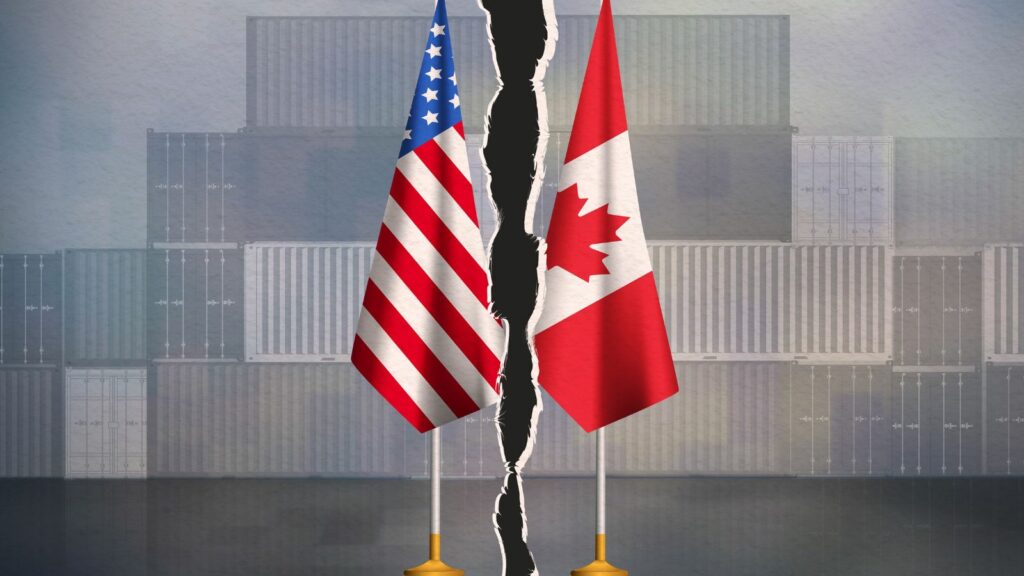
Canada’s auto industry is confronting a problem that does not stop at the border. On September 9, the Canadian dollar weakened to 72.44 U.S. cents as the escalating Canada–U.S. trade conflict outweighed support from higher oil prices. For an industry built around parts, vehicles and equipment moving through deeply integrated North American supply chains, a softer currency creates another potential layer of expense.
The pressure comes at an awkward moment. Canadian manufacturers are already navigating U.S. automotive tariffs, Canadian countermeasures and rapidly changing trade rules. A weaker loonie can make U.S.-priced components and equipment more expensive in Canadian-dollar terms, even as tariffs threaten access to the American market. That combination is turning exchange rates from a financial-market story into another operational concern for assemblers, suppliers, dealers and ultimately vehicle buyers.
The Loonie’s Drop Shows How Quickly Trade Anxiety Can Reach Currency Markets
The Canadian dollar traded around C$1.3805 per U.S. dollar on September 9, equivalent to 72.44 U.S. cents. It was down about 0.2% during the session and had moved between C$1.3767 and C$1.3820. Just one day earlier, the loonie had strengthened to roughly 72.52 U.S. cents as investors focused more heavily on higher oil prices. The reversal illustrated how quickly trade headlines can overpower other forces traditionally supportive of Canada’s currency.
That matters because Canada is normally considered a commodity-sensitive economy. Higher crude prices can strengthen the country’s terms of trade and sometimes provide support for the dollar. This time, that relationship was not enough. RBC Capital Markets pointed to the latest retaliatory trade measures as a drag on short-term Canadian-dollar sentiment. The movement itself was hardly a currency crisis, but the reason behind it matters. Persistent trade uncertainty can influence investment flows, expectations for Canadian growth and the relative attractiveness of holding Canadian assets, keeping the loonie vulnerable even when other economic signals appear favourable.
A Weaker Canadian Dollar Can Turn Ordinary U.S. Purchases Into Higher Costs
For Canadian manufacturers, exchange rates matter long before a completed vehicle reaches a showroom. Components, specialized machinery, software, tooling and other inputs purchased in U.S. dollars become more expensive in Canadian-dollar terms when the loonie weakens, unless a company is protected by hedging arrangements or has negotiated prices in Canadian currency. The Bank of Canada has repeatedly identified currency depreciation as a mechanism that raises the price of imports and imported production inputs.
The effect is not necessarily immediate or uniform. Suppliers can absorb part of a currency move in their margins, buyers can negotiate contracts, and larger corporations often manage foreign-exchange exposure. Still, those protections do not eliminate the economic pressure indefinitely. Bank of Canada research describes exchange-rate pass-through as a process in which currency movements first affect import prices and can later influence consumer prices. Canadian businesses surveyed during the trade conflict have similarly reported that currency depreciation has made imported goods more expensive. For an auto industry with substantial U.S. sourcing, that makes the value of the loonie part of day-to-day cost management rather than an abstract financial indicator.
Few Canadian Industries Are More Exposed to the U.S. Relationship
Canada’s automotive sector is unusually tied to the American economy. Statistics Canada found that 94.1% of the C$80.3 billion in Canadian domestic exports of motor vehicles and parts in 2024 went to the United States. On the import side, motor vehicles and parts were worth C$141.6 billion that year, with goods of U.S. origin accounting for 57.9%. Those numbers illustrate why simultaneous currency and tariff pressures are particularly difficult for automotive manufacturers to escape.
The industrial footprint is substantial. Innovation, Science and Economic Development Canada says the automotive industry contributed C$16.8 billion to GDP in 2024 and directly employed more than 125,000 people. Five major automakers—Ford, General Motors, Honda, Stellantis and Toyota—assembled more than 1.31 million light-duty vehicles in Canadian plants that year. Those factories are supported by nearly 700 parts suppliers. A shift in the cost of American components therefore does not affect only multinational assembly plants. It can flow through businesses producing everything from stamped metal and powertrain components to moulds, electronics and specialized manufacturing equipment across Ontario and other parts of Canada.
Tariffs Are Now Layering Additional Risk Onto the Currency Problem
The exchange-rate pressure is arriving after more than a year of automotive tariff disruption. Since April 2025, Canadian-made vehicles have faced a 25% U.S. tariff on their non-U.S. content, while the value of U.S. content in qualifying CUSMA-compliant vehicles has been exempt under that measure. Washington subsequently escalated its dispute with Canada, using Section 338 of the U.S. Tariff Act to impose additional 50% duties on specified Canadian products connected to the automotive dispute.
The rules have continued changing. A September 8 U.S. proclamation modified the products covered by the Section 338 action and stated that the applicable 50% duties would be imposed in addition to Section 232 duties on affected products beginning September 15. Canada, meanwhile, put new counter-tariffs of 15%, 25% and 50% on C$27.6 billion of U.S. imports into effect on September 8, while maintaining existing counter-tariffs on American automobiles. That creates a challenging environment for companies trying to price contracts months ahead. The risk is not simply one tariff rate, but overlapping policies, exemptions, remissions and changing effective dates.
Canada Was Importing Record Amounts of Vehicles and Parts Before the Latest Escalation
Recent trade data make the currency move especially relevant. Statistics Canada reported that imports of motor vehicles and parts jumped 11.4% in July to a record high. It was the fifth monthly increase during the first seven months of 2026, and the automotive category accounted for most of the increase in Canada’s overall merchandise imports that month. Passenger-car and light-truck imports alone climbed 19.8% on a seasonally adjusted basis.
Imports from the United States increased 1.8% in July, primarily because Canada brought in more passenger cars and light trucks. That occurred before September’s latest round of retaliatory measures and renewed currency weakness. High import volumes do not automatically translate into higher consumer prices, but they increase the amount of commerce exposed to exchange-rate changes. A Canadian distributor settling a U.S.-dollar invoice ultimately needs more Canadian dollars when the loonie depreciates. Automakers may offset that pressure through U.S.-dollar revenues, financial hedges or sourcing changes, but companies without equally large U.S.-dollar income streams can be more exposed. That makes the impact uneven across the industry.
Parts Suppliers Could Feel the Squeeze Before Vehicle Buyers Do
The assembly plant is only one piece of Canada’s automotive system. Nearly 700 parts suppliers support domestic vehicle production, and many participate in supply chains that stretch repeatedly across the Canada–U.S. border. The Bank of Canada has specifically used automobile manufacturing to demonstrate why tariffs on intermediate goods are potentially damaging: parts and components can cross the border several times during production, meaning trade barriers imposed at multiple stages can compound manufacturing costs.
Currency weakness creates a parallel problem. Even where a component is not directly hit with a new Canadian tariff, a U.S.-dollar price can become more expensive after conversion into Canadian currency. Companies then have several imperfect choices. They can absorb the increase and accept lower margins, negotiate with customers, raise prices, find an alternative supplier or redesign the sourcing chain. The Bank of Canada has warned more broadly that lower Canadian-dollar values and tariffs can raise import costs and constrain profit margins, while trade uncertainty can discourage investment. For a smaller parts manufacturer operating on tight automotive contracts, prolonged rather than temporary currency weakness is therefore the more consequential risk.
Consumers May Not See the Full Cost Increase Immediately
Higher tariffs and currency-related import costs do not necessarily appear instantly on a vehicle’s window sticker. Manufacturers, importers and dealers can initially absorb some increases, use inventory acquired under earlier exchange rates or adjust incentives rather than change headline prices. Competition and weak demand can also limit how much additional cost a business is able to pass through. That delay can make the initial effects of a trade dispute look smaller than the ultimate economic impact.
Recent Bank of Canada research provides a useful Canadian example, although it covered a broad range of retail products rather than automobiles specifically. Researchers examining Canada’s 2025 counter-tariffs found that prices for affected goods rose about 6% relative to untariffed goods after roughly three months. That represented approximately one-quarter of the 25% tariff rate. The research also found that pricing behaviour depended partly on how long businesses expected tariffs to remain. The lesson for automobiles is not that vehicles will follow the same percentage pattern, but that sustained policy uncertainty matters. Companies become more likely to reconsider pricing when temporary costs begin looking permanent.
Ottawa Is Using Tariff Relief to Keep Production and Investment in Canada
The federal government has already built relief mechanisms around the automotive trade dispute. Canadian-based automakers can receive remission from certain automotive counter-tariffs when they meet production and investment commitments in Canada. Under the framework, qualifying manufacturers have been allowed to import a defined volume of U.S.-assembled vehicles without paying Canadian counter-tariffs, provided they maintain required Canadian production levels and follow through on planned investments.
Ottawa spent part of 2026 consulting on changes intended to make that framework a stronger incentive for domestic manufacturing. The broader strategy is straightforward: rather than providing unconditional tariff relief, the government wants access to relief connected to production, jobs and investment in Canada. More recently, the federal government announced a C$7.5 billion package of new and enhanced support measures for workers and companies affected by U.S. tariffs, including additional resources for businesses facing liquidity pressures. These policies can soften parts of the trade shock, but they cannot directly control the Canadian dollar. That leaves manufacturers managing two related but distinct variables—government trade policy and financial-market pricing.
Diversifying Auto Trade Is Much Harder Than Diversifying Some Other Exports
Canada has made measurable progress selling more goods outside the United States. In July, merchandise exports to non-U.S. destinations increased 7.4% to a record C$25.6 billion, representing 33.7% of Canadian exports that month. Greater shipments to markets including the Netherlands, China and Germany helped drive that gain. Those numbers demonstrate that trade diversification is possible at the national level.
Automobiles are a tougher case. More than 90% of Canadian-made vehicles and roughly 60% of Canadian-made auto parts are currently exported to the United States, according to the federal government. Assembly plants have been designed around North American vehicle programs, supplier networks and distribution systems rather than a collection of interchangeable global markets. Ottawa’s automotive strategy includes efforts to deepen partnerships outside the United States and attract new investment, but replacing the American market would require far more than redirecting containers to another port. Vehicle specifications, consumer preferences, transportation costs, production allocations and dealer networks all matter. Diversification may reduce future vulnerability, but it cannot quickly duplicate the scale and proximity of the U.S. market.
The Biggest Question Is Whether the Trade Shock Becomes Permanent
Currency forecasters were already treating trade relations as the central uncertainty before the newest escalation. A Reuters poll of 32 foreign-exchange analysts conducted from August 31 to September 2 produced a median forecast of C$1.39 per U.S. dollar in three months, followed by an improvement to C$1.36 over a year. That longer-term recovery depended heavily on expectations that Canada–U.S. trade tensions would eventually fade. Developments since the poll underline how quickly that assumption can be challenged.
The Bank of Canada’s July outlook had separately assumed the Canadian dollar would average around 71 U.S. cents over its projection horizon, illustrating that a currency in the low-70-cent range was already embedded in policymakers’ economic assumptions. The larger danger for autos is therefore not one day at 72.44 cents. It is the possibility of prolonged currency weakness combined with escalating trade barriers. Washington has already announced that certain Canadian products covered by its automotive dispute will be barred from import beginning September 29. If restrictions deepen, the sector could face higher input costs at home while confronting reduced market access abroad. If tensions ease, both trade costs and currency sentiment could improve much more quickly.
