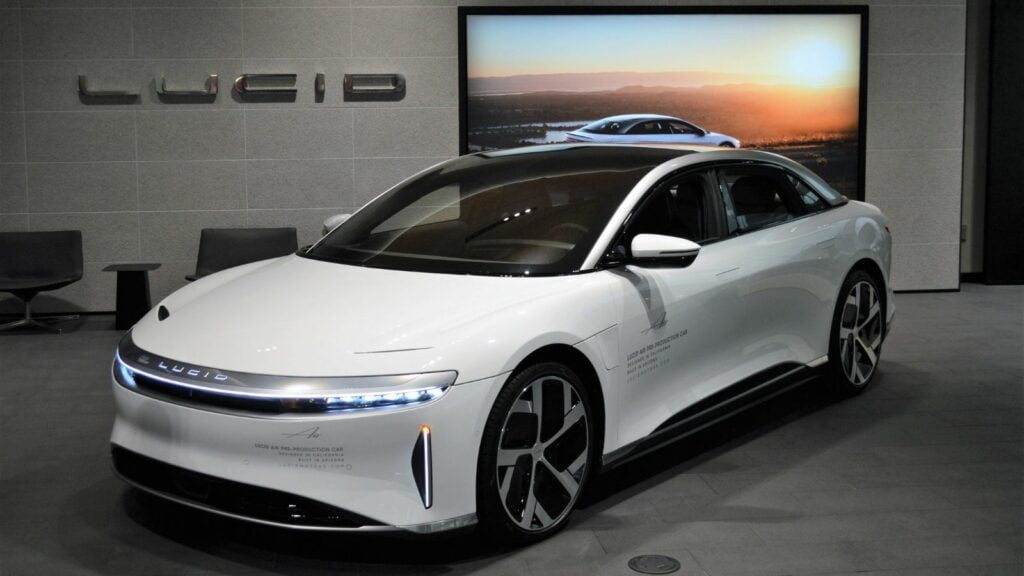
Lucid’s latest software push is arriving in Canada with a split experience for owners. Air UX 3.0, released as part of Software Version 2.11.0 on September 29, 2026, brings a substantially redesigned interface, smarter EV routing, broader smartphone integration and more flexible use of the sedan’s multiple displays. Model-year 2025 and newer Airs can receive it over the air, while 2022, 2023 and some 2024 cars need an infotainment hardware upgrade priced at C$1,366 before tax. The new system is standard on the 2027 Air.
For Canadian owners, that makes this more than another routine download. It is a major refresh that also draws a clear line between Airs with newer computing hardware and earlier vehicles that need a physical retrofit.
Air UX 3.0 Brings the Gravity’s Interface to the Air
Air UX 3.0 is Lucid’s biggest rethink of the Air’s cabin software in years, borrowing heavily from the interface developed for the Gravity SUV. Lucid says the package delivers more responsive displays, faster performance, improved multitasking and revised navigation, media and profile functions. The company has also reworked how the Cockpit Panel and lower Pilot Panel interact, rather than simply changing fonts or graphics. That matters in the Air because so much of the vehicle’s daily operation runs through its screens, from navigation and media to charging information and vehicle settings. The update is therefore designed to change the rhythm of everyday use, not just the way the dashboard looks when the car starts.
The rollout began September 29 as part of Software Version 2.11.0. Eligible owners who install that software receive the Air UX 3.0 experience automatically, while the 2027 Lucid Air leaves the factory with it as standard equipment. Lucid says availability and functionality can still vary by vehicle configuration, model year, market and connected services, an important qualifier for owners comparing notes online. The broader design also reflects work first introduced in the Gravity, whose interface Lucid used as the foundation for this Air refresh. In practical terms, the sedan is being brought closer to the company’s newer digital architecture without requiring a new vehicle—provided the Air already has compatible infotainment hardware.
The C$1,366 Charge Applies to the Older Infotainment Hardware
The biggest catch for early Canadian Air owners is the processor requirement. Lucid states that model-year 2022, 2023 and some 2024 Air vehicles need a hardware upgrade before Air UX 3.0 can be enabled. In Canada, that upgrade is listed at C$1,366 before applicable taxes. The distinction around 2024 cars is important: Lucid told InsideEVs that the company moved to its second-generation infotainment processor partway through that model year, which is why some 2024 vehicles can support the software without the same retrofit while others cannot. That makes the vehicle’s actual hardware build more important than simply seeing “2024” on the registration.
Affected owners cannot solve the issue by waiting for a larger download. Lucid says they can schedule a service appointment to upgrade the infotainment system, and the company will provide more information directly about whether a particular vehicle needs the hardware change. The U.S. version of the retrofit is described as a US$950 processor upgrade, including installation and excluding taxes, but Lucid’s Canadian page separately lists the Canadian hardware price at C$1,366 before tax. For an owner of an early Air, that difference between software eligibility and hardware eligibility is the key question. Two visually identical cars from the same broad model-year period may take different paths to the same UX 3.0 interface.
The Screens Are Designed to Work More Like a Coordinated System
One of the most visible changes is the Home experience on the cockpit display. Lucid keeps the familiar Home, Navigation, Media and Phone shortcuts in place, but adds swipeable cards for frequently used actions. Those cards can surface media controls, vehicle functions, calls, saved destinations and nearby charging options. A card can then be swiped down to open the full application on the lower Pilot Panel. The idea is to reduce the number of steps needed for common tasks while preserving enough continuity that drivers accustomed to Air UX 2.0 are not starting from zero. Lucid also adds a Quick Controls menu that appears by swiping down from the top of the Pilot Panel.
The more meaningful change may be what happens between the displays. Lucid says the revised architecture allows smoother movement among navigation, media, vehicle controls and apps without interrupting what was already happening on another screen. InsideEVs noted that the old arrangement more tightly linked the upper and lower screens, while UX 3.0 allows owners to use them more independently—for example, keeping navigation visible above while adjusting media below. That kind of change sounds small until it becomes part of a daily commute. Instead of replacing one task with another, the cabin can keep more than one function visible and active, which better matches how drivers actually use navigation, audio and vehicle controls at the same time.
EV Routing Gets More Useful for Canadian Road Trips
Navigation receives a substantial functional upgrade rather than a simple map redesign. Air UX 3.0 introduces a revised dual-screen navigation experience, Favourites and Auto Dark Mode, along with new EV-routing preferences. Drivers can tell the system to favour particular charging networks, include stations that require a Lucid-approved adapter and set a minimum amount of range they want remaining when they arrive. Those controls can be especially useful when a route crosses areas where charging options vary widely, because the system can be asked to plan around network preference and arrival buffer rather than treating every compatible charger as effectively interchangeable.
That capability fits with a charging network that has expanded for Air owners since the sedan first launched. Lucid says Air owners can access more than 23,500 Tesla Superchargers across North America with a Lucid-approved NACS-to-CCS adapter, although only compatible V3-and-newer Superchargers work with the Air. Lucid has also said Air charging on the Tesla network can reach up to 50 kW, so a driver may still prefer a different high-power network when time matters. Air UX 3.0’s routing filters make that trade-off easier to express directly in the car: network availability, adapter requirements and desired arrival range can all become part of the route plan instead of being managed separately.
CarPlay and Android Auto Get Much More Screen Space
Apple CarPlay and Android Auto are not new to the Lucid Air, but UX 3.0 changes how prominently they appear. Lucid says both experiences now extend across the full right side of the Cockpit Display, giving smartphone-projected navigation, calls, music, messages and other supported apps a larger working area. The company also says the update improves performance and reliability for both systems. Wireless and USB connections are supported, so owners are not being pushed into a single connection method. For drivers who spend most trips inside Apple Maps, Google Maps, Spotify, podcasts or messaging apps, the larger presentation may be one of the most immediately noticeable changes after the update.
The change also shows how far Lucid’s smartphone integration has evolved through software. Apple CarPlay was added to every Air through an over-the-air update in March 2023, with both wired and wireless support. By 2026, Lucid said Air sedans already came standard with both Apple CarPlay and Android Auto. Air UX 3.0 therefore is not introducing phone mirroring from scratch; it is giving those familiar services more space and integrating them into a more flexible multi-screen environment. That is a useful distinction for existing owners. The value of this update is less about gaining a missing app ecosystem and more about making the ecosystem they already use feel less constrained by the Air’s original screen layout.
Profiles, Guest Mode and Easy Entry Are More Personalized
Air UX 3.0 also spends considerable effort on features that are easy to overlook until several people share the same car. Lucid says driver profiles now switch faster, while the Primary profile gains more control over keys linked to other profiles. Guest profiles can be reset more easily, and leaving Guest mode now requires a PIN, helping keep Primary and Secondary profile information separated when another person borrows the vehicle. Lucid’s launch material also describes six-digit PIN authentication as part of the revised security flow. These are not headline-grabbing changes, but they can matter in a household where seat settings, keys, media preferences and driving profiles regularly change from one person to another.
Easy Entry & Exit has been revised as well. When the feature is enabled, the driver’s seat now moves relative to that driver’s saved seating position, rather than relying on a more generic movement. That should make the entry-and-exit behaviour feel more tailored to people of different heights and seating preferences. One trade-off is also worth noting: published Version 2.11.0 release notes reported by EV outlet Electric Vehicles indicate that Face Login is removed, with manual profile switching and PIN authentication remaining available. Lucid’s main launch announcement emphasizes the faster profile and PIN changes rather than the removal, so owners who regularly used facial recognition may notice that the new profile experience gains some controls while dropping that particular method.
The Upgrade Shows Both the Strength and Limit of a Software-Defined Car
Lucid has used over-the-air updates as a major part of the Air ownership model from the beginning. In October 2022, UX 2.0 delivered hundreds of changes and features, including faster-starting displays, a new on-screen layout, navigation improvements and Highway Assist. In September 2024, UX 2.4 added features such as Lane Change Assist, new lane visualization, curve control and the Lucid Assistant voice system. Lucid’s 2024 annual filing later said the company had deployed more than 100 OTA software updates for improvements and bug fixes since customer deliveries began in October 2021. That history helps explain why a large interface refresh arriving years after launch is technically possible.
Air UX 3.0 also illustrates the other side of that model: software eventually depends on the computer running it. Earlier cars now need a newer infotainment processor to receive the same user experience delivered wirelessly to newer Airs. Separately, Transport Canada records show Lucid has used OTA software as corrective action in Canadian recalls, including a 2026 rearview-camera issue and another involving exterior-lighting circuit protection. Those safety actions are unrelated to UX 3.0, but they show how deeply software updates are woven into the vehicle’s lifecycle. The C$1,366 retrofit is therefore a useful reminder that a “software-defined” vehicle can keep changing for years, but not every generation of hardware can run every future feature indefinitely.
Canadian Owners Should Check the Car, Not Just the Model Year
For a Canadian owner, the next step depends mainly on the Air’s build. Model-year 2025 and newer vehicles are eligible for the over-the-air rollout, and Lucid says owners can install or schedule the update when it becomes available. Owners of 2022, 2023 and affected 2024 cars need the infotainment upgrade first. Because some 2024 vehicles already have the newer processor, Lucid says it will provide specific information directly about whether the hardware change is required. That makes individual eligibility more reliable than assuming every pre-2025 Air is identical. Owners who need the retrofit can schedule service, including through Lucid’s mobile-app service system where available.
The Canadian price is clearly posted at C$1,366 before tax, while Lucid currently lists the Air itself from C$99,900 in Canada. The software is standard on the 2027 Air, so this paid hardware step is concentrated on earlier vehicles that lack the required processor. For owners who already have compatible hardware, UX 3.0 is delivered as part of Version 2.11.0 rather than sold as a separate software package. For those who do not, the decision is whether the redesigned interface, smarter navigation, expanded phone integration and profile improvements justify adding newer infotainment hardware to an older luxury EV. Either way, the important detail is that the update path is no longer determined by software version alone; the computer behind the screen now matters too.
