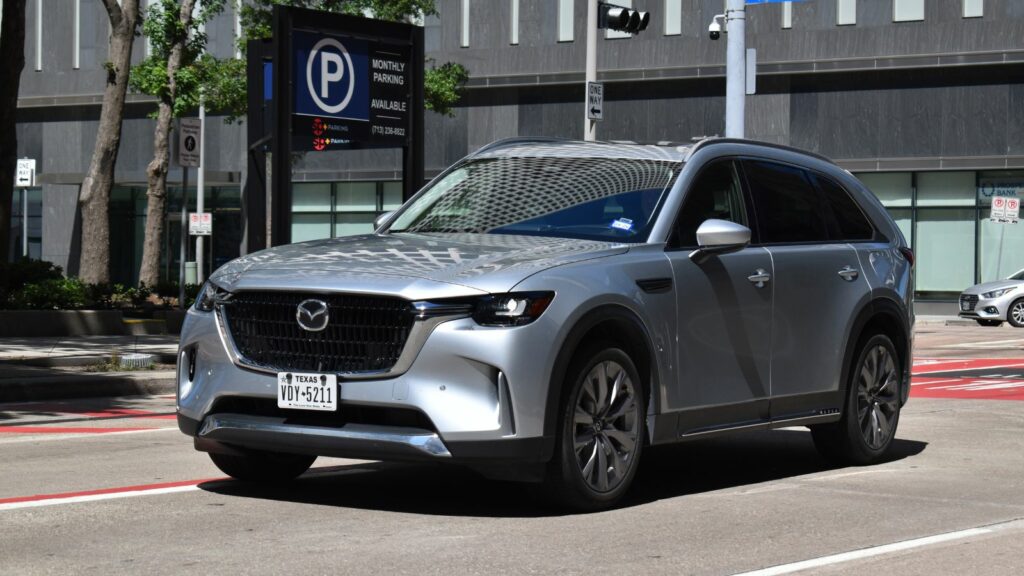
The price of a new three-row SUV can climb quickly once families begin comparing engines, seating layouts and comfort features. Mazda is entering that conversation with a clear starting point: its 2027 CX-90 costs $47,600 in Canada, while the plug-in hybrid begins at $49,999.
Announced on October 27, 2026, the latest CX-90 retains space for up to eight occupants and offers two different approaches to electrification. Mazda has also targeted everyday comfort with suspension revisions, quieter low-speed operation for the plug-in hybrid and an expanded list of standard safety features. The new model is expected at Canadian dealerships this winter, bringing buyers a familiar three-row SUV with some meaningful changes beneath the surface.
An Eight-Seat SUV With a $47,600 Starting Price
At $47,600, the 2027 CX-90 MHEV GS is Mazda’s least expensive entry into its three-row flagship. That price buys an eight-passenger configuration, standard all-wheel drive and a turbocharged six-cylinder engine rather than a stripped-down, front-wheel-drive family hauler. For households juggling children, grandparents and weekend luggage, the combination of passenger capacity and standard equipment may matter more than an exterior redesign. Mazda says the model will reach Canadian showrooms this winter.
The headline figure is a manufacturer’s suggested retail price, not a guaranteed drive-away total. Mazda lists $2,195 for freight and pre-delivery expenses, bringing the base price plus those charges to $49,795 before sales taxes and fees. Dealers determine transaction prices. The distinction matters when shoppers compare vehicles promoted at similar starting prices: a few thousand dollars in fees or optional equipment can change a household budget. Buyers should request an itemized quote rather than relying on the first number displayed.
Plug-In Hybrid Starts at $49,999, Just $2,399 More
The plug-in hybrid CX-90 GS starts at $49,999, leaving $2,399 between it and the base mild-hybrid model. That price difference makes the decision less about whether a household can afford electrification and more about how the vehicle will be used. A family with a place to charge overnight may be drawn to electric-powered school runs, while another that covers long distances might prefer the fueling routine of the six-cylinder model.
The base CX-90 uses a 48-volt mild-hybrid system that assists its gasoline engine but cannot be plugged into an outlet. The PHEV combines a 2.5-litre gasoline engine, electric motor and rechargeable battery, with standard all-wheel drive and a combined output of up to 323 horsepower. Its GS trim includes heated front seats, tri-zone climate control and smartphone connectivity. Buyers are weighing two different driving experiences, not paying extra for a badge. Savings depend on charging habits, electricity and fuel prices.
Eight-Passenger Seating Offers Flexibility for Canadian Families
The eight-seat promise is concrete: the CX-90 MHEV GS carries up to eight people across three rows. For an extended family heading to dinner, that may eliminate a second car. Yet maximum capacity does not mean maximum convenience. Buyers should consider how often the third row will be occupied, whether child seats will sit in the second row and how much luggage remains when every seat is filled.
Higher trims offer flexibility. GS-L, GT and GT-P mild hybrids, plus GS-L and GT plug-in hybrids, offer second-row captain’s chairs at no extra MSRP. Choosing captain’s chairs may reduce seating capacity, depending on trim, while offering second-row passengers more personal space. That distinction is practical: a family of five might prefer independent seats, while a household regularly transporting eight needs every position. Before ordering, families should examine the layout and check how easily children and older relatives can reach the back row.
Turbocharged Six-Cylinder Engine Delivers Up to 340 Horsepower
The CX-90’s mild-hybrid models take a route. Each uses a turbocharged 3.3-litre inline-six with Mazda’s 48-volt M Hybrid Boost system and an eight-speed automatic. In the GS, GS-L and GT, output is 280 horsepower and 332 lb-ft of torque on regular 87-octane gasoline. That means a family choosing the least expensive CX-90 still receives the engine architecture of buyers spending more for comfort and technology.
Performance rises on the GT-P and Signature: Mazda quotes up to 340 horsepower and 369 lb-ft with premium fuel. Towing is another distinction. The GS is rated for 3,500 pounds, while the GS-L can reach 5,000 pounds with Mazda towing accessories; equipped trims also reach 5,000 pounds. For owners hauling a small camper or boat, those numbers may matter more than leather colour or screen size. What counts is the towing rating of the specific trim and equipment, not the highest figure in a brochure.
Plug-In Hybrid Gives Drivers an Electric Option for Daily Travel
The CX-90 plug-in hybrid is built for both short local journeys and longer highway trips. Mazda pairs a 2.5-litre gasoline engine with an electric motor for up to 323 horsepower and 369 lb-ft of torque. Unlike the mild hybrid, the PHEV can be charged externally and driven on electricity alone. A parent making a school run and a shopping stop could use less gasoline with regular charging.
Electric range matters. In June 2026, Mazda cited an estimated 42 kilometres of electric-only range for the 2026 CX-90 PHEV; its October announcement did not provide a range for the 2027 model. That earlier estimate offers context, not a guarantee for the latest version or every winter commute. Cold weather, highway speeds and cabin heating can affect actual results. Once the battery’s charge is depleted, the gasoline engine keeps the vehicle moving, but fuel savings depend on how often the owner plugs in.
Mazda Improves Ride Comfort and Makes Rear Seat Alert Standard
Mazda has prioritized refinements for 2027. A revised rear suspension crossmember is intended to improve the CX-90’s composure over broken pavement, an important consideration when every row is occupied. Plug-in hybrid versions gain insulation around the electric drive motor to reduce noise at low speeds. Neither change promises a reinvention, but less harshness and fewer mechanical sounds could make commutes and long holiday drives more relaxing for families.
Rear Seat Alert is standard across the range. Mazda says it prompts drivers to check the back rows; it does not sense whether anyone is inside. The entry GS also includes Smart Brake Support, Blind Spot Monitoring, Rear Cross Traffic Alert, Lane Departure Warning, Lane-keep Assist and radar cruise control with Stop & Go. These features support attentive driving rather than replacing it. For families sharing a vehicle, the useful change is that key assistance systems are present without selecting a higher trim.
Premium Trims Push the 2027 CX-90 Above $60,000
The 2027 CX-90 lineup stretches beyond its headline prices. Mild-hybrid prices run from $47,600 for GS to $51,600 for GS-L, $56,200 for GT, $60,150 for GT-P and $64,150 for Signature. Plug-in hybrid pricing rises from $49,999 for GS to $57,750 for GS-L, $62,350 for GT and $69,650 for Signature. Compared with 2026, mild-hybrid versions cost $500 more, while plug-in hybrid prices remain unchanged.
Higher trims add conveniences, although their value varies by household. The GS-L adds a 12.3-inch centre display, heated steering wheel, Alexa Built-in and power liftgate. The GT brings a panoramic moonroof, Bose audio and a 360-degree camera system, while Signature versions introduce richer upholstery and driver-personalization technology. Mazda also adds Navy Blue Mica and Aero Grey Metallic exterior colours for 2027; Aero Grey carries a $300 premium. A family might appreciate easier luggage loading daily but find luxury trim less essential than keeping a manageable monthly payment.
Federal EV Incentives Could Influence the $49,999 Plug-In Hybrid Price
The $49,999 PHEV price matters: it sits $1 below the federal Electric Vehicle Affordability Program’s $50,000 transaction-value threshold. Mazda lowered the 2026 CX-90 PHEV GS to that price in June, making qualifying transactions eligible for a federal incentive. On October 27, Transport Canada’s list named the 2026 GS, not the 2027 version. That omission does not automatically rule out a rebate; the government says unlisted vehicles can still qualify when purchases meet program requirements.
Eligibility depends on transaction value, not advertised MSRP. Options, accessories and certain dealer fees count toward the $50,000 limit, while freight, pre-delivery inspection and taxes do not. The maximum federal incentive for qualifying plug-in hybrids is $2,500 in 2026, declining to $2,000 in 2027. The relevant year is when the dealer submits the eligibility assessment, not model year or delivery. Buyers should confirm the final quote and incentive eligibility before treating government support as guaranteed savings.
