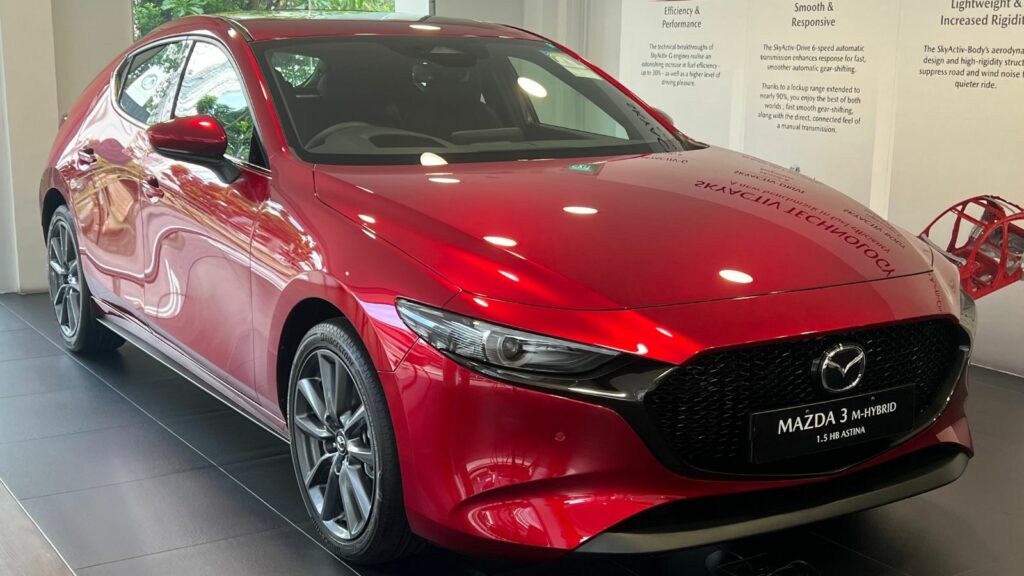
For Canadians shopping for a new compact car, another $500 has been added to the starting line. Mazda has priced the 2027 Mazda3 sedan at $25,750, up from $25,250 for 2026, while the Mazda3 Sport hatchback now begins at $26,500. The increase reaches every listed trim, not just the entry-level model.
Announced on November 3, the new pricing comes with one notable equipment addition: Rear Seat Alert is now standard throughout the lineup. Otherwise, Mazda continues to offer familiar choices, from a 186-horsepower sedan with heated front seats to an all-wheel-drive turbo model producing up to 250 horsepower. The challenge for Canadian buyers is deciding which upgrades deserve a place in a budget already stretched by freight charges, taxes and everyday ownership costs.
The $500 Increase Applies to Every Version
Mazda’s new price list shows the same $500 increase across all comparable 2026 and 2027 configurations. The base GX sedan moves from $25,250 to $25,750, while the GS rises from $27,850 to $28,350. At the other end, the GT Turbo sedan goes from $38,450 to $38,950. The Mazda3 Sport hatchback follows the same pattern, with its GX now priced at $26,500 instead of $26,000. These are manufacturer’s suggested retail prices, before freight, taxes and other charges.
The timing is notable because Mazda3 sales in Canada have already softened. Mazda reported 10,008 sales through October 2026, down 19.5 per cent from 12,428 during the same period a year earlier. That does not prove that price increases caused the decline, and the 2027 increase was announced only in November. It does show the pressure facing a model competing for households that may be weighing new-car payments against used vehicles, family expenses or the appeal of a small SUV.
The Base GX Sedan Still Offers Useful Everyday Equipment
The $25,750 GX sedan is the least expensive way into the 2027 Mazda3 family. Its naturally aspirated 2.5-litre four-cylinder engine develops 186 horsepower and 186 lb-ft of torque, paired with a six-speed automatic transmission and front-wheel drive. Rather than reserve every convenience for a pricier package, Mazda includes heated front seats, cloth upholstery, push-button start, an electronic parking brake and wired Apple CarPlay and Android Auto. For a commuter facing cold mornings, that is a meaningful set of basics.
The GX also comes with an extensive list of safety equipment. Mazda Radar Cruise Control with Stop & Go joins front automatic emergency braking, lane-keeping assistance, lane-departure warning, blind-spot monitoring, rear cross-traffic alert and a rearview camera. Not everyone needs a power moonroof or leather seats, especially when the budget is tight. For that customer, the GX’s strongest argument is that its lower price does not require giving up the fundamental engine or many of the driver-assistance features offered further up the range.
The Sport Hatchback Adds Flexibility for $750 More
The Mazda3 Sport GX starts at $26,500, exactly $750 above the GX sedan. That gap stays consistent at equivalent trims: the GS Sport is $29,100 against $28,350 for the sedan, and the GT Turbo Sport reaches $39,700 against $38,950. Mazda retains the same naturally aspirated 2.5-litre engine in the standard versions and the same turbocharged powertrain at the top. The price difference is therefore less about power and more about the usefulness and appearance of the body style.
For someone who regularly transports bulky grocery bags, sports equipment or small furniture, the hatchback’s larger rear opening can make loading easier than a traditional trunk. A sedan, on the other hand, may be perfectly adequate for a work commute, school runs and ordinary luggage, while saving $750 at purchase. Neither shape is automatically the better bargain. The smart comparison is what actually goes into the cargo area during an average week, rather than which silhouette looks sportier in a dealership showroom.
Rear Seat Alert Becomes Standard Across the Lineup
The most important equipment change for 2027 is not a larger screen or a more powerful engine. Mazda has made Rear Seat Alert standard on every Mazda3 sedan and Sport hatchback. The feature is designed to remind a driver to check the back seats before leaving the vehicle, where a child, pet or belongings might otherwise be overlooked. It joins the existing safety equipment rather than replacing any of the active driving aids already fitted to GX models.
Mazda’s owner documentation explains an important limitation: the reminder uses the history of rear-door openings and closings to judge whether something may have been placed in the back. It is not a sensor that confirms whether a person is actually sitting there. Depending on the sequence of events, the reminder may sound with an empty rear seat or fail to activate when something is present. That distinction matters in a busy family routine. The added prompt can be valuable, but drivers still need to look inside every time.
The GS Trim Adds Technology Without Going Fully Luxury
At $28,350 for the sedan and $29,100 for the Sport hatchback, the GS sits $2,600 above the corresponding GX. For that increase, Mazda adds a 10.25-inch centre display with touchscreen functionality for smartphone integration, wireless Apple CarPlay and Android Auto, and wireless phone charging. Heated exterior mirrors, rain-sensing windshield wipers, dual-zone automatic climate control and a heated leather-wrapped steering wheel also arrive at this level. The updates target comfort and convenience rather than greater engine output.
Those details can matter more than their specification-sheet descriptions suggest. A driver who uses navigation every day might appreciate leaving the phone in a pocket rather than connecting a cable. A couple sharing a car may value separate temperature settings, especially during Canadian winters. Yet the GX already has heated seats and many of the same safety systems, so the GS upgrade is not essential for everyone. The decision comes down to whether the improved cabin experience is worth an extra $2,600 before taxes and fees.
The GS Luxury Package Opens the Door to All-Wheel Drive
Mazda reserves all-wheel drive on the GS for vehicles equipped with the Luxury Package. The front-wheel-drive GS Luxury sedan costs $30,550, or $2,200 more than the regular GS, while the AWD version starts at $32,550. The Sport equivalents are $31,300 and $33,300. The package adds leatherette upholstery, a 10-way power-adjustable driver’s seat with lumbar support and memory, a moonroof, advanced keyless entry, an auto-dimming rearview mirror and mirrors that tilt downward in reverse.
This arrangement makes the actual price of entry to an AWD Mazda3 more important than the $25,750 figure in advertisements. A sedan shopper must move from the base GX to the GS Luxury AWD, a difference of $6,800 in MSRP, to obtain that drivetrain. Drivers in snowy regions may consider the added traction worthwhile, but it is not a substitute for appropriate tires. Transport Canada recommends winter tires on all four wheels in cold, snowy or icy conditions. An accurate budget should account for the full trim upgrade and seasonal tire costs, not AWD alone.
The GT Introduces a Near-Luxury Cabin and More Driver Aids
The Mazda3 GT sedan starts at $34,550 with front-wheel drive or $36,550 with all-wheel drive. The Sport GT automatic is priced at $35,300 with front-wheel drive and $37,300 with AWD. This is where the compact Mazda moves beyond routine commuting into a noticeably more upscale specification. Standard GT features include black leather upholstery, 18-inch alloy wheels, a 12-speaker Bose sound system, SiriusXM, Mazda navigation and Alexa integration.
Additional equipment changes how the car is used in parking lots and heavy traffic. Mazda fits a 360-degree camera, front and rear parking sensors, traffic-sign recognition, rear braking support and a windshield-projected Active Driving Display. A front wiper de-icer and adaptive headlights also have obvious appeal in poor weather. The trade-off is price: a front-drive GT sedan is $8,800 more than a GX, despite sharing its 186-horsepower engine. For buyers who spend long hours behind the wheel, the cabin upgrades may justify the premium. Others might find the GS strikes a more comfortable balance.
The GT Turbo Pushes the Mazda3 Beyond $40,000 With Freight
The most powerful 2027 Mazda3 costs $38,950 as a sedan and $39,700 as a Sport hatchback before additional charges. Both GT Turbo models come with all-wheel drive and Mazda’s 2.5-litre Dynamic Pressure Turbo engine, which delivers up to 250 horsepower and 320 lb-ft of torque on premium gasoline. Black-finish 18-inch wheels, Turbo badging and available Garnet Red leather help distinguish these cars from ordinary GT versions. The appeal is stronger acceleration without moving to a larger vehicle.
There is an important budget threshold hidden by the sticker price. Adding Mazda’s listed $2,095 freight and pre-delivery charge brings the turbo sedan to $41,045 and the hatchback to $41,795, even before taxes or other fees. Premium fuel is also the condition for achieving the advertised maximum power. Drivers considering this version should decide whether the extra performance will be useful enough in daily driving to justify the cost. The GT Turbo is not merely an inexpensive sedan with a bigger engine; its pricing places it in a substantially different shopping conversation.
The Six-Speed Manual Survives, but Only in the Sport GT
Canadian buyers who still want to change gears themselves have one clearly defined choice in Mazda’s 2027 price schedule: the Mazda3 Sport GT with a six-speed manual transmission and front-wheel drive, listed at $35,300. The regular sedan does not offer a manual. Nor is the turbocharged GT Turbo listed with one. For drivers who enjoy the physical rhythm of a clutch pedal and gear lever, retaining the option gives the hatchback an identity that goes beyond cargo convenience or exterior styling.
The financial distinction is interesting. The manual Sport GT carries the same $35,300 starting MSRP as the front-wheel-drive automatic Sport GT, so choosing the manual does not produce a sticker-price discount. It is a preference about how the car feels, not a cheaper route to GT equipment. Buyers who want both a manual gearbox and AWD must also make a trade-off: the 2027 pricing structure pairs the manual with front-wheel drive, while the Sport GT’s AWD configuration is automatic. Mazda is keeping a niche choice alive, but within specific limits.
The Final Bill—and the Warranty—Deserve Equal Attention
For an entry-level Mazda3 sedan, the $25,750 MSRP becomes $27,845 once the stated $2,095 freight and pre-delivery charge is added. That is still not an all-in quote: taxes, registration, optional equipment and any other applicable charges must be considered, and Mazda says retailers set actual selling prices. Extras can add up quickly. Soul Red Crystal Metallic costs another $500, Machine Gray Metallic adds $400, and several other premium finishes add $300. A buyer choosing a colour and a higher trim could cross a budget line before visiting the finance office.
Ownership protection is part of the calculation, too. Mazda Canada’s unlimited-mileage warranty provides three years of new-vehicle coverage and roadside assistance, five years of powertrain coverage and seven years of anti-perforation protection, subject to warranty terms. These are time limits without corresponding mileage caps, not permanent coverage. For a high-mileage commuter, the distinction could matter. Ultimately, the 2027 Mazda3 still offers a broad choice of compact-car configurations, but its value depends on the final written quote and the equipment genuinely needed—not the lowest advertised number alone.
