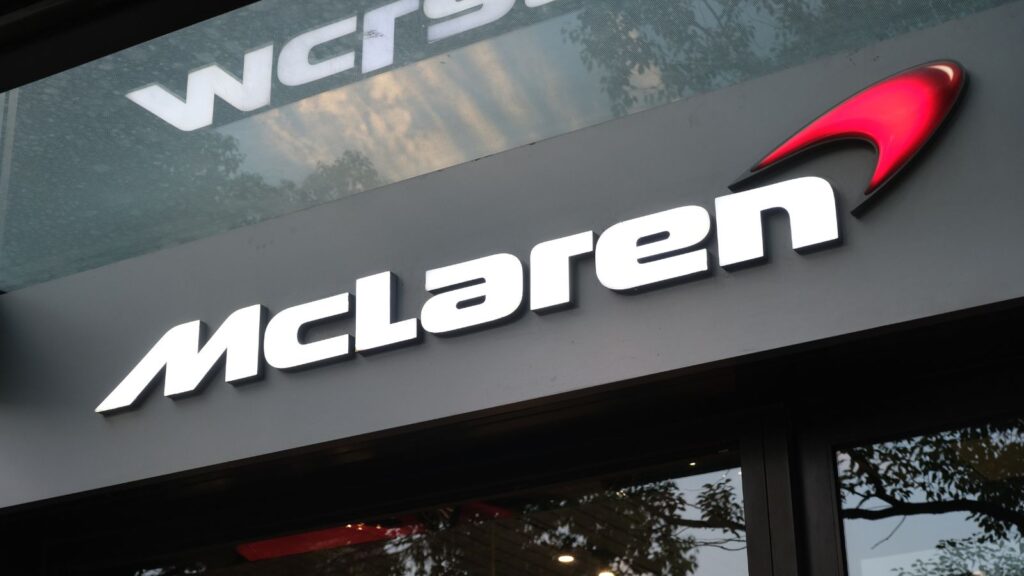
McLaren is changing the way the world sees its name at almost exactly the same moment it is changing the shape of its business. The British performance brand has unveiled an evolved visual identity designed to create a more consistent connection between McLaren Automotive and McLaren Racing, reaching from road cars and Formula 1 to merchandise, digital platforms and customer experiences.
The timing is significant. McLaren Automotive is preparing for a major expansion of its UK operations, a broader vehicle portfolio and its first performance SUV, while McLaren Racing is celebrating championship success and preparing to return to the top class of endurance racing in 2027. At the centre of the new look is a wordmark inspired not by a futuristic design studio, but by the New Zealand service station where Bruce McLaren’s story began.
One McLaren Look for Two Distinct Businesses
The most important part of McLaren’s September 22 announcement is not simply that its logo has changed. The company says the evolved identity will provide one connected visual expression across McLaren Automotive and McLaren Racing, bringing previously distinct areas of the brand closer together in the way they appear to customers, racing fans, partners and the wider public.
That does not mean the road-car and racing businesses have suddenly become one operating company. McLaren Racing has previously stressed that it operates independently from McLaren Automotive, even as ownership links and opportunities for collaboration have increased. The change is therefore better understood as brand alignment rather than an operational merger. A Formula 1 fan seeing McLaren merchandise, a supercar customer entering a showroom and a supporter following the future World Endurance Championship programme should increasingly encounter the same visual language. For a company attempting to expand its global reach, that consistency gives the McLaren name more room to function as a broad luxury and performance brand rather than several related identities.
A Wordmark That Reaches Back to Auckland
McLaren could have created an aggressively futuristic badge to accompany its next generation of vehicles. Instead, the company went back to Remuera in Auckland, New Zealand. The new wordmark takes inspiration from the sign above the family service station operated by Bruce McLaren’s parents, Les and Ruth. It was an important place in Bruce’s early mechanical life and where he worked on the car that would take him to his first racing victory.
The historical reference does not mean McLaren is abandoning familiar symbols. The curved Speedmark remains part of the identity, while the Speedy Kiwi continues to reference Bruce McLaren’s New Zealand roots. Papaya also remains an important colour, particularly around the racing operation. McLaren has introduced a bespoke typeface called McLaren Sans, while its broader corporate palette is moving toward darker tones intended to give the road-car business a more premium character. McLaren’s logos have changed repeatedly since the first kiwi-based crest appeared in the 1960s, but this version deliberately reconnects the modern company with the founder behind the name.
The Rebrand Arrives After a Major Corporate Reset
The visual changes come after a much deeper restructuring of McLaren’s automotive operations. In April 2025, Abu Dhabi-based CYVN Holdings completed its acquisition of McLaren Automotive and acquired a non-controlling interest in McLaren Racing. CYVN then brought McLaren Automotive together with British luxury-vehicle start-up Forseven under the newly formed McLaren Group Holdings, led by CEO Nick Collins.
That restructuring matters because McLaren is no longer approaching the future simply as a specialist producer refining a familiar range of mid-engined supercars. The new ownership structure was created with an explicit intention to broaden the automotive portfolio and strengthen the business financially. McLaren Racing, meanwhile, said its day-to-day operations would remain independent. That makes the new identity particularly useful: it creates a common public face without pretending that every part of McLaren performs the same corporate function. The arrangement allows racing, road cars, licensing and other activities to reinforce the same brand story while retaining separate management and commercial responsibilities where necessary.
£500 Million Is Going Into McLaren’s UK Expansion
A new logo would carry considerably less significance without new industrial investment behind it. Just six days before unveiling the identity, McLaren confirmed an approximately £500 million programme to increase its manufacturing and engineering capacity in Britain. Plans include a new UK vehicle assembly facility and expansion of research, development and production capabilities in South Yorkshire.
The programme also represents a notable change in the way McLaren develops its cars. Future powertrains are expected to be designed and manufactured in-house, beginning with two new engines and transmissions. The broader investment builds on McLaren facilities in Woking as well as newer operations including its design and innovation centre in Bicester and an engineering, testing and development site at MIRA in the Midlands. The UK government says the programme is expected to create 1,000 jobs by 2032 and could support as many as 3,000 additional positions across the wider automotive sector. McLaren is effectively building the industrial capacity required for a company with a larger and more varied product portfolio.
The First McLaren SUV Changes the Commercial Equation
Perhaps no part of the expansion illustrates McLaren’s changing ambitions more clearly than its confirmation of a performance SUV. The company has built its modern road-car reputation around lightweight two-seat performance machines, making a larger and more practical vehicle one of the biggest departures from its established formula. CEO Nick Collins has said the model will be approached in a distinctly McLaren way, although detailed specifications and a firm launch date have not been publicly confirmed.
There is a financial reason for broadening the range. Reuters reported that McLaren’s vehicle sales declined to roughly 2,000 units in 2025 from just under 3,300 in 2024 during a restructuring that included reducing dealer inventory and cutting one of two production shifts at Woking. The company has moved toward producing cars against customer orders in an effort to limit discounting and strengthen residual values. McLaren has been loss-making for years, and management sees a broader product range as one route toward greater scale and stronger margins. For now, executives have also said there is insufficient customer demand to justify launching a fully electric McLaren.
Racing Success Gives the New Identity More Weight
McLaren’s branding overhaul is arriving at a particularly strong moment for its Formula 1 operation. The team captured the 2024 Constructors’ Championship, its first since 1998, and successfully defended the title in 2025. Lando Norris also secured McLaren’s 13th Formula 1 Drivers’ Championship in 2025, reinforcing a competitive revival that has turned the papaya-coloured team back into one of the sport’s headline operations.
Another milestone arrived in Monaco in June 2026, when McLaren participated in its 1,000th Formula 1 Grand Prix. Only Ferrari had previously reached that mark. The location was especially fitting because Monaco was also where Bruce McLaren entered his own team in a Formula 1 World Championship event for the first time in 1966. Six decades later, McLaren marked the occasion with a special MCL40 livery and a gathering of past and present drivers. That racing momentum gives the unified identity considerable visibility: the McLaren name and colours are being presented to a global audience during a period when the racing side can once again point to championships rather than relying entirely on historical achievements.
The WEC Return Connects Road Cars and Racing Even More Closely
Formula 1 is only one part of McLaren’s expanding competition strategy. The company is preparing to enter the top Hypercar category of the FIA World Endurance Championship in 2027 with the MCL-HY, returning McLaren to the highest level of international endurance racing nearly three decades after its celebrated Le Mans success.
The programme provides one of the clearest practical links between McLaren Racing and McLaren Automotive. The MCL-HY has been developed with involvement from both sides of McLaren, will use a twin-turbocharged V6 and is built to LMDh regulations, with Dallara involved in its construction and United Autosports participating in the racing operation. McLaren Automotive has also developed the MCL-HY GTR client track car as part of Project: Endurance. The historic connection is powerful: the road-derived McLaren F1 GTR won the 24 Hours of Le Mans outright on its debut in 1995. That victory helped McLaren become the team associated with wins at Monaco, Indianapolis and Le Mans — motorsport’s unofficial Triple Crown.
McLaren Wants the Brand to Extend Beyond Cars and Lap Times
McLaren describes the evolved identity as supporting a wider ecosystem built around ownership, personalisation, experiences and community. That is why the wordmark is intended to appear consistently across vehicles, merchandise, branding and digital channels rather than being treated merely as a badge attached to the front of a new car.
The racing business has already been moving in that direction. McLaren Racing Club launched in 2026 as a connected digital membership platform combining the team’s website and app, with competitions, exclusive content, merchandise access and fan experiences. The road-car side is simultaneously placing greater emphasis on premium presentation, customisation and a wider range of vehicles. A unified identity gives those efforts a common visual foundation. Whether the expansion ultimately succeeds will depend far more on product execution, profitability and racing performance than typography or colour palettes. But the rebrand makes McLaren’s intention unusually clear: the next phase is meant to be larger than the supercar business or the Formula 1 team considered separately. The company wants the McLaren name itself to become the central product.
