Momenta Global is preparing for a far more ambitious phase of the robotaxi race. The Chinese autonomous-driving company, backed by Mercedes-Benz and linked through investments and commercial partnerships to major automakers including Toyota and BYD, says it wants its robotaxi fleet to grow from more than 100 vehicles today to hundreds by the end of 2026 and “several thousand” by the end of 2027. The expansion is no longer centered only on China. Momenta is already testing in Munich and Abu Dhabi, is targeting Dubai next year, is discussing additional European cities and considers Japan a priority. The plan combines something many robotaxi developers do not have at the same scale: a large business supplying driver-assistance software to production cars and a smaller Level 4 fleet intended to become a global mobility service. The next 15 months will show whether those two businesses can reinforce each other fast enough.
The 2027 Target Is a Step Change From Today
Momenta’s robotaxi operation remains relatively small compared with the scale implied by its 2027 goal. Shuo Xie, who leads the company’s robotaxi business, told Reuters that more than 100 vehicles are currently deployed across three countries. She said the fleet should reach the hundreds by the end of 2026 and then rise to several thousand by the end of 2027. The company has not disclosed an exact 2027 figure, so “several thousand” is best treated as a target range rather than a fixed production commitment. Even so, moving from a fleet counted in the low hundreds to one counted in the thousands would require a major increase in vehicle availability, operating capacity and local market approvals.
The geographic footprint is already widening. Momenta says robotaxi testing is underway in five Chinese cities as well as Munich and Abu Dhabi. That matters because autonomous-driving systems are not simply moved from one city to another like a conventional software product. Road design, traffic behavior, weather, regulations and operating procedures vary by market. A robotaxi that performs well in Shanghai still has to prove itself in Germany or the Gulf. Momenta’s schedule therefore represents more than a manufacturing ramp. It is simultaneously a technology-validation exercise, a regulatory expansion and an attempt to build repeatable fleet operations in multiple countries.
Mercedes Has Been Involved Since 2017
Mercedes-Benz’s connection to Momenta stretches back nearly a decade. In 2017, Daimler participated in Momenta’s $46 million Series B1 financing, making the German automaker one of the startup’s early strategic investors. Mercedes later participated in Momenta’s Series C financing, and the relationship has evolved from financial backing into product development. Mercedes says its China-market assisted-driving technology has been co-developed with Momenta, while Momenta says the system now spans highway, urban and parking scenarios. The partnership therefore gives Momenta something more valuable than a recognizable investor name: access to a global premium automaker with production engineering, safety processes and international market reach.
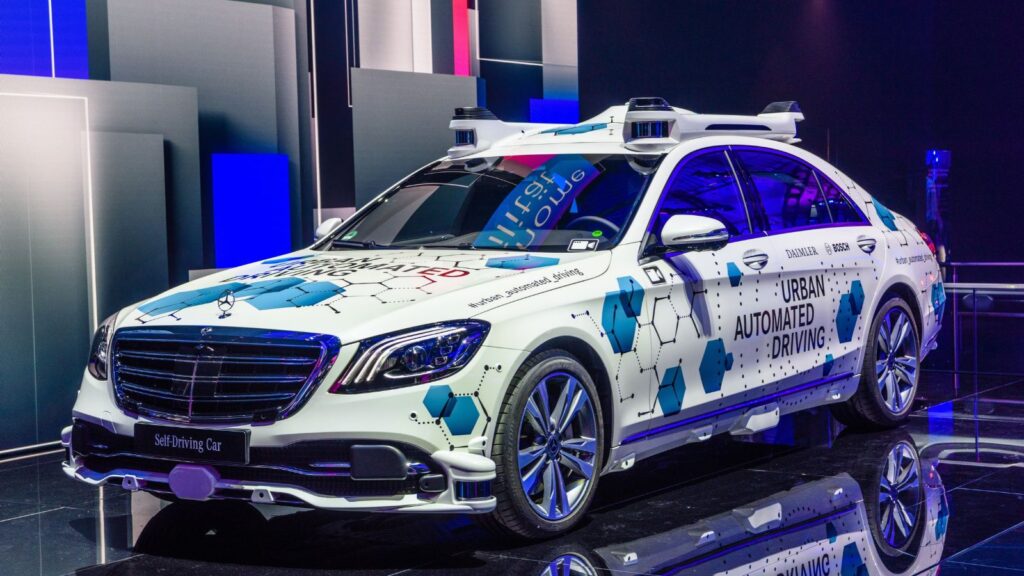
The relationship has also moved into Level 4 robotaxis. Mercedes, Momenta and UAE mobility provider Lumo announced an S-Class-based robotaxi program for Abu Dhabi in December 2025. Mercedes described the project as an SAE Level 4 driverless shuttle effort, with Lumo responsible for operating the future fleet locally. Using the flagship S-Class places the project firmly at the luxury end of autonomous mobility, while providing a high-profile test bed for Momenta’s software and Mercedes’ vehicle architecture. Separately, Mercedes has been expanding Momenta-powered driver assistance in China, including the electric CLA. That gives the partnership both a near-term production-car business and a longer-term autonomous-mobility track.
Toyota Brings Investment and China-Market Deployment
Toyota’s relationship with Momenta is also deeper than a simple supplier agreement. Toyota was among the strategic investors that led Momenta’s $500 million Series C financing announced in March 2021, alongside SAIC Motor, Bosch, Temasek and Yunfeng Capital. Later that year, Momenta said Toyota remained among the leading investors in a Series C financing total that exceeded $1 billion. Those investments tied one of the world’s largest automakers to a Chinese autonomy startup at a time when global manufacturers were looking for locally developed software that could handle China’s fast-moving intelligent-driving market. It also provided Momenta with an important early endorsement from an established global manufacturer.
The commercial connection has continued through Toyota’s Chinese operations. Momenta says its technology is used in assisted-driving programs tailored for Toyota vehicles in China, including work with GAC Toyota and FAW Toyota. GAC Toyota’s Bozhi 3X, launched in 2025, used Momenta’s end-to-end driving model, while Momenta said in March 2026 that it was supplying advanced assisted-driving solutions for FAW Toyota models including the bZ3 and bZ5. That is important context for the robotaxi story. Toyota’s ties demonstrate Momenta’s ability to work inside high-volume automaker programs, but there is no public evidence in the latest expansion announcement that Toyota will supply the vehicles for Momenta’s planned several-thousand-unit robotaxi fleet. The relationship should not be overstated.
BYD’s Tie Runs Through a Dedicated Joint Venture
Momenta’s link to BYD has a different structure. In December 2021, the two companies announced the creation of DiPi Intelligent Mobility Co., a joint venture established to develop advanced intelligent-driving capabilities in China. Momenta said the venture combined BYD’s vehicle technology and vertical integration with Momenta’s autonomous-driving algorithms. Its current corporate materials describe the program as focused on developing and deploying L2++ driving features. The venture was announced in Shenzhen as both companies looked to accelerate intelligent-driving deployment. In other words, BYD is a meaningful technology partner, but the relationship is rooted in passenger-vehicle driver assistance rather than the specific international robotaxi fleet Momenta is now trying to build.
That distinction matters because “Toyota and BYD ties” can sound as if both automakers are directly furnishing the 2027 robotaxis. The available evidence does not establish that. Instead, the partnerships show how broadly Momenta has embedded itself across the auto industry. BYD brings experience in high-volume electric-vehicle manufacturing and vertically integrated components; Toyota brings global manufacturing scale and a large China operation; Mercedes adds premium-vehicle engineering and a direct Level 4 robotaxi project. For Momenta, those relationships create technical credibility and multiple channels for deploying its software. They also reduce the company’s dependence on a single automaker, an important advantage in a sector where vehicle platforms, sensors and computing hardware can change quickly.
Momenta’s Data Flywheel Is Built on Production Cars
Momenta has long described its strategy as “one flywheel” and “two legs.” One leg is mass-production driver assistance, historically known as Mpilot, while the other is technology aimed at full autonomy and robotaxi services. The flywheel is the data loop connecting them: production vehicles generate driving data, that data is used to improve algorithms, and improved algorithms can then be deployed back into production programs and higher-level autonomous systems. The company argues that this structure lets its much larger assisted-driving business contribute to the development of its much smaller robotaxi fleet instead of treating the two businesses as separate engineering efforts.
The scale of the production side has grown quickly. Reuters reported that more than 680,000 vehicles were using Momenta technology by the end of 2025. By its Hong Kong listing in July 2026, Momenta said its mass-production systems had been deployed in more than one million vehicles across more than 100 production models and over 210 nomination programs. Those are company-reported figures, but they illustrate the imbalance that could become an advantage: Momenta has vastly more software-equipped customer cars than robotaxis. If the data and software architecture can genuinely be reused across assisted driving and Level 4 systems, that installed base could give the company a broader stream of real-world edge cases than a robotaxi-only fleet of similar size.
Europe and the Middle East Are the First International Proving Grounds
Europe is becoming one of Momenta’s most important tests of whether its technology can travel. Momenta and Uber first agreed in May 2025 to bring autonomous vehicles to Uber’s platform in international markets outside the United States and China. Four months later they named Munich as the starting point for Level 4 testing in Europe in 2026. In July 2026, Momenta announced that Germany’s Federal Motor Transport Authority had granted it nationwide approval to test Level 4 technology on urban roads, significantly broadening where validation could take place. Reuters now reports that Momenta is testing in Munich and is in discussions with a few additional European cities.
The Middle East provides a parallel route to commercialization. Abu Dhabi is already a testing location, supported by the Mercedes-Momenta-Lumo program, while Xie told Reuters that Dubai is planned for vehicle deployment in 2027. Japan is also a priority market, although the company has not provided the same level of deployment detail there. Taken together, these markets reveal a partnership-heavy expansion model. Uber can provide rider demand and platform access, Lumo can handle local fleet operations, Mercedes can provide a vehicle platform, and Momenta supplies the autonomous-driving stack. That structure could reduce the need for Momenta to build every layer of the mobility business itself, but it also makes execution dependent on multiple companies and local approvals.
Custom Chips Are Becoming Part of the Cost Strategy
Autonomous vehicles carry a heavy computing burden, and Momenta is increasingly trying to shape the hardware underneath its software. In August 2026, Momenta, chip developer XHeart and BlackBerry’s QNX announced a production-oriented autonomous-driving platform combining Momenta’s software, XHeart’s X7 automotive system-on-chip and the QNX operating system for safety. The companies said the platform had achieved ISO 26262 ASIL D functional-safety certification and was intended to support production deployments for automakers operating under demanding global standards. The significance is not only technical. A robotaxi operator that wants to put thousands of vehicles on the road has to care about the cost, power consumption, reliability and supply of every computing unit installed in the fleet.
Momenta is already looking beyond the X7. Xie told Reuters that XHeart is developing a next-generation X9 chip and said she hopes many of the robotaxis deployed globally in a couple of years will run on it. She also said the cost of Momenta-specific chips should be “significantly lower” than Nvidia hardware offering equivalent computing power. That is a company claim, not an independently verified cost comparison, and the X9 is still a future product. Still, it shows where Momenta believes one of the biggest scale advantages could come from. At thousands of vehicles, even modest savings per autonomous-driving computer can materially change fleet economics.
The IPO Gives Momenta Capital — and Public-Market Pressure
Momenta entered the public markets just as its robotaxi ambitions were accelerating. The company priced its Hong Kong offering at HK$295.60 per share and raised about HK$5.89 billion, or roughly US$751 million, before beginning trading on July 8, 2026. Its prospectus earmarked about 60% of the net proceeds for research and development, including AI computing, data storage and engineering staff, while about 20% was designated for expanding robotaxi services. Mercedes-Benz was also among the cornerstone investors in the offering. The funding mix makes the priority clear: robotaxis matter, but they sit inside a much larger and still expensive AI-development program.
The listing also exposes the gap between technological ambition and near-term financial results. Reuters reported that Momenta’s 2025 revenue climbed 82.1% to 2.41 billion yuan, while its loss attributable to owners widened to 3.46 billion yuan from 3.21 billion yuan a year earlier. By September 30, Reuters said the shares had fallen about 45% from the IPO price, amid broader caution toward Hong Kong-listed AI companies. That does not determine whether the robotaxi strategy will work, but it raises the pressure to show that research spending can translate into commercially useful deployments. Moving from tests to thousands of revenue-generating vehicles would be one of the clearest ways to demonstrate that progression.
The Competitive Bar Is Already High
Momenta is entering the large-fleet phase later than several robotaxi specialists. Reuters identifies Alphabet’s Waymo and China’s Pony.ai among its competitors. Pony.ai reported that its robotaxi fleet had reached 1,975 vehicles in the second quarter of 2026 and said it was targeting more than 3,500 by year-end. WeRide reported more than 1,800 robotaxis as of July 31, 2026, within a broader Level 4 fleet of about 3,400 vehicles. Those figures are company-reported and are not perfectly comparable because firms use different definitions for deployed, operating, commercial and test vehicles, but they show that the race is already well beyond small pilot fleets.
Momenta’s answer is to compete differently rather than simply match vehicle counts today. Unlike a robotaxi-focused company, it has a large assisted-driving supplier business tied to global automakers and more than one million production vehicles equipped with its systems, according to the company. That could spread development costs across a broader revenue base and feed more data into its models. On the other hand, operating a robotaxi network adds challenges that selling vehicle software does not: dispatch, maintenance, local service coverage, fleet uptime and rider experience all become part of the product. The 2027 target will therefore measure not only whether Momenta’s AI works, but whether the company and its partners can run autonomous mobility at scale.
The 2027 Goal Depends on More Than Putting Cars on the Road
“Level 4” does not mean a car can drive anywhere under every condition. Under the current SAE definition, Level 4 automation performs the driving task under defined conditions without requiring a human to take over. NHTSA similarly describes Level 4 vehicles as capable of handling the full driving task within limited service areas. That distinction is central to Momenta’s expansion plan. A testing permit, a working demonstration or a successful operation in one district does not automatically translate into unrestricted service across an entire country. Each deployment still has to fit the local operating domain, safety requirements and commercial rules.
Momenta has assembled many of the pieces needed for that work. The company says Germany’s KBA has granted it nationwide Level 4 testing approval; Uber is a mobility-platform partner; Lumo is involved in Abu Dhabi operations; Mercedes is providing an S-Class platform for one program; and XHeart and QNX are part of its computing and safety stack. The remaining question is execution. “Several thousand” robotaxis by the end of 2027 is a management target, not an installed fleet today. What makes the plan credible enough to watch is the breadth of Momenta’s partners and production-car footprint. What makes it difficult is the distance between proving a system in multiple cities and operating thousands of vehicles reliably, legally and economically every day.
