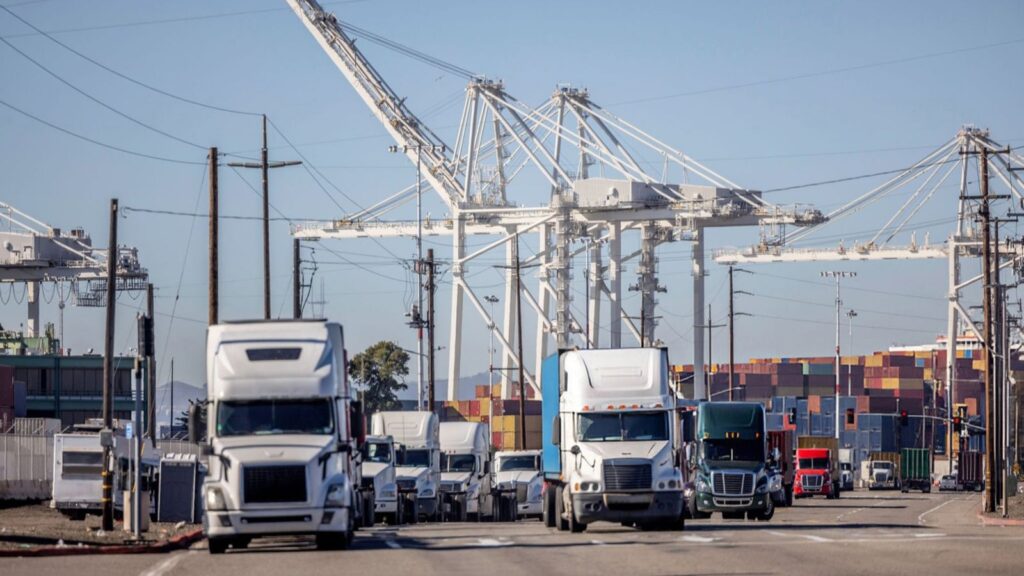
A seemingly small change to shipping invoices could make a noticeable difference in how Canadian businesses track transportation costs. Effective November 1, 2026, global shipping company Maersk began separately identifying a US$50 port gate fee on applicable inland trucking charges involving the Port of Montreal.
The charge, labelled “Token Fee – Export / Import,” applies to qualifying container pickups and deliveries arranged by Maersk at Montreal port terminals. Rather than announcing a universal new fee on all cargo, the company is changing how the port-related expense appears in its billing.
For importers, exporters, freight forwarders, and transportation companies, the update raises important questions about pricing transparency, existing terminal charges, and which shipments actually qualify. It also highlights how individual logistics expenses can affect businesses operating through one of Canada’s most important international trade gateways.
The November 1 Change Makes Port Costs More Visible
Maersk outlined the billing adjustment in an October 14, 2026, customer announcement, giving businesses just over two weeks to prepare for its implementation. Under the updated approach, eligible inland transportation charges will identify the Montreal port gate expense as a separate US$50 item. The fee will appear under the description “Token Fee – Export / Import,” distinguishing it from the broader cost of transporting a container between a terminal and an inland destination. For companies processing numerous freight invoices every month, that distinction can simplify cost tracking and reconciliation.
Importantly, the announcement does not establish that every affected customer will experience an additional US$50 increase in total transportation costs. Maersk describes the change primarily as greater pricing transparency and says the charge has been standardized across applicable Montreal terminals. Whether an individual invoice becomes more expensive depends on the original quotation, existing contractual terms, and how the fee was previously incorporated. The clearest comparison is between the complete transportation cost before and after the change, rather than examining the newly visible line item alone.
Not Every Container Moving Through Montreal Qualifies
The most important limitation concerns the type of transportation being purchased. Maersk’s announcement specifies that the charge applies when trucking arranged by the company involves collecting a container from, or delivering one to, a Port of Montreal terminal in Quebec. That covers qualifying import and export trucking movements, but it does not mean every shipment handled by the shipping line automatically attracts the fee. The defining factor is whether the relevant Maersk-arranged truck movement connects directly with a Montreal port terminal.
Consider two businesses receiving imported merchandise. One purchases inland delivery through Maersk, with a truck collecting its container directly from a Montreal terminal. The other arranges transportation independently through a separate trucking company. The first movement falls within the scope described by Maersk, while the second does not automatically fall under this particular Maersk trucking charge. However, independently arranged transportation may still involve terminal access expenses billed through another provider. The distinction matters because avoiding Maersk’s specific invoice line does not necessarily eliminate the underlying cost of terminal services.
Montreal Terminals Already Publish Their Own Gate Charges
Terminal gate fees are not unique to Maersk, and Montreal’s terminal operators maintain their own published schedules. Termont, one of the port’s container terminal operators, currently lists a C$63 gate fee for each full container transported by truck through its facilities. Its schedule also identifies separate expenses, including a C$320 late-gate charge per container for pickups or deliveries outside normal operating hours. These amounts illustrate how terminal access is only one component of the broader costs associated with moving cargo through a busy commercial port.
However, Maersk’s US$50 invoice item should not automatically be treated as identical to Termont’s C$63 terminal tariff. They are expressed in different currencies and arise within different billing arrangements. The amount a terminal publishes and the amount a shipping company charges its customer are not necessarily interchangeable without examining the applicable agreement. Maersk says its new billing approach standardizes the specified charge across eligible Montreal terminals, making costs easier to compare. Customers should still distinguish the ordinary gate charge from separate expenses involving storage, delayed pickups, or special terminal services.
Gate Fees Have Been Part of Montreal Shipping for Years
Although Maersk’s updated presentation begins in November 2026, Montreal’s container terminals have a much longer history of charging for truck gate services. In September 2018, Montreal Gateway Terminals introduced a $35 fee per full incoming or outgoing container alongside extended truck gate hours. A 2019 notice from shipping company Hapag-Lloyd subsequently reported that Montreal Gateway Terminals and Termont would increase their gate charges to C$36 per container effective January 1, 2020. The carrier indicated that the expense would be passed through to shipments involving truck movements at those terminals.
Costs continued to evolve. In February 2023, Montreal Gateway Terminals adjusted its gate service fee to $50 per loaded container, according to a notice circulated by the Canadian Society of Customs Brokers. That adjustment accompanied operating-hour changes intended to make terminal access available earlier in the morning. The historical figures are not a substitute for today’s tariffs, but they establish an important distinction: gate charges existed well before Maersk’s latest announcement. The November 2026 development concerns how Maersk identifies and standardizes the expense within applicable trucking bills, rather than the creation of terminal gate fees from nothing.
Importers Gain a Clearer View of Delivery Expenses
For importers, the revised invoice presentation makes it easier to examine one part of the journey between a ship arriving in Montreal and merchandise reaching its destination. The port handles a wide range of imported goods, including food products, building materials, steel, chemicals, and manufactured merchandise. In 2025 alone, nearly 1.95 million tonnes of inbound containerized food products moved through the port. Businesses receiving such goods must account for more than ocean freight: inland transportation, terminal services, customs processing, and other shipment-specific expenses can all influence the final landed cost.
Consider a Quebec food distributor receiving regular container shipments from overseas suppliers. When Maersk arranges transportation from the terminal to the distributor’s warehouse, an applicable gate charge can now be identified separately from the broader trucking bill. This allows the company’s accounting team to compare costs more precisely and investigate unexpected differences. It does not automatically mean food prices will rise or that customers will face an entirely new expense. The actual financial impact depends on whether the updated billing changes the total amount paid and how transportation costs are allocated under existing commercial agreements.
Exporters Must Also Account for the Fee
The change is not restricted to imported containers. Maersk explicitly identifies both export and import movements in its announcement, meaning eligible trucking deliveries into Montreal terminals are also covered. This matters for Canadian manufacturers, agricultural businesses, and other exporters that rely on the port to move goods into international markets. Montreal’s importance to these businesses is substantial. Port statistics show that approximately 808,000 tonnes of grains and cereals and 874,000 tonnes of forest products moved outbound in containers during 2025, alongside vehicles, metal products, food, and other merchandise.
For an exporter shipping goods from a factory or distribution centre to a Montreal terminal, the port gate expense becomes another identifiable component of the transportation invoice when Maersk arranges the qualifying truck movement. A company quoting overseas customers a delivered price may need to ensure that its freight calculations account for the charge without counting it twice. Exporters operating on narrow margins have particular reasons to monitor changes in logistics pricing. Yet the November adjustment should not be interpreted as a demonstrated increase in total export transportation costs. The relevant comparison remains the full price of the contracted service, including any previously incorporated terminal expenses.
Trucking Operations Remain Central to the Port’s Efficiency
The Port of Montreal depends heavily on reliable connections between container terminals and inland transportation networks. Its 2024 annual reporting indicated that approximately 60% of dockside container transportation moved by truck, with the remaining 40% handled by rail. An average of 1,707 trucks circulated through port terminals daily that year. Each movement requires coordination between drivers, terminal operators, shipping lines, and cargo owners. Gate charges are therefore associated with a large and highly organized transportation system rather than an occasional administrative transaction.
The physical process of retrieving cargo also involves requirements that are separate from Maersk’s invoice update. Termont instructs drivers collecting imports to ensure containers have been released by Canadian customs, obtain the appropriate pickup and booking information, settle outstanding storage charges, and arrange terminal appointments. Delays in meeting those requirements can create additional complications for a trucking company trying to keep drivers and equipment moving. The US$50 charge does not replace those procedures, guarantee expedited access, or cover every possible terminal expense. Its significance is primarily financial: it gives customers a clearer description of one charge associated with an eligible truck movement.
US-Dollar Pricing Creates Another Accounting Consideration
Another detail deserves attention: Maersk expresses the revised fee in US dollars, while some Montreal terminal charges are published in Canadian dollars. This distinction can complicate comparisons for Canadian businesses preparing budgets in their domestic currency. An importer reviewing Maersk’s US$50 charge against a terminal’s C$63 tariff should account for the invoicing arrangement and applicable currency conversion before deciding whether the figures are inconsistent. The actual amount recorded in Canadian dollars can depend on the exchange-rate procedures and commercial terms governing the shipment.
The timing is particularly relevant because Maersk has announced a separate financial-system modernization for Canadian customers. The company expects possible invoice-creation delays between November 13 and 15, 2026, followed by revised PDF invoice formats beginning November 16. Its planned Logistics & Services billing changes include a single exchange rate per service, aligned with the first invoice-creation date. Maersk says the rate will be sourced from LSEG, with a possible conversion adjustment. These changes are distinct from the Montreal gate-fee announcement, but together they make accurate invoice reconciliation increasingly important.
Small Transportation Charges Matter Across a High-Volume Port
Montreal’s scale helps explain why a relatively modest fee deserves attention. According to the Montreal Port Authority, the port handled approximately 1.52 million twenty-foot equivalent units, or TEUs, during 2025, representing a 3.6% increase over the previous year. The volume remained substantial in 2026. Through September, cumulative container traffic reached 1,208,701 TEUs, approximately 3% above the comparable period in 2025. Those figures reflect the port’s continuing role in moving goods between Canadian businesses and international markets.
However, total container traffic should not be confused with the number of shipments subject to Maersk’s US$50 charge. A TEU is a measure of container capacity rather than a count of individual truck movements. Some cargo moves by rail, some trucking is arranged independently, and not every shipment through Montreal involves Maersk. Multiplying the port’s entire container volume by US$50 would therefore produce a misleading estimate of revenue from this fee. The more meaningful consideration is how recurring transportation charges affect individual businesses. For companies handling qualifying containers regularly, consistent pricing and accurate records can matter considerably over an entire financial year.
Freight Forwarders Need to Communicate the Change Clearly
Freight forwarders occupy an important position between shipping companies and the businesses moving goods. They frequently organize transportation, prepare shipment documentation, coordinate carriers, and help customers understand the various expenses attached to international freight. The Canada Revenue Agency recognizes that a forwarder may act as an agent arranging transportation or assume responsibility as a carrier, depending on the arrangement. Those differences can influence how transportation services are billed and which company is responsible for paying particular expenses.
Maersk’s new itemization creates an opportunity for freight forwarders to make their quotations more understandable. If a customer receives a price covering ocean transport, terminal services, and final delivery, the forwarder should be able to explain how the US$50 charge fits into that figure. It is equally important to avoid applying the charge indiscriminately to shipments outside Maersk’s published conditions. A business using independently contracted trucking may have different terminal costs, but that does not automatically justify adding Maersk’s specified fee. Clear communication can prevent disputes, especially when customers compare quotations from providers that organize and itemize inland transportation differently.
What Businesses Should Review on Their Next Invoice
The practical response to Maersk’s announcement is to review applicable trucking invoices against the original booking and agreed transportation rates. Businesses should confirm whether Maersk arranged the container’s pickup or delivery at a Montreal port terminal, whether the charge corresponds to an import or export movement, and whether the US$50 amount matches the published policy. It is also worth checking the complete invoice for other terminal-related costs and comparing the total against the original quotation. This can help identify cases where an expense has been accounted for twice or applied to a movement outside the stated conditions.
Maersk provides a formal invoice-dispute process through its MyFinance platform. Customers can raise concerns involving incorrect rates, payments already made, incorrect payers, or missing information, and submit supporting documents for review. The company also directs customers with questions about the Montreal change to their sales or customer-service representatives. Ultimately, the November 1 update creates a more visible billing category, but its value will depend on how consistently it is applied. For Canadian businesses managing international freight, the ability to understand, verify, and question transportation costs remains just as important as the amount printed on the invoice.
