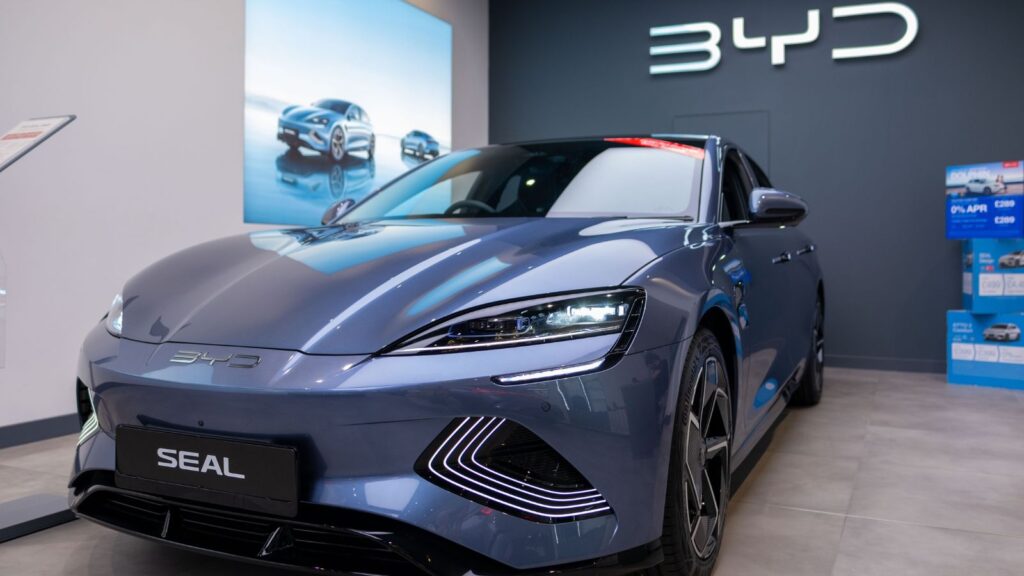
BYD’s already fast-moving electric sedan lineup is taking another significant step forward. Newly published Chinese regulatory information for an updated Seal 07 EV reveals a long-range version with an 88.682-kWh lithium-iron-phosphate battery and a claimed 875 kilometres of range under China’s CLTC testing cycle. The most powerful version also reaches 300 kW, or roughly 408 horsepower.
Just as important is the charging technology attached to the new-generation battery platform. BYD’s Flash Charging system is designed to take a compatible second-generation Blade Battery from 10% to 97% charge in nine minutes under specified conditions. Those are attention-grabbing numbers, but the details matter: 875 kilometres is not a real-world guarantee, and nine minutes does not mean charging from completely empty to completely full. Even with those qualifications, the filing shows how quickly BYD is pushing battery performance forward.
The New Filing Pushes the Seal 07 Well Beyond 700 Kilometres
The biggest number in the new regulatory information is straightforward: 875 kilometres of claimed CLTC range for the longest-range Seal 07 EV. China’s Ministry of Industry and Information Technology published its latest vehicle and new-energy-vehicle catalogues on September 18, building on regulatory information about the redesigned Seal 07 that first emerged in August. The battery details now provide a clearer picture of what BYD intends to put underneath the larger sedan.
That represents a sizable jump from the Seal 07 EV BYD launched in China in March 2026. The existing car carries a 69-kWh-class battery and is rated at 705 kilometres CLTC. The new filing therefore lifts the headline range by 170 kilometres, or roughly 24%. It is worth stressing that this is regulatory information for an upcoming configuration rather than evidence of how far the car will travel during every highway journey. Still, an 875-kilometre certified-cycle claim moves the Seal 07 into a substantially different range category than the version introduced only months earlier.
An 88.682-kWh Battery Sits Behind the 875-KM Claim
The long-range Seal 07 EV combines an 88.682-kWh lithium-iron-phosphate battery with a 300-kW electric motor. Regulatory information cited by Chinese EV publications puts the battery pack itself at approximately 618.6 kilograms, while the complete vehicle has previously been filed at about 2,060 kilograms. That is a substantial battery, but BYD is extracting an unusually large laboratory range figure from a pack that remains below 90 kWh.
There is also a less powerful version. Its battery has a capacity of 76.744 kWh and is reported to weigh 539 kilograms, while its motor produces 245 kW. That version carries a 775-kilometre CLTC rating. In other words, adding roughly 11.9 kWh of battery capacity in the higher specification accompanies another 100 kilometres of claimed range while power rises by 55 kW. Both versions use LFP chemistry, an area in which BYD has invested heavily through its Blade Battery program. The figures suggest the Seal 07 is being engineered around efficiency as much as sheer battery size.
The Nine-Minute Charging Number Comes With Important Conditions
The nine-minute figure may ultimately matter more to many drivers than another 100 kilometres of laboratory range. BYD says its second-generation Blade Battery and Flash Charging technology can raise state of charge from 10% to 70% in five minutes and from 10% to 97% in nine minutes. Those numbers are dramatically different from the charging times associated with most existing mass-market EVs, but they require compatible battery hardware and BYD’s ultra-high-power charging infrastructure.
BYD says its Flash Charger can deliver as much as 1,500 kW through a single connector. The company has also claimed strong cold-weather performance: at minus 30 degrees Celsius, a compatible second-generation Blade Battery can go from 20% to 97% in 12 minutes. For perspective, that means the headline nine-minute number is not a 0-to-100% recharge performed on an ordinary public DC fast charger. A driver pulling into a conventional charging station should not expect identical results. The hardware at both ends of the cable is essential to achieving the advertised charging curve.
An 875-KM CLTC Rating Is Not the Same as 875 KM on the Highway
Range figures become much more useful when their test cycle is identified. The 875-kilometre number comes from China’s CLTC procedure, which uses a different speed profile from Europe’s WLTP system or American range-testing methods. Published research comparing standardized cycles shows that CLTC operates at an average speed of roughly 29 km/h, compared with about 46.5 km/h for WLTP, while WLTP also reaches a higher maximum speed. Those differences can materially change an EV’s certified energy consumption and range.
One EV publication has translated the Seal 07’s 875-kilometre CLTC result into roughly 718 kilometres under WLTP assumptions. That figure should be treated as an estimate, not an official European homologation result for the car. Real driving can differ further. International Council on Clean Transportation research examining EV performance in China found high-speed driving could reduce observed range by roughly 15% to 25% in the vehicles studied, while very cold conditions produced even larger reductions. None of those percentages predicts the Seal 07 specifically, but they explain why its 875-kilometre figure needs context.
The New Seal 07 Is Physically Bigger as Well
This is more than a battery upgrade. BYD’s updated Seal 07 measures 5,080 mm long, 1,960 mm wide and 1,495 mm tall, with a 2,960-mm wheelbase. The Seal 07 EV currently on sale measures 4,995 mm by 1,910 mm by 1,495 mm and has a 2,900-mm wheelbase. The new car is therefore 85 mm longer, 50 mm wider and gains 60 mm between the axles while retaining the same stated height.
Those changes push the Seal 07 farther toward the dimensions associated with large executive sedans. The longer wheelbase is particularly noteworthy because those extra millimetres can be used to improve rear-passenger space, battery packaging or both, although interior measurements for the production vehicle will ultimately determine how much passengers benefit. Regulatory information continues to identify it as a five-seat model. Images filed with Chinese authorities also show BYD continuing its latest Ocean-series styling direction, while a roof-mounted lidar unit appears among the equipment visible on the newly filed vehicle.
Power Rises to 300 kW and Top Speed Climbs to 240 KM/H
The long-range version is not being tuned solely for efficiency. Its 300-kW electric motor translates to about 408 horsepower, while Chinese regulatory filings list a top speed of 240 km/h. The other electric version produces 245 kW but carries the same filed maximum speed. By comparison, the Seal 07 EV launched in March uses a 240-kW rear-mounted motor and has a listed top speed of 200 km/h.
That makes the highest-output new configuration 60 kW stronger than the existing model, an increase of 25%. The top-speed figure rises by 40 km/h. Those numbers do not reveal acceleration, handling or sustained high-speed performance, and final production specifications could provide additional context. They do show that BYD is widening the Seal 07’s mission. The larger battery is being paired with more performance rather than using every available kilowatt-hour purely to stretch range. For buyers comparing large electric sedans, that combination of long-range positioning and more than 400 horsepower makes the specification sheet notably more ambitious.
BYD Is Updating the Seal 07 at an Exceptionally Fast Pace
The timing is almost as striking as the specifications. BYD officially launched the current Seal 07 EV in China on March 5, 2026, with two versions priced at 169,900 yuan and 189,900 yuan. Both offered a 705-kilometre CLTC rating, a roughly 69-kWh battery and a 240-kW rear motor. By August, regulatory filings were already revealing a substantially larger Seal 07 with new powertrain choices, and September brought more detailed battery and range information.
That means the technical story surrounding the model changed dramatically within roughly half a year. BYD’s current Chinese product page still highlights the 705-kilometre Seal 07 EV and advertises the same five-minute and nine-minute Flash Charging milestones. The newly filed car therefore needs to be distinguished from the vehicle customers can already find in showrooms. Reports describe the larger model as an upcoming successor, but its final retail lineup will become clear only when BYD formally launches it and publishes prices, equipment levels and complete specifications.
The Filing Reveals a Lot, but Several Questions Remain
Regulatory filings are valuable because they expose specifications manufacturers must disclose before a vehicle reaches the market, but they are not substitutes for a complete launch announcement. The Seal 07 documents now establish key dimensions, motor outputs, battery capacities and Chinese-cycle range figures. They provide strong evidence that an 875-kilometre version is progressing toward production. They do not, by themselves, establish final pricing, standard equipment across every trim or availability in markets outside China.
The same caution applies to charging. BYD has independently documented its nine-minute, 10%-to-97% Flash Charging capability and is building dedicated infrastructure to support it, with a stated goal of 20,000 Flash Charging stations in China by the end of 2026. The real significance of the new Seal 07 will therefore depend on how completely those technologies come together in the production car. If the 875-kilometre configuration retains the rapid charging performance demonstrated by BYD’s second-generation Blade Battery system, the story will be about more than another large range number. It will be about reducing both how often an EV needs to stop and how long those stops last.
