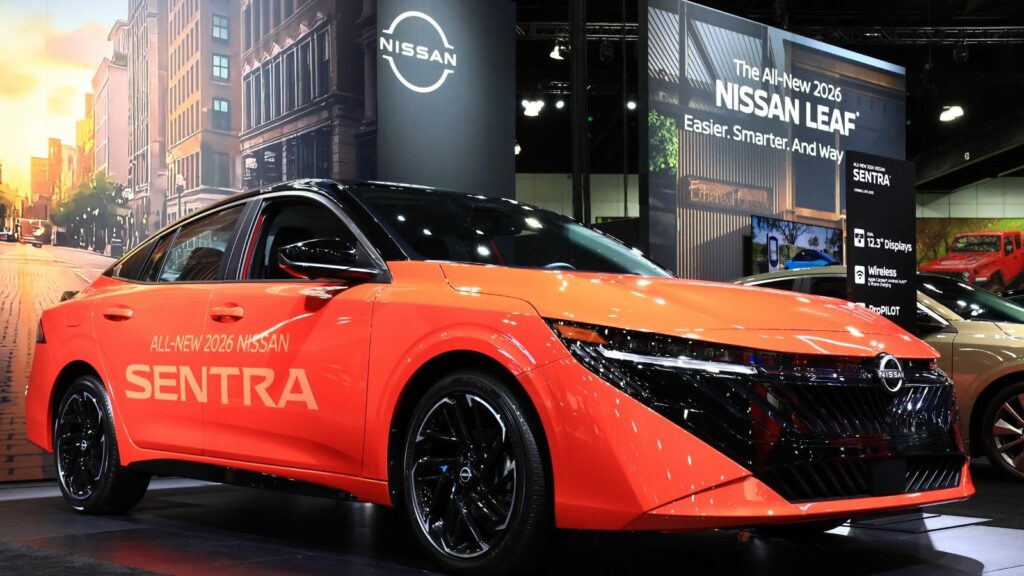
Nissan has built the Sentra that driving enthusiasts have spent years wishing for: a turbocharged Spec-V with 300 horsepower, a six-speed manual transmission, and serious performance hardware borrowed from the GT-R.
Unveiled on October 28, 2026, ahead of the SEMA Show in Las Vegas, the aggressive new concept transforms Nissan’s familiar compact sedan into something far more exciting. There is one significant catch: Nissan has confirmed that the vehicle is not available for purchase.
Meanwhile, Canadian buyers are being offered a very different Sentra. The newly released 2027 model retains its 149-horsepower engine and continuously variable transmission, with no manual gearbox or higher-output engine available. The contrast highlights a growing divide between the performance cars Nissan is capable of building and the practical sedans it actually sells.
Nissan Brings Back the Spec-V Spirit for SEMA 2026
The Sentra Spec-V debuted on October 28 in Nissan’s 2026 SEMA lineup. From November 3–6, Nissan will display it beside Project NAT2, a race-prepared Z, and a Datsun S30 restomod developed with drifting champion Chris Forsberg. Unlike an appearance package, the Sentra demonstrates what the compact platform can do when performance takes priority. Nissan connects the project to the Sentra SE-R, introduced in North America 35 years ago. That history gives the Spec-V badge meaning beyond a spoiler or special paint.
SEMA celebrates modified vehicles, aftermarket parts and engineering experiments that might never reach dealerships. Nissan says it uses the event to learn from enthusiasts and explore potential directions. That does not turn every display car into a product announcement. The Spec-V is a Nissan creation, but it is not a Canadian trim, and the company has announced no production program. The manual is real; an order form is not.
The 300-HP Engine Is Far More Than a Simple Turbo Upgrade
The concept starts with Nissan’s MR20DD 2.0-litre four-cylinder, also used in the regular Sentra. In production form, it delivers 149 horsepower and 146 lb-ft of torque without turbocharging. For the Spec-V, Nissan lists a Garrett G25-550 turbocharger, a front-mounted intercooler and internal changes, including Carrillo connecting rods and JE pistons. The build specifies a 10:1 compression ratio, modified crankshaft support and treated engine components. These are far more than cosmetic modifications; they address the demands of an engine working much harder.
Fuel delivery also changes, with additional 550-cc Bosch injectors, a custom manifold spacer and an AEM 400-litre-per-hour in-tank pump. One detail matters: Nissan’s announcement says 300 horsepower, while its build sheet specifies 300 wheel horsepower. The production car’s 149-hp number is an engine rating. Wheel output and engine output are not directly comparable because power is lost through the drivetrain, but the difference still indicates a leap in performance.
A Six-Speed Manual From the Juke NISMO RS Changes Everything
Rather than use a CVT, the Spec-V fits a modified six-speed gearbox from the Nissan Juke NISMO RS. The build sheet identifies the RS6F94R transmission with a helical limited-slip differential. Nissan also specifies a lightweight Centerforce flywheel and FX350 clutch kit, plus a modified short shifter. These components serve a purpose: the gearbox puts gear selection in the driver’s hands, while the limited-slip differential helps distribute torque when grip differs between the two front wheels. In a powerful front-drive car, that hardware matters far more than a decorative shift knob.
For Canadians, the contrast is unusually sharp. Nissan offered a six-speed manual on certain 2025 Sentra trims, but the redesigned 2026 model switched to a CVT-only lineup. The 2027 Sentra continues that approach. A concept that celebrates shifting gears therefore arrives just as Canadian buyers have lost that option on the ordinary sedan. A showroom Spec-V would require Nissan to reverse its current direction.
GT-R Brakes and Racing Suspension Give the Sentra Serious Hardware
Nissan did not stop at engine and gearbox changes. Its parts list calls for a braking conversion derived from the R35 GT-R NISMO, with six-piston Brembo front calipers squeezing 390-mm rotors and four-piston rear calipers working with 380-mm rotors. The production Sentra uses conventional disc brakes. The concept’s large brakes are suited to the heat management demands that can accompany repeated hard stops. Nissan has not released independently verified stopping distances, however, so the hardware alone cannot establish a braking-performance claim.
The suspension and wheels tell the same story. Nissan specifies track-tuned NISMO Sentra coilovers, revised front dampers with external reservoirs, stiffer springs and anti-roll bars. Forged 19-by-9.5-inch NISMO LM-RS1 wheels carry 265/35R19 Yokohama ADVAN NEOVA AD09 tires. Those numbers describe a significantly wider performance-oriented setup than a typical compact family sedan. Together they show that Nissan treated the Spec-V as a complete engineering exercise, not an engine-swap publicity stunt.
Widebody Styling and GT-R Parts Give the Sentra a Radical New Look
The Spec-V looks more at home in a paddock than a dealership lot. Nissan fitted a BOMEX widebody kit, vented hood with a functional intake, a side-exit exhaust and a rear wing taken from the R35 GT-R NISMO. The large front opening reveals the intercooler, a clue to the cooling demands of the turbocharged engine. Dramatic bodywork does not establish a new production body style; it helps communicate a show car’s ambitions in a crowded convention hall.
Inside, the same idea continues with GT-R NISMO Recaro front seats, a NISMO steering wheel, black accents and a custom harness bar. These details emphasize the driver’s role more than everyday commuting comfort. The standard Sentra, by comparison, is a five-passenger compact with convenience and cabin technology among its major selling points. The concept takes a recognizable shape and asks a different question: how extreme could a familiar family sedan become when practicality is no longer the main priority?
Canada’s 2027 Sentra Remains a 149-HP, CVT-Only Sedan
Seven days before the concept announcement, Nissan Canada published pricing and specifications for the 2027 Sentra. Its October 21 release confirmed the model was already on sale, still using a naturally aspirated 2.0-litre MR20DD engine. Output stays at 149 horsepower at 6,000 rpm and 146 lb-ft at 4,000 rpm. The front wheels receive power through Nissan’s Xtronic continuously variable transmission on every listed grade. There is no six-speed option, turbocharged SR or factory Spec-V in the Canadian lineup.
Nissan has revised the CVT’s programming, promising smoother, more linear acceleration and crisper responses to accelerator inputs. That may make daily commuting more pleasant, but it neither changes the engine’s power rating nor creates a track-focused sedan. The proximity of the two announcements makes the contradiction difficult to miss. One Nissan release describes how the company has refined its 149-hp commuter car; the next shows what that same badge can represent when the constraints of production are set aside.
Sportier Trims Buy More Style, Not More Horsepower
Canadian pricing for the 2027 Sentra starts at CA$25,868 MSRP, with Nissan listing a CA$28,536 selling price including specified fees, before tax and registration. The SR carries a CA$30,268 MSRP, while the SR Premium Midnight Edition reaches CA$32,998. Neither brings a more powerful engine. Instead, sportier trims emphasize appearance and equipment, including 18-inch wheels, a rear spoiler and, on the Midnight Edition, black exterior details and a contrasting roof. Upgrading the Sentra changes its presentation, not its basic performance.
Those upgrades still have value for everyday drivers. Every 2027 Sentra has a 12.3-inch touchscreen with wireless Apple CarPlay and Android Auto. Available features include dual 12.3-inch displays, Bose audio and Qi2 wireless charging. Nissan also estimates combined fuel consumption as low as 7.1 L/100 km for S and SV grades. For commuters, comfort, connectivity and fuel costs can matter more than lap times. But for shoppers drawn to the Spec-V concept, a larger screen and darker wheels are unlikely to replace a clutch pedal.
Nissan Has Sold Real Sentra Performance Cars Before
The Spec-V name resonates because Nissan once sold affordable performance cars, not just dramatic concepts. The 1991 Sentra SE-R combined a 140-horsepower 2.0-litre engine with a close-ratio five-speed manual and limited-slip differential. Nissan revived the SE-R nameplate in 2002. Canadian buyers could later purchase the 2012 Sentra SE-R Spec V with a 200-horsepower 2.5-litre engine and six-speed manual. That model was a genuine showroom offering, complete with sport-tuned suspension, performance front brakes and summer tires.
The loss of the manual gearbox is much more recent. Nissan offered six-speed manuals on the Canadian 2025 Sentra S and SR, with the entry-level S manual carrying a CA$23,898 MSRP. When the redesigned 2026 Sentra arrived, the manual disappeared and the base MSRP rose to CA$25,268. Additional technology and design changes make a simple price comparison imperfect. Still, one important choice was lost: Canadians could no longer buy a new Sentra with a clutch pedal, regardless of trim or budget.
Rival Brands Still Sell the Manual Sport Compacts Nissan Doesn’t
Canada still has manual sport compacts. Honda’s 2026 Civic Si uses a turbocharged 1.5-litre engine producing 200 horsepower and comes with a six-speed manual. Hyundai’s 2026 Elantra N makes 276 horsepower from a turbocharged 2.0-litre engine and offers either a six-speed manual or an eight-speed dual-clutch transmission. The 2026 Civic Type R goes further, delivering 315 horsepower with a six-speed manual. These cars demonstrate that performance-oriented compact vehicles with factory-backed powertrains remain available, even as Nissan shifts its everyday Sentra toward automatic-only driving.
Direct comparisons require caution. Honda’s and Hyundai’s published horsepower figures are engine ratings, whereas Nissan’s detailed Spec-V build sheet specifies 300 horsepower at the wheels. Nissan has also released no production price, fuel-consumption estimate or independently tested acceleration figures for the concept. Without those details, a meaningful value comparison is impossible. The distinction for Canadian shoppers is simpler: buyers seeking a new manual sport compact currently have to look beyond the Sentra.
Nissan Has Offered Inspiration, Not a Production Promise
The central unanswered question is whether a more affordable version of the Spec-V could eventually reach showrooms. Nissan’s response is carefully limited. Its SEMA announcement explicitly states that the concept vehicles are not for sale, while acknowledging that ideas developed through such projects can influence future production models. Nissan points to its Rock Creek-branded vehicles as examples of directions inspired by earlier SEMA concepts. That leaves room for future inspiration, but it is not confirmation of a turbocharged Sentra, a revived production Spec-V or a return to manual transmissions.
Turning a custom project into a road-legal production car would also require difficult decisions about durability, emissions, safety certification, warranty protection and cost. Nissan itself warns that vehicle modifications can affect those areas, and the Spec-V uses numerous custom and track-focused components. For Canadian drivers, the conclusion is clear. The 300-horsepower manual Sentra demonstrates that Nissan still understands the appeal of an enthusiast-focused compact car. But until a separate production announcement arrives, the 149-horsepower CVT-equipped Sentra remains the version Canadians can actually purchase.
