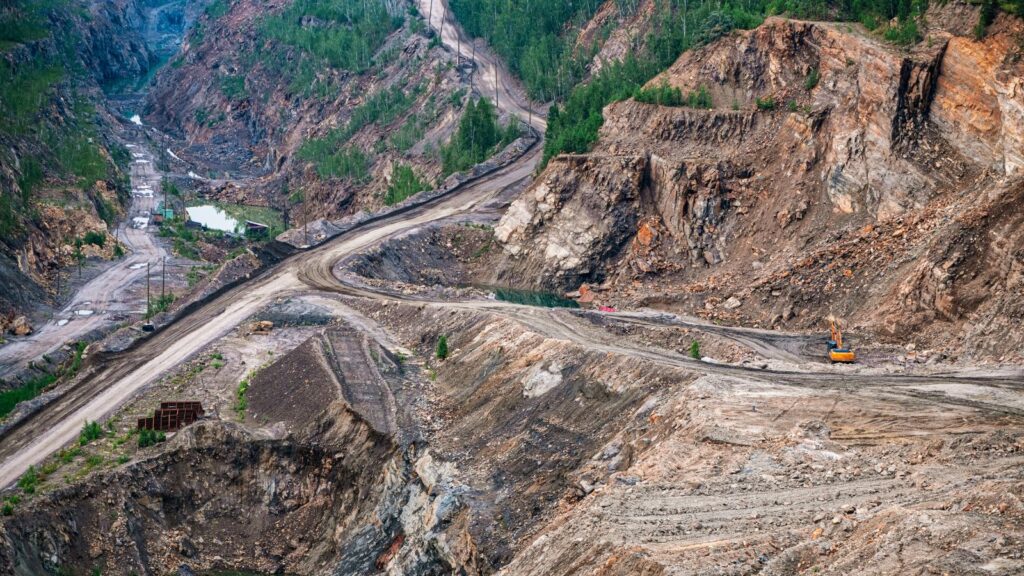
A battery-powered haul truck capable of carrying 22 tonnes of material is being tested at an Ontario graphite mine, marking a significant step toward electrifying the heavy machinery used in Canada’s critical minerals industry.
Global Battery Materials announced on November 23, 2026, that its Kearney Graphite Mine is hosting a weeklong trial of a battery-electric truck developed by Ontario-based MEDATech Engineering. The federally funded study combines real-world hauling operations with digital modelling to determine how electric equipment could perform in a working mining environment.
The testing comes as Global Battery Materials prepares to restart the previously producing mine by 2028. Beyond demonstrating a new vehicle, the project could help establish whether electric haulage is practical for Canadian mines seeking to reduce diesel consumption while expanding domestic production of minerals essential to electric vehicle batteries.
A Battery-Electric Truck Is Being Put to Work at Kearney
At the Kearney Graphite Mine in Ontario, a battery-electric haul truck is being tested under actual mine-site conditions. Global Battery Materials is hosting the trial, while MEDATech Engineering leads the technical study with support from Green Graphite Technologies. The weeklong demonstration is designed to examine how electric haulage equipment handles the demands of moving material around a mining operation. Unlike a conventional vehicle demonstration focused on showcasing technology, the Kearney project aims to collect operating information that can influence future investment decisions.
The distinction is particularly important because Kearney is not yet operating as a fully restarted commercial mine. Global Battery Materials is working toward bringing the property back into production, and equipment selection represents one of the decisions that must be made before regular operations resume. Testing an electric truck now gives engineers an opportunity to examine its suitability for the site rather than committing to a fleet based entirely on theoretical performance. The findings could also be useful to other Canadian mining companies considering similar equipment.
The 22-Tonne Payload Makes This More Than a Small Equipment Experiment
The truck’s most important published specification is its 22-tonne payload capacity, equivalent to 22,000 kilograms of material. That figure describes the load the vehicle can carry, not its own weight. In mining, carrying capacity matters because equipment must move substantial quantities of material repeatedly while keeping transportation costs under control. A truck that performs well without a load may behave differently when fully loaded, particularly on steep or uneven haul roads. The Kearney demonstration is intended to provide evidence about how battery-electric equipment performs under demanding operating conditions.
MEDATech, headquartered in Collingwood, Ontario, specializes in engineering heavy-duty electric and hybrid powertrain systems through its AltDrive division. The company has previously worked on electric hauling equipment for mining applications, including a battery-electric concentrate hauler associated with Teck Resources. However, the November 23 announcement did not disclose the Kearney truck’s battery capacity, driving range or charging time. Those details are important because payload capacity alone cannot establish whether the vehicle can complete a productive mining shift without excessive charging interruptions.
Engineers Are Comparing Computer Predictions With Real-World Performance
One of the most important features of the Kearney project is its combination of digital modelling and physical testing. Engineers are using computer simulations to estimate how a battery-electric haul truck should perform, then comparing those predictions with data gathered during the weeklong trial. This approach can help determine whether assumptions about energy consumption, battery requirements and vehicle configuration reflect actual operating conditions. For a mining company considering a substantial equipment investment, the difference between predicted performance and measured performance can influence the economics of an entire hauling operation.
Research shows why this kind of testing matters. A 2026 study published in the Journal of Cleaner Production examined battery-electric haulage fleets in simulated open-pit mines and found that charging constraints were an important factor in determining fleet requirements. The research also demonstrated that the least expensive fleet configuration was not necessarily the one with the lowest emissions. For Kearney, the practical questions are similarly interconnected: how much energy the truck needs to complete its assigned routes, when it must recharge, and whether charging can be incorporated without interfering with production schedules. These questions will be central to understanding the trial’s results.
Ottawa Is Funding the Study as Canada Pushes Mining Electrification
The federal government is supporting the Kearney demonstration through Natural Resources Canada’s Energy Innovation Program. The program finances research, development and demonstration projects intended to help Canadian businesses adopt cleaner energy technologies. Its mining decarbonization initiatives specifically recognize mobile equipment as an important area for reducing emissions. By supporting field testing, Ottawa is helping companies examine technologies that could eventually replace diesel-powered machinery in mining operations.
The distinction between funding a feasibility study and financing a full electric fleet is important. Global Battery Materials has confirmed federal support for the study but has not disclosed a specific contribution amount for the Kearney truck trial. The Ontario Ministry of Energy and Mines is identified as the provincial regulator, rather than as a confirmed financial contributor. Separately, federal records identify a $4.75-million award to Green Graphite Technologies for a graphite-processing project involving British Columbia and Ontario. That is a different project and should not be confused with funding for Kearney’s truck test. For now, the federal investment at Kearney is intended to help establish whether the technology makes operational and economic sense.
Kearney’s Planned Restart Could Bring a Historic Mine Back Into Production
The electric truck trial is taking place at a property with a history stretching back more than three decades. The Kearney graphite mine began operating in 1989 but closed in 1994 after weak graphite prices undermined its commercial prospects. Located in the Almaguin Highlands, west of Algonquin Provincial Park, the former open-pit operation still has infrastructure associated with its earlier mining activities. That existing footprint is one reason Global Battery Materials believes the property could be restarted more quickly than a completely new mining development.
The company acquired the mine in 2025 and is targeting a full restart by 2028, potentially earlier. In July 2026, it released a preliminary economic assessment outlining a potential 20-year mine life and estimated initial capital expenditures of approximately $65.9 million. Earlier company projections suggested initial annual graphite production could reach 23,000 tonnes. However, these figures are planning estimates rather than guaranteed outcomes. Additional engineering, financing, regulatory work and development decisions remain necessary. The electric truck study could influence the equipment and infrastructure choices made as those plans progress.
Graphite Is Becoming Strategically Important to North America’s EV Industry
Although lithium often receives the most attention in electric vehicle discussions, graphite is another essential battery material. It is widely used in the anode of lithium-ion batteries, where it helps store and release energy during charging and discharging. Natural Resources Canada identifies graphite as the largest component by weight in a typical lithium-ion battery. The mineral also serves traditional markets, including steelmaking, lubricants and industrial applications. Its growing role in battery manufacturing has made dependable graphite supply an increasingly important consideration for automakers and battery producers.
The global supply picture helps explain the interest in reopening Canadian mines. The U.S. Geological Survey estimated that China accounted for approximately 82% of world natural graphite production in 2025. The International Energy Agency has also identified China’s dominance in battery anode material manufacturing, which exceeds 90% of global production. Canada, meanwhile, produced approximately 12,000 tonnes of natural graphite in 2024, representing less than 1% of global output that year. Against that backdrop, a restarted Kearney mine could help diversify North American supply. However, producing graphite concentrate is only one step toward supplying finished material suitable for battery manufacturers.
Ontario Is Trying to Build More of the Battery Supply Chain at Home
The Kearney project involves more than extracting graphite from the ground. Global Battery Materials is working with Green Graphite Technologies, a Canadian company developing purification processes that transform mined or recycled graphite into higher-purity material for batteries. Green Graphite Technologies has demonstrated its processing technology at a scale of approximately 100 kilograms per day and is pursuing a proposed 1,000-tonne-per-year pre-commercial facility. These activities are important because battery manufacturers require materials that meet demanding specifications, rather than simply accepting untreated mineral concentrate.
The proposed connection between the businesses creates an opportunity to combine Canadian mining, specialized processing and electric transportation. Global Battery Materials also has anode-processing technology piloted in South Korea and plans to expand its North American operations. However, the companies have not demonstrated that every stage of a Kearney-to-battery supply chain is commercially operating. Processing technology must be scaled, customers must qualify materials, and long-term supply arrangements need to be secured. The truck demonstration addresses the transportation and mining-equipment portion of that challenge. Its contribution may be relatively modest compared with building an entire battery materials industry, but it represents a practical test of how cleaner industrial operations could fit into the larger strategy.
Electric Trucks Could Cut Mining Emissions, but the Economics Still Need Proof
Replacing diesel-powered hauling equipment with battery-electric alternatives offers potential environmental benefits, particularly by eliminating exhaust emissions from the vehicles themselves. A 2026 study in the Journal of Cleaner Production examined simulated open-pit mining fleets and estimated operational greenhouse gas reductions of approximately 61.7% to 63.5% under its reference assumptions. However, those results came from modelled mine layouts and electricity conditions, not the Kearney site. Actual savings depend on factors including vehicle utilization, the source of charging electricity, battery manufacturing emissions and the amount of equipment needed to maintain production.
Ontario’s electricity system offers advantages because nuclear and hydroelectric generation supply a substantial portion of provincial power. According to the Independent Electricity System Operator, nuclear supplied approximately 48.2% of transmission-connected generation in 2025, while hydro supplied about 23.1%. Even so, electricity infrastructure remains a crucial consideration. Kearney’s July preliminary economic assessment contemplated initially using diesel-generated power before a future connection to a regional 44-kilovolt electricity line. That distinction matters: an electric truck’s environmental and financial benefits depend partly on how its electricity is produced and delivered. The trial must therefore inform charging and power infrastructure planning, not simply determine whether the truck can move a heavy load.
The Next Major Milestone Will Be the Truck’s Published Test Results
The weeklong demonstration is intended to produce information that other Canadian mining companies can evaluate. Once testing is completed, MEDATech plans to publish a case study examining vehicle performance, electricity consumption and charging requirements under Kearney’s operating conditions. The findings will also be compared with the study’s digital modelling. Global Battery Materials and MEDATech intend to present the results during a Canadian Institute of Mining, Metallurgy and Petroleum-sponsored webinar in April 2027, potentially giving other operators a practical example of mine-site electrification.
As of the November 23 announcement, the partners had not published final performance results or confirmed a broader electric truck fleet purchase. Those decisions will depend on whether the trial demonstrates a suitable balance between carrying capacity, productivity, energy costs and charging infrastructure. For Kearney, the immediate goal is to make informed choices before commercial mining resumes. For the wider industry, the significance could extend beyond one graphite operation. If electric haulage proves financially and technically practical under real Canadian mining conditions, similar projects may find it easier to justify investments in equipment that reduces reliance on diesel without compromising the demanding work of moving minerals.
