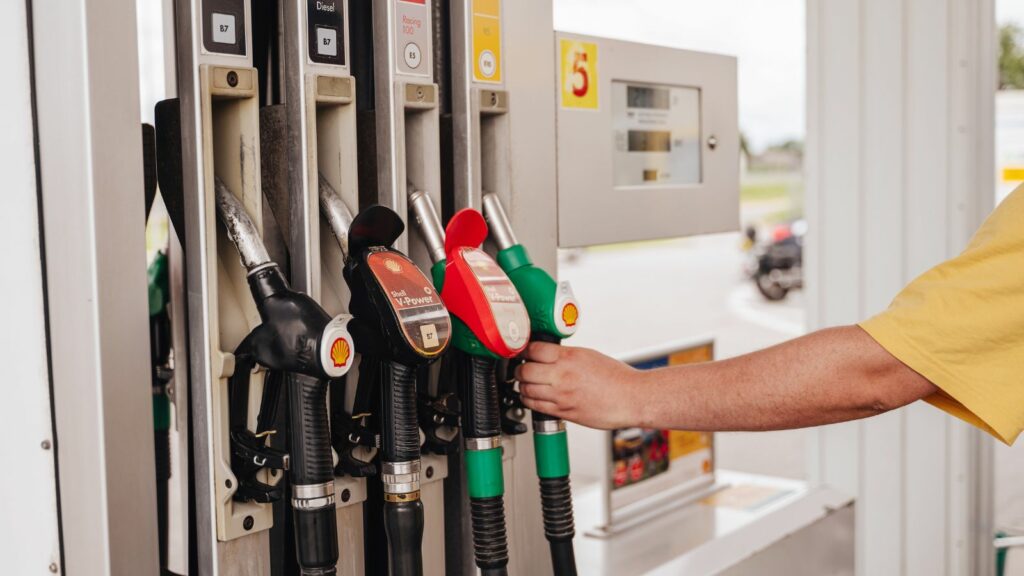
Gasoline prices have become an early pocketbook battleground in Quebec’s 2026 election campaign. Quebec Conservative Leader Éric Duhaime is promising to pull the province out of its cap-and-trade carbon market and suspend Quebec’s gasoline tax for at least five months, a combination his party says would reduce pump prices by roughly 33 cents a litre.
The proposal is unusually tangible: at a Lévis gas station, Duhaime illustrated it by saying gasoline selling for $1.83 a litre could instead cost about $1.50. But the headline reduction remains a campaign estimate rather than a guaranteed retail-price change. The plan would also remove a major source of climate-program revenue, turning what sounds like a simple tax cut into a larger debate over household affordability, transportation policy and how Quebec finances its emissions-reduction strategy.
The 33-Cent Promise Is Built From Two Different Policies
The first part of the Conservative proposal is straightforward: suspend Quebec’s provincial gasoline tax for at least five months. The regular provincial rate on gasoline is 19.2 cents per litre, although Revenu Québec notes that rates can be higher or lower in certain regions. The second component is more structural. A Conservative government would withdraw Quebec from its carbon market, removing the compliance cost associated with greenhouse-gas emissions from gasoline and other fuels.
Together, Duhaime says those moves could lower gasoline by approximately 33 cents a litre. During the August 29 announcement in Lévis, he used a real-world illustration, saying a posted price of $1.83 could have been roughly $1.50 under his plan. That makes the policy immediately understandable to motorists: at the party’s claimed 33-cent reduction, filling a 50-litre tank would cost $16.50 less. Whether every cent ultimately appears at the pump, however, depends on wholesale prices, competition and tax pass-through.
Quebec’s Carbon Market Is Not a Fixed Per-Litre Tax
Quebec’s carbon-pricing system operates differently from the familiar 19.2-cent gasoline tax. Fuel distributors are required to account for emissions associated with fuels they sell, purchasing or surrendering emission allowances under the province’s cap-and-trade system. Quebec has linked its carbon market with California, creating a joint allowance market in which the price of carbon can rise or fall from one auction to another.
That distinction matters because there is no permanently legislated carbon-market charge of exactly 11 cents on every litre. At the August 19, 2026 joint Quebec-California auction, current-year emission units sold for C$45.11 per tonne. Those compliance costs eventually form part of the economics of selling gasoline, and the Conservatives argue that removing them would materially lower prices. The party is therefore combining a clearly defined 19.2-cent tax suspension with the estimated retail impact of eliminating a market-based carbon cost to reach its roughly 33-cent headline figure.
Suspending Quebec’s Fuel Tax Would Carry a Significant Fiscal Cost
The provincial gasoline-tax portion is the most immediate part of the plan. Quebec currently imposes a regular 19.2-cent-per-litre tax on gasoline, meaning its suspension could represent a noticeable saving whenever motorists fill their tanks. The Conservatives say they would keep the tax at zero for at least five months, targeting relief toward households that depend heavily on vehicles, including families outside major urban centres.
The party estimates that the five-month pause would cost the provincial treasury approximately $600 million. That is an important part of the policy calculation: unlike withdrawing from the carbon market, which the Conservatives say would be accompanied by eliminating programs financed by carbon revenue, suspending the gasoline tax directly reduces existing tax receipts. A household driving long distances would receive more dollar-value relief than one using little gasoline, while a household relying on public transit or an electric vehicle would receive little or no direct benefit. The measure is therefore broad but strongly linked to fuel consumption.
Ottawa’s Temporary Gas-Tax Holiday Could Complicate What Drivers See
There is another moving part at the pump that Quebec does not control. The federal government temporarily reduced the federal gasoline excise tax from its normal 10 cents per litre to zero beginning April 20, 2026. That federal suspension runs only through September 7, meaning the 10-cent charge is scheduled to return on September 8.
That timing matters when assessing any promise based on the gasoline price seen during the Quebec campaign. A motorist could experience a federal tax increase while provincial parties are simultaneously proposing reductions of their own. Ottawa estimated its temporary fuel-tax suspension would provide more than $2.4 billion in tax relief nationally during 2026. The Quebec Conservatives’ 33-cent calculation should therefore be understood as the estimated effect of their own provincial measures, not a promise that posted prices will necessarily be 33 cents lower than late-August prices after every other tax, crude-oil movement and refinery or wholesale price change is taken into account.
The Conservatives Put the Household Saving at $1,573
The Quebec Conservatives say abolishing the carbon-market charge and temporarily suspending the gasoline tax would save an average household $1,573. They have placed the proposal inside a much broader tax-cutting platform, which the party says would return $11,166 to an average household through several measures, including previously announced reductions in personal income tax.
The gasoline component offers an easy illustration of why the policy may resonate politically. A 33-cent reduction, if fully reflected at retail, translates into $16.50 on a 50-litre fill-up. For a household with two vehicles, long commutes or regular drives between smaller communities, those individual savings can accumulate quickly. But the party’s average-household estimate depends on assumptions about fuel use and the duration of the measures, and the announcement does not provide a detailed household-by-household methodology. The actual gain would therefore vary considerably: heavy gasoline users would receive more, while households driving sparingly would capture substantially less.
A Tax Cut Does Not Always Reach the Pump Dollar for Dollar
One of the biggest economic questions is how much of a fuel-tax reduction retailers ultimately pass on to customers. Duhaime has rejected the suggestion that oil companies or gasoline retailers would simply absorb the available space through higher margins. Yet research on previous gasoline-tax holidays suggests the amount passed through to motorists can vary depending on local competition, supply constraints and market conditions.
A 2024 study in Energy Economics examined gasoline-tax suspensions across 108 cities in 15 U.S. East Coast states and the District of Columbia. It estimated average pass-through of 79%, meaning consumers received most, but not all, of the tax reduction on average. The results also varied significantly between places. That does not predict exactly what would happen in Quebec, whose fuel market and policy structure differ, but it provides a useful caution. A legislated tax reduction can be calculated precisely; the resulting change on a station’s roadside price sign is ultimately determined within a functioning market.
Scrapping the Carbon Market Would Remove Billions in Climate Financing
Leaving Quebec’s carbon market would have consequences well beyond gasoline prices. Provincial law directs carbon-auction proceeds into the Electrification and Climate Change Fund, which finances programs intended to reduce emissions, improve energy efficiency and help households, businesses, municipalities and institutions adapt to a lower-carbon economy.
By June 17, 2026, Quebec’s carbon auctions had generated roughly $11.55 billion in cumulative proceeds. The August 19 auction subsequently produced another approximately $312 million in gross Quebec revenue, with the province saying the carbon market had generated more than $11.8 billion to date. The Conservatives argue that abolishing the carbon market would have no net fiscal cost because they would also eliminate the spending financed through those proceeds. That makes the proposal fundamentally different from merely lowering a tax. It would dismantle an existing revenue-and-program structure, forcing Quebec to either discontinue associated initiatives, redesign them or find another way to finance any programs a future government chose to retain.
Transportation Makes the Climate Trade-Off Especially Important
The debate is especially consequential because transportation remains Quebec’s largest source of greenhouse-gas emissions. The province’s latest inventory shows transportation accounted for 44.8% of Quebec emissions in 2023. Road transportation alone represented 33.4% of the provincial total. Those figures explain why policies affecting gasoline, vehicles and electrification occupy such an important place in Quebec’s climate strategy.
Quebec has committed to reducing emissions 37.5% below 1990 levels by 2035 and reaching carbon neutrality by 2050. Carbon pricing is one instrument intended to help move consumption and investment toward lower-emission alternatives. The Conservatives are making a different affordability calculation, arguing that the price signal imposes disproportionate costs on people who cannot easily stop driving or buy an electric vehicle. For a rural family with no practical public-transit alternative, that argument can feel concrete. For supporters of carbon pricing, however, making gasoline cheaper could weaken incentives designed to reduce fossil-fuel consumption over the longer term.
The Proposal Creates a Clear Election Choice Over Cost and Climate Policy
The promise arrived on the third day of Quebec’s provincial election campaign, with voters scheduled to cast ballots on October 5 across a newly configured map of 127 electoral districts. Against competing commitments on transit, immigration, business regulation and public services, Duhaime has chosen a policy whose advertised benefit can be displayed directly on a gas-station sign.
Its political simplicity hides a more complicated policy choice. Suspending the 19.2-cent fuel tax would provide temporary and readily measurable tax relief but reduce provincial revenue. Leaving the carbon market could remove an additional cost embedded in fossil fuels, while simultaneously eliminating a system that has generated more than $11.8 billion for climate initiatives. And the promised 33-cent retail reduction ultimately depends on how completely those savings are passed through. The Conservatives are effectively asking voters to prioritize lower near-term driving costs and a smaller climate-policy apparatus; opponents must make the case for preserving the existing price signal and the programs it finances.
