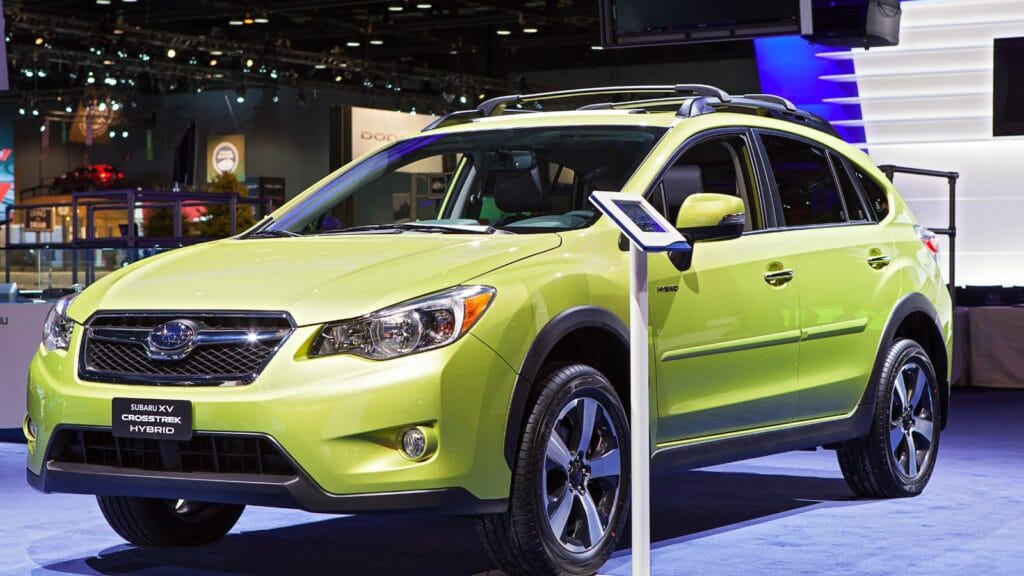
For Canadian drivers considering a fuel-efficient SUV without giving up all-wheel drive, Subaru has introduced a more affordable option. The company announced pricing for its 2027 Crosstrek lineup on October 13, 2026, confirming a new Hybrid Onyx model with a starting price of C$36,995.
That is C$3,500 less than the C$40,495 Hybrid Limited, previously the only hybrid configuration available in the Crosstrek family. Despite the lower price, the new model retains Subaru’s 194-horsepower hybrid system, standard full-time all-wheel drive and the manufacturer’s estimated maximum range of 1,000 kilometres.
The announcement arrives as Canadian motorists increasingly turn toward hybrids to reduce fuel consumption without depending on charging stations. Subaru’s expanded lineup offers more choice, although differences in equipment, cargo space and final purchase costs mean the lower starting price is only part of the story.
Subaru Introduces a More Affordable Hybrid Onyx
Subaru Canada’s October 13 announcement confirms that the 2027 Crosstrek Hybrid Onyx will start at C$36,995 before freight, fees and taxes. The addition creates a second hybrid option within the compact SUV lineup, making the electrified powertrain available without requiring customers to purchase the highest equipment package. The existing Hybrid Limited now carries a manufacturer’s suggested retail price of C$40,495. Both versions use the same 194-horsepower hybrid system, meaning the C$3,500 difference primarily reflects changes in equipment and interior appointments rather than the vehicle’s fundamental powertrain.
The pricing change is particularly meaningful because the 2026 Crosstrek offered its hybrid system exclusively in the Hybrid Limited, which had an MSRP of C$40,595. The new Hybrid Onyx therefore lowers the entry price for a hybrid Crosstrek by C$3,600 compared with last year’s only hybrid offering. For buyers interested mainly in fuel savings and all-wheel-drive capability, Subaru has removed a substantial part of the previous financial barrier without requiring them to move into a smaller or less powerful vehicle.
The Hybrid Costs Just $1,600 More Than a Gasoline Onyx
Another important comparison sits directly below the new hybrid in Subaru’s price list. The gasoline-powered 2027 Crosstrek Onyx starts at C$35,395, making the Hybrid Onyx exactly C$1,600 more expensive. That relatively narrow difference could influence customers who were already considering the Onyx equipment package. Instead of paying several thousand dollars to reach the most expensive Crosstrek, buyers can now add hybrid technology while keeping the vehicle close to the middle of the range. The hybrid also delivers 14 additional horsepower compared with the conventional 2.5-litre engine.
The wider Crosstrek lineup contains six trims. Convenience starts at C$30,695, Touring at C$33,895, Onyx at C$35,395, Hybrid Onyx at C$36,995, Limited at C$38,495 and Hybrid Limited at C$40,495. Four use gasoline-only engines, while two offer hybrid power. This structure gives customers a clearer choice between lower purchase costs, improved fuel efficiency and premium features. A driver comparing the gasoline Onyx with the Hybrid Onyx can focus on the smaller C$1,600 premium rather than the much larger difference between the base vehicle and the fully equipped hybrid.
A 194-Horsepower Hybrid System Powers Both Models
The new Hybrid Onyx uses Subaru’s series-parallel hybrid system, combining a naturally aspirated 2.5-litre BOXER gasoline engine with an electric motor generator, electric traction motor and 1.1-kWh lithium-ion battery. Power reaches the wheels through a Hybrid Lineartronic continuously variable transmission. The combined system produces 194 horsepower, compared with 180 horsepower from the conventional gasoline Crosstrek. Subaru designed this arrangement to improve efficiency while maintaining the familiar driving characteristics of its horizontally opposed engine layout and mechanically driven all-wheel-drive system.
Unlike a plug-in hybrid, the Crosstrek Hybrid does not require an external charging cable. Its relatively small battery works with the gasoline engine, and regenerative braking helps recover energy during deceleration. This makes the technology particularly practical for households without a driveway, home charger or convenient access to public charging stations. The vehicle can use electric assistance during suitable driving conditions, but it should not be confused with a battery-electric SUV designed for extended gasoline-free travel. The system’s main advantage is reducing fuel consumption while preserving conventional refuelling convenience.
Fuel Economy Is Where the Hybrid Makes Its Strongest Case
Subaru’s Canadian specifications list fuel consumption of 6.5 litres per 100 kilometres in both city and highway testing for the 2027 Crosstrek Hybrid. The gasoline-only 2.5-litre model is rated at 9.0 L/100 km in the city and 7.1 L/100 km on the highway. Those numbers suggest the hybrid’s greatest advantage appears in urban driving, where repeated acceleration and braking create more opportunities for electric assistance and energy recovery. Highway savings are smaller, although the hybrid remains more efficient under Subaru’s published test figures.
Consider a hypothetical driver covering 15,000 kilometres annually under conditions matching the published city test. The difference between 9.0 and 6.5 L/100 km represents approximately 375 litres of gasoline over that distance. At an illustrative fuel price of C$1.60 per litre, that would equal C$600 in annual savings. Real-world results will differ, particularly for drivers who spend more time on highways. Fuel prices, winter temperatures, driving style and vehicle loading also matter. Still, the smaller C$1,600 purchase-price premium over the gasoline Onyx makes the potential savings worth examining.
Subaru Promises Up to 1,000 Kilometres Between Fill-Ups
One of the strongest claims attached to the new Crosstrek Hybrid is its estimated maximum driving range of 1,000 kilometres on a single tank of gasoline. Both hybrid trims carry a 63-litre fuel tank, allowing the electric assistance system and gasoline engine to work together over extended journeys. Subaru bases its advertised maximum range on estimated fuel-economy performance under prescribed testing conditions. It is not a guarantee that every driver will achieve four-digit mileage between visits to the gas station.
For Canadian families, the appeal is easy to understand. A long weekend trip from Toronto into cottage country, or a journey across less densely populated parts of the Prairies, becomes easier when fuel stops are relatively infrequent. Unlike battery-electric vehicles, the Crosstrek Hybrid does not require drivers to plan around charging-station availability. However, highway speeds, strong headwinds, mountainous terrain and winter temperatures can reduce actual range. Subaru’s estimated maximum should therefore be treated as an indication of the vehicle’s potential efficiency rather than a distance drivers can automatically expect from every full tank.
Full-Time All-Wheel Drive Remains Standard Across the Lineup
Subaru has retained one of the Crosstrek’s defining mechanical features: Symmetrical Full-Time All-Wheel Drive. Every 2027 Crosstrek includes the system, whether equipped with the gasoline engine or the new hybrid powertrain. Unlike some hybrid arrangements that rely on a separate electric motor to drive the rear axle, Subaru’s system continues transferring power mechanically through its drivetrain. The Hybrid Onyx also includes the dual-function version of X-MODE, offering settings intended to improve vehicle control on snow, dirt, deep snow and muddy surfaces.
The SUV retains 220 millimetres of ground clearance, an important consideration for drivers dealing with uneven cottage roads, snow-covered driveways and occasional gravel trails. Its fully independent suspension is designed to balance everyday comfort with rough-road capability. Those characteristics help distinguish the Crosstrek from crossovers focused almost entirely on urban efficiency. Still, all-wheel drive does not replace suitable tires or careful winter driving. The hybrid system may reduce fuel consumption, but traction and braking remain influenced by road conditions. Subaru’s decision to preserve the drivetrain gives customers a fuel-saving option without abandoning the model’s traditional versatility.
The Hybrid Onyx Still Includes Substantial Technology
The lower-priced hybrid is not a stripped-down version of the Crosstrek. It builds on the gasoline Onyx’s equipment, which includes distinctive dark-finish 18-inch alloy wheels, yellow interior accents, a 10-way power-adjustable driver’s seat and dual-function X-MODE. The Hybrid Onyx also receives an 11.6-inch touchscreen infotainment system with navigation functionality, wireless Apple CarPlay and Android Auto, and six speakers. Subaru’s DriverFocus distraction-mitigation technology and MySubaru connected services are among its included features.
A particularly noticeable upgrade is the 12.3-inch digital instrument cluster, reserved for the two hybrid models. It replaces the conventional analogue gauge arrangement with a configurable display that can show driving information and navigation details. Subaru has also improved the wireless smartphone charging system for 2027, while the vehicle’s exterior now uses HYBRID badges instead of the previous e-BOXER designation. These changes may sound modest individually, but they help make the Hybrid Onyx feel like a modern, well-equipped SUV rather than a discounted alternative. Buyers still receive much of the everyday technology expected in this price category.
Paying $3,500 More Gets the Hybrid Limited’s Premium Interior
The Hybrid Limited occupies the top of the Crosstrek range with an MSRP of C$40,495. Its main appeal is a more upscale cabin rather than additional horsepower. The higher trim includes leather seating surfaces, premium interior appointments and a 10-speaker Harman Kardon audio system. The less expensive Hybrid Onyx uses a six-speaker audio system and a less luxurious interior treatment. Both share the same basic hybrid powertrain and 12.3-inch digital instrument cluster, so buyers are not giving up the hybrid system’s principal performance and fuel-economy advantages by choosing the lower-priced version.
There is also one notable reduction in equipment for 2027. Subaru has removed the surround-view 360-degree camera previously associated with the Limited grades. Customers paying for the Hybrid Limited should therefore not assume that every feature from the preceding model year has been retained. The decision becomes a familiar automotive trade-off: upgraded materials and sound quality against a C$3,500 saving that could instead cover insurance, maintenance or fuel. For drivers who prioritize efficiency and capability over luxury, the Hybrid Onyx makes a compelling argument on paper.
The Hybrid Battery Reduces Available Cargo Space
The hybrid powertrain introduces a practical compromise that may matter more to some families than the differences between trim levels. Subaru’s Canadian specifications list 527 litres of cargo capacity behind the rear seats for the hybrid versions, compared with 564 litres for gasoline-only Crosstreks. That represents a reduction of 37 litres. With the rear seats folded, hybrid cargo capacity reaches 1,433 litres, versus 1,549 litres in the gasoline models. The lithium-ion battery and associated hybrid components take up space that would otherwise be available for luggage or equipment.
The difference will not necessarily be obvious during a short dealership visit. Grocery bags, sports equipment and ordinary weekend luggage may fit without difficulty. However, a family packing camping equipment, a stroller and several suitcases could discover that the hybrid’s slightly smaller cargo area requires more careful organization. The Crosstrek still offers seating for five, roof rails and a 60/40-split folding rear bench. Buyers who frequently carry bulky items should compare the cargo compartments directly rather than relying on the vehicle’s exterior dimensions, which remain effectively the same across the lineup.
Subaru Retains a Broad Collection of Safety Features
The 2027 Crosstrek Hybrid Onyx includes Subaru’s EyeSight driver-assistance technology, which is standard throughout the model range. Its camera-based features include adaptive cruise control, lane-centring assistance, pre-collision braking and Emergency Stop Assist. The Hybrid Onyx also benefits from available systems found on higher Crosstrek trims, including blind-spot monitoring, rear cross-traffic alert and Reverse Automatic Braking. DriverFocus uses an interior camera to monitor signs of driver distraction or fatigue and provide warnings when attention appears to be slipping.
These technologies have practical value beyond their descriptions on an equipment sheet. Rear cross-traffic alerts can help when backing out of a crowded parking space, while adaptive cruise control can reduce some of the effort involved in long highway journeys. Reverse Automatic Braking may also intervene when the system detects an imminent collision with an obstacle behind the vehicle. However, Subaru emphasizes that driver-assistance systems have operating limitations and do not replace attentive driving. Weather, visibility and road conditions can affect their performance. The significant point is that choosing the less expensive hybrid does not mean sacrificing the Crosstrek’s central active-safety package.
The Advertised $36,995 Is Not the Final Purchase Price
Canadian shoppers should distinguish between the manufacturer’s suggested retail price and the amount required to drive a new vehicle home. Subaru lists the Hybrid Onyx at C$36,995 MSRP, but its October 2026 announcement provides an estimated vehicle price of C$40,056 after including freight, pre-delivery inspection, air-conditioning charges and maximum specified dealer and other fees. The Hybrid Limited carries an estimated vehicle price of C$43,552 using the same approach. Neither estimate includes sales taxes, licensing, registration or insurance, which can increase the total considerably.
Actual quotations can also vary depending on the province, dealership, accessories and available promotions. Subaru’s online configurator displays different fee-inclusive figures in certain locations, reinforcing why customers should request a written, itemized quote. Some paint choices also cost extra; Sand Dune Pearl is listed at an additional C$300 on eligible trims. Another consideration is government assistance. The Crosstrek Hybrid is a conventional, non-plug-in hybrid, so it does not qualify for Canada’s federal Electric Vehicle Affordability Program incentives reserved for eligible battery-electric, fuel-cell and plug-in hybrid vehicles. Buyers should evaluate the actual transaction price without assuming an EV rebate will reduce it.
Canada’s Growing Hybrid Market Gives Subaru an Opportunity
The timing of Subaru’s expanded hybrid lineup reflects a broader shift in Canadian vehicle purchasing. Statistics Canada reported that registrations of new conventional hybrid vehicles increased 39.5% in the second quarter of 2026 compared with the same period in 2025. Battery-electric registrations increased 37.4%, while plug-in hybrids rose 8.0%. Across all powertrain types, Canadians registered 547,673 new vehicles during the quarter, the highest second-quarter total since 2019. These numbers suggest that growing demand for electrified vehicles extends well beyond fully electric models.
Competition remains important. The Toyota Corolla Cross Hybrid already offers an alternative for customers seeking a compact, fuel-efficient crossover, while manufacturers are expanding their own hybrid selections. Subaru’s advantage lies in pairing a familiar SUV format with standard mechanical all-wheel drive and a relatively modest premium over its gasoline Onyx. Its challenge is convincing buyers that the fuel savings, equipment and driving characteristics justify the added cost and reduced cargo capacity. The C$36,995 Hybrid Onyx will not be the cheapest Crosstrek, nor is it necessarily the most economical hybrid in its class. But it gives Canadian customers a more accessible way to choose Subaru’s electrified powertrain without moving directly to the highest-priced trim.
