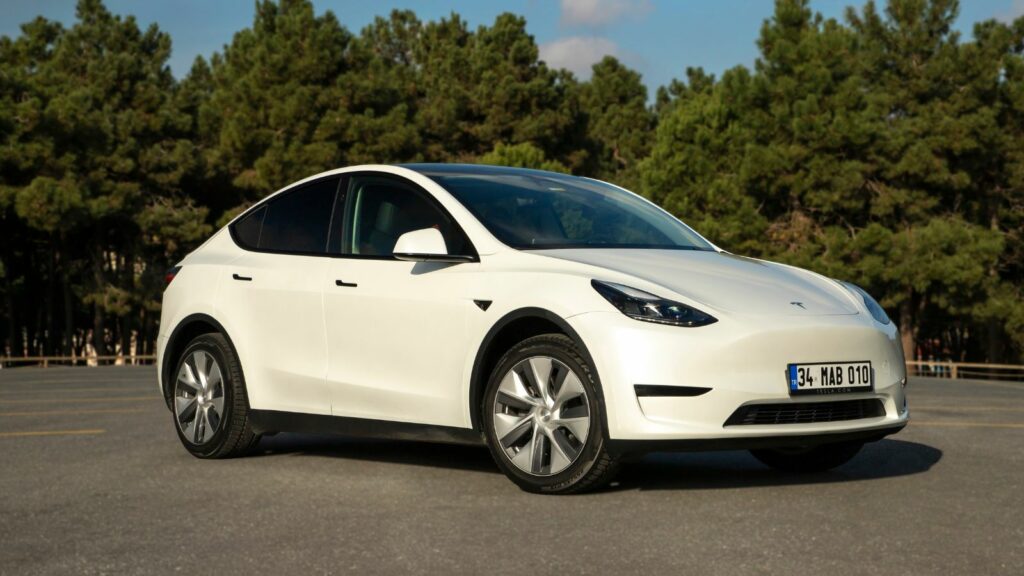
For a few hours, Tesla’s Canadian Model Y lineup appeared to gain one of the most practical features an electric vehicle can offer while parked. The company’s website showed Vehicle-to-Load capability for the Model Y Premium All-Wheel Drive and Performance, allowing stored battery energy to run external electrical devices through the charging port.
Then the wording disappeared.
The change lasted less than a day, according to screenshots and website checks documented on October 9. Tesla has not publicly explained the reversal, leaving Canadian buyers with an unusual contradiction: the technology is expanding quickly on Model Y vehicles in other markets, while Tesla’s Canadian documentation and accessory store currently indicate that local owners should not count on having it.
The Feature Appeared and Disappeared Within Hours
The sequence moved quickly enough that a shopper checking Tesla’s website on Thursday evening and again on Friday afternoon could have seen two different vehicles on paper. Drive Tesla captured Canadian specifications showing Vehicle-to-Load, or V2L, on both the Model Y Premium AWD and Model Y Performance. The displayed specification described 120-volt, 20-amp AC output through the charge port when using Tesla’s Outlet Adapter.
By Friday afternoon, October 9, that wording had vanished. Drive Tesla updated its original report at 4:15 p.m. Pacific time to note that Tesla had removed V2L from the Model Y page. The publication later reported that neither Canadian variant continued to show the capability. There was no accompanying Tesla announcement explaining why the specification had appeared, why it was removed or whether it represented a feature that had been posted prematurely. That leaves an important distinction: the website briefly advertised V2L, but that alone does not establish that Canadian vehicles actually received functioning V2L hardware or software.
What Tesla Had Promised Was More Than a Minor Convenience
The removed specification was relatively specific. Tesla’s Canadian Model Y page reportedly described “Vehicle to load (120V 20A AC)” using the charge port and Outlet Adapter. At 120 volts and a maximum of 20 amps, Tesla’s own adapter specification is rated for up to 2.4 kilowatts of power. That turns the vehicle battery into something resembling a very large portable power station rather than simply an energy source reserved for driving.
A 2.4-kW outlet cannot run every electrical load imaginable, but it can be useful in ordinary situations. Tesla’s U.S. marketing specifically mentions equipment such as space heaters, e-bikes and power tools, while other Tesla material illustrates laptops, lights and refrigerators. For someone camping, working away from an electrical outlet or dealing with a temporary power interruption, that capability can make the energy stored in an EV useful when the vehicle is stationary. That practical utility is why the Canadian listing attracted attention despite appearing to be a relatively small specification change.
The Canadian Outlet Adapter Never Matched the Vehicle Listing
Even while Tesla’s Canadian Model Y page was displaying V2L, another part of the company’s website told a different story. Tesla Canada’s Outlet Adapter listing identifies the accessory as a 120-volt, 20-amp device with maximum output of 2.4 kW, but its compatibility note says the adapter is currently available only with Cybertruck. The Canadian shop lists a retail price of C$110 and, at the time checked, also showed the accessory as out of stock.
Tesla requires more than the small adapter itself. Its instructions say the Outlet Adapter works with the Gen 3 Mobile Connector, which plugs into the vehicle’s charging port. The electrical device then connects to the adapter on the opposite end of the Mobile Connector. That means Canadian Model Y buyers briefly faced an awkward situation: the vehicle page appeared to promise V2L while the official accessory page still said the hardware needed to use that function was a Cybertruck product. The inconsistency existed before Tesla removed the Model Y claim, making the rollout look incomplete even during the short period when the feature was advertised.
Tesla’s Canadian Owner’s Manual Still Explicitly Excludes Canada
The strongest reason for Canadian buyers to remain cautious comes from Tesla’s own Model Y owner documentation. The Canadian manual contains a section explaining how electrical devices can be powered through the charge port using a Gen 3 Mobile Connector and Tesla Outlet Adapter. Yet the same section says the adapter is available for Model Y Performance while specifically excluding Canada. It also repeats the 120-volt, 20-amp and 2.4-kW maximum specifications.
That language is difficult to reconcile with the feature that appeared briefly on Tesla Canada’s vehicle page. The manual even explains how a compatible vehicle manages V2L: owners can set a battery discharge limit, power shuts off when battery charge drops beneath that threshold, and Powershare can be controlled through the touchscreen or Tesla mobile app. Tesla therefore clearly has documentation for how the function operates. The issue is regional eligibility. As the Canadian documentation currently stands, instructions for the technology exist while Model Y availability in Canada is expressly restricted. Until Tesla changes those documents, the safer interpretation is that Canadian Model Y V2L is not officially supported.
The U.S. Model Y Tells a Very Different Story
Crossing the border changes the picture substantially. Tesla’s U.S. Outlet Adapter listing currently names Model Y Premium, Model Y Performance vehicles produced in 2025 or later, and Cybertruck as compatible. The accessory is listed at US$80. Tesla’s American Model Y page also actively promotes the ability to use the vehicle battery to power devices and appliances, describing it as “Enough Power to Share.” In other words, the functionality that vanished from the Canadian page is openly marketed to American buyers.
Tesla had already broadened U.S. Model Y V2L availability before the Canadian website incident. In August 2026, the Outlet Adapter became available for Model Y Premium variants in the United States after initially being associated with more limited configurations. By October, Tesla’s broader Powershare strategy had expanded further. The regional contrast therefore cannot be dismissed as Tesla lacking the underlying technology. V2L exists, Tesla sells the hardware, and compatible Model Ys can use it. The unanswered question is why Canadian specifications briefly suggested the same rollout before retreating.
V2L and Home Backup Are Related but Not the Same Feature
The terminology can become confusing because Tesla now uses the Powershare name across several kinds of power export. Vehicle-to-Load is the simpler function involved in the Canadian website change. It uses an adapter to turn the vehicle’s charging connection into a conventional electrical outlet. Vehicle-to-Home, or V2H, goes considerably further by allowing the EV battery to supply an appropriately configured house during an electrical outage.
Tesla recently expanded Powershare Home Backup to eligible Model 3 and Model Y vehicles in the United States and Puerto Rico. For those cars, Tesla says a Powerwall and either a Universal Wall Connector or Wall Connector 3 are required. New Model 3 and Model Y vehicles ordered in the U.S. and Puerto Rico after October 1, 2026 are Powershare-capable by default, while some earlier vehicles can also support it. Tesla identifies PCS2 Lite as the bidirectional inverter technology used by Model 3 and Model Y. The Canadian V2L listing did not mean Canadian owners were suddenly promised full home backup; it concerned the smaller 2.4-kW portable-output function.
Tesla Canada’s Powershare Page Still Centres on Cybertruck
Tesla’s regional Powershare pages make the Canadian-U.S. difference even clearer. The Canadian version currently describes Powershare primarily through Cybertruck. It says Powershare is available for Cybertruck and not for Model S, Model 3, Model X or Model Y. It also details Cybertruck’s much greater electrical output, including its onboard 120-volt and 240-volt outlets and the ability to deliver substantially more power than the Model Y’s portable adapter.
The American support material has already moved beyond that limitation. It explicitly discusses Model 3 and Model Y owners using Powershare Home Backup and instructs owners to check whether their vehicle supports the feature through the touchscreen under Software and Additional Vehicle Information. Tesla estimates that Premium and Performance versions of Model 3 and Model Y can extend home backup for more than two days under its stated assumptions when paired with the appropriate equipment. Canada’s customer-facing Powershare material has not made the same transition. That regional documentation makes the short-lived Model Y V2L listing look even more isolated from Tesla’s official Canadian support structure.
Canadian Model Y Performance Buyers Have Seen This Confusion Before
The October reversal is not the first Canadian question surrounding Model Y power output. Earlier in 2026, Canadian Model Y Performance owners encountered conflicting information about V2L. Drive Tesla reported in April that the capability marketed on Model Y Performance vehicles in other countries was missing from Canadian versions. The publication examined Tesla parts information and raised questions about whether Canadian vehicles had the necessary bidirectional power-conversion hardware.
The confusion continued into the summer. When Tesla expanded Model Y Premium V2L availability in the United States in August, the Canadian Outlet Adapter page no longer identified Model Y Performance as compatible. Drive Tesla reported that some Canadian customers had previously received different explanations, ranging from suggestions that V2L was awaiting approval to statements that particular vehicles lacked the required hardware. Those reports are not a substitute for an official Tesla engineering statement, but they make the October website reversal more consequential. Canadian shoppers were already looking for clarity when Tesla briefly appeared to provide it—and then withdrew it within hours.
Existing Owners Should Not Assume a Software Update Will Solve Everything
Tesla’s ability to add vehicle features through over-the-air updates can create the impression that almost any missing capability may eventually appear through software. Bidirectional power output is more complicated. Tesla’s current U.S. Powershare documentation identifies compatible power-conversion hardware and tells owners of older Model 3 and Model Y vehicles to check whether “Powershare Support” is enabled in Additional Vehicle Information. Some older vehicles qualify; others do not.
That hardware dependence matters for Canada. The temporary Canadian website listing does not establish that Model Y Premium AWD or Performance vehicles already delivered there contain everything necessary for V2L. Nor has Tesla announced a Canadian retrofit program or promised that previously delivered vehicles will receive the function through an OTA update. Until the company provides VIN-level eligibility guidance, Canadian owners should avoid assuming that a future software release will be enough. Tesla’s current Canadian manual and accessory listing remain the more concrete references, and both continue to place restrictions on Model Y use of the Outlet Adapter.
The Disappearing Specification Matters Most to Buyers With Pending Orders
A specification that survives for less than 24 hours might look trivial, but timing makes it relevant for customers actively configuring vehicles. Someone placing an order while V2L was listed could reasonably have considered the feature part of the vehicle’s advertised equipment, especially because Tesla provided voltage, current and adapter details rather than a vague reference to future functionality. Drive Tesla specifically noted the importance of clarification for buyers who might have ordered while the specification was visible.
There is nevertheless no evidence that Tesla deliberately attempted to mislead Canadian shoppers, and the cause of the change remains unknown. It could have been a premature publication, a regional website error, a delayed launch or another mismatch between vehicle hardware and Tesla’s online content. None of those possibilities has been confirmed. What can be established is narrower: V2L appeared on the Canadian Model Y page, the required Canadian accessory listing still did not recognize Model Y compatibility, and Tesla removed the vehicle-page claim less than a day later without publicly explaining the discrepancy.
Canada Is Still Waiting for a Clear Answer
Tesla now has a straightforward way to end the uncertainty. It can confirm whether newly produced Canadian Model Y Premium AWD and Performance vehicles contain V2L-capable hardware, identify any build-date or VIN limitations, update the Canadian Outlet Adapter compatibility list, and state whether vehicles already delivered can gain the feature. Until those pieces align, website screenshots alone are not enough to establish that a Canadian Model Y can export power.
The broader direction of Tesla’s technology suggests why Canadian owners are watching closely. Model Y V2L is already supported in markets including the United States, while Tesla has expanded more advanced Powershare Home Backup functionality for new American Model 3 and Model Y orders. The Canadian market is therefore not waiting for Tesla to invent the capability; it is waiting for Tesla to say which vehicles can actually use it locally. As of October 10, the evidence remains contradictory in places, but the practical conclusion is clear: Canadian Model Y buyers should treat V2L as unavailable unless Tesla explicitly reinstates and supports the feature.
