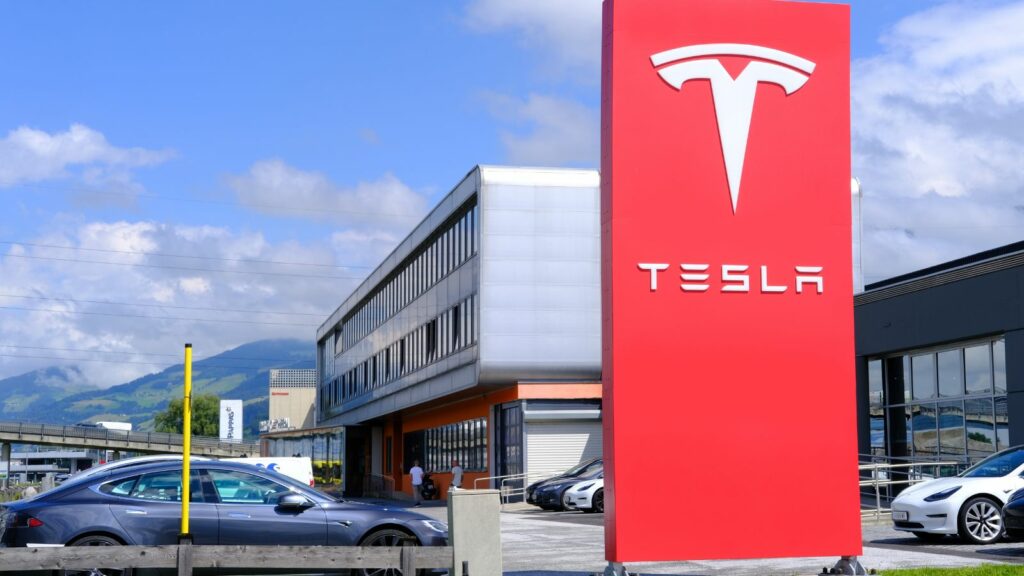
Fast charging in Canada is no longer limited to waiting for a charging-network operator to pick a property. Tesla has opened its Supercharger for Business program to Canadian companies, allowing site owners to purchase V4 Supercharger equipment directly and build customer-owned fast-charging locations with Tesla’s software and service layer behind them. The threshold is notable: Tesla requires a minimum purchase of four charging posts.
The move turns Tesla’s charging platform into a commercial product for retailers, hotels, fuel stations, parking operators, workplaces, residential properties and municipalities—not only a network that drivers visit. It also arrives as Canadian EV registrations are recovering and public fast-charging demand is climbing. For businesses, the proposition could be attractive, but the hardware is only one part of the investment and Tesla does not publish a standard Canadian purchase price.
Canadian Businesses Can Now Buy the Charging Asset Instead of Only Hosting It
Tesla has long invited Canadian property owners to apply to host Superchargers, with site selection based on factors such as network expansion needs, route popularity and location. Supercharger for Business creates another path. Instead of relying solely on Tesla’s host-selection process, a company can purchase Supercharger equipment for its own property. Tesla’s Canadian program requires at least four charging posts per order, a floor that makes the offer relevant to smaller commercial sites while still pushing buyers beyond the one- or two-charger installations seen at many public charging locations. Tesla’s Canadian inquiry form specifically lists property categories including convenience stores, gas stations, lodging and resorts, workplaces, parking garages, retail, restaurants, residential properties, municipalities and recreational sites. That range suggests Tesla is targeting far more than highway service centres.
Ownership also brings more control. Tesla says the chargers can be white-labelled, while the business can monitor utilization, adjust charging prices and track financial performance through a management portal. The customer can hire a preferred installer, with a Tesla design or project engineer supporting the technical process, while Tesla provides commissioning support, network operations and required equipment servicing. In practical terms, a hotel group could decide that four fast chargers fit a busy highway property, while a shopping centre could deploy more stalls and use charging as both an amenity and a revenue-producing service. The distinction matters because it opens another route for expansion: Tesla no longer has to be the party making every individual site-investment decision. Canadian businesses that believe their location can support fast charging can make that bet themselves while still using the hardware, software and support system developed around the Supercharger network.
V4 Hardware Brings Up to 500 kW and Support for Multiple Charging Standards
The equipment being offered is not a scaled-up home charger. Tesla’s V4 Supercharger post is rated for up to 500 kW for passenger vehicles, with a voltage range reaching 1,000 volts and a continuous-current rating of 615 amps. Tesla lists a three-metre cable and support for several charging standards, including NACS and CCS1, the two formats most relevant to the North American passenger-vehicle market, as well as CCS2, GB/T and MCS in the broader hardware specification. Tesla describes the business chargers as designed for compatible EVs rather than being limited to Tesla vehicles. That is important for a commercial property seeking higher utilization from a mixed population of Tesla and non-Tesla drivers. Still, the 500-kW figure is a hardware ceiling, not a promise that every vehicle will charge at that rate; the car’s battery, voltage architecture, charging curve, temperature and state of charge all influence the power it can actually accept.
Behind the charging posts, Tesla’s V4 cabinet can supply up to 1.2 MW of DC output shared across as many as eight posts. The company says its power-sharing architecture typically requires less than 1 MW across eight posts to deliver maximum available power to passenger vehicles 99% of the time, based on its operating data and system design. Tesla also lists cabinet efficiency above 96% and allows as much as 100 metres between the cabinet and charging post, giving designers more flexibility when fitting equipment into an existing parking lot. The software layer is equally central to the proposition. Tesla says charging locations can provide real-time stall availability, wait-time information and outage status, while compatible vehicles can use navigation and battery preconditioning to prepare for faster charging before arrival. For a business owner, the product is therefore more than a power pedestal. It is a charger connected to a mature routing, payment, monitoring and service ecosystem.
The Four-Post Minimum Still Leaves Businesses With a Real Infrastructure Project
A four-charger minimum may sound modest next to Tesla’s large highway Supercharger sites, but it can still represent a substantial property and electrical project. Tesla does not list a fixed Canadian price for the V4 system. Its ordering process asks for the installation address before generating an estimate or quote, reflecting the reality that the final economics depend on far more than the number of posts. Utility upgrades, transformers, switchgear, trenching, concrete work, parking-layout changes, permits and local labour can all affect a DC fast-charging project. Under Tesla’s business model, the customer is responsible for installation and standard site upkeep, while Tesla supplies project-engineering assistance and supports commissioning, network operations, driver assistance and equipment service. That division gives the property owner control, but it also means this is not a plug-and-play purchase comparable with installing four ordinary commercial appliances.
Whether a location pays off will depend heavily on utilization and the price a host chooses to charge. Paren’s latest Canadian fast-charging report counted 3.84 million charging sessions in the third quarter of 2026, up 37% from a year earlier, while national fast-charger utilization reached about 10.4%. Paren also put the average fast-charging price at roughly C$0.486 per kWh for the quarter. Those figures show a growing market, but they also underline why location matters: a charger beside a busy intercity route or high-traffic retail centre can perform very differently from one at a lightly visited property. Reliability and location matter just as much as headline charging speed. J.D. Power’s 2026 U.S. public-charging study found overall satisfaction with DC fast charging had climbed 12 points year over year to 666 on a 1,000-point scale, while the share of visits in which drivers arrived but could not charge fell to a study-low 12%. The highest satisfaction was recorded at chargers located at hotels, followed closely by gas stations or convenience stores and restaurants—many of the same property types Tesla is targeting in Canada.
Canada’s Growing EV Fleet Makes the Timing More Significant
The Canadian rollout lands as EV demand has begun to strengthen again. Statistics Canada recorded 58,811 new zero-emission vehicle registrations in the second quarter of 2026, up 26.7% from the same quarter a year earlier. ZEVs represented 10.7% of all new motor-vehicle registrations during the quarter, and battery-electric registrations alone increased 37.4% year over year. Charging infrastructure is growing too. Paren counted 2,740 public DC fast-charging stations with 9,615 ports nationwide at the end of the third quarter of 2026, up from 7,585 fast-charging ports one year earlier. Tesla remained the largest individual fast-charging network with 3,091 ports, or 32.1% of the national total, even as its market share declined because competing networks were also expanding. During Q3 alone, Canada added 391 fast-charging ports, including 88 from Tesla.
Even that expansion does not remove the longer-term infrastructure challenge. Natural Resources Canada’s charging-needs modelling estimates that the country will require about 234,000 public charging ports by 2030 and roughly 447,000 by 2035 under its baseline scenario, with an average of around 40,000 public ports needing to be installed annually between 2025 and 2040. Most of that requirement is expected to consist of Level 2 charging rather than ultra-fast DC equipment, so Supercharger for Business is only one piece of the buildout. Its significance is that it broadens the group that can finance and own the fast-charging layer. A restaurant chain, hotel operator, shopping centre, parking company or municipality no longer has to wait for a charging-network operator to prioritize its property. If the economics work, it can initiate a Tesla-equipped project itself. The four-post minimum creates a meaningful entry cost, but it also means participating properties begin with something more substantial than a token single charger as Canada’s EV population and expectations for dependable public charging continue to grow.
