
A car deal can look attractive until the numbers are gathered into one unavoidable total. The most revealing question is simple: “What is the complete out-the-door price, itemized in writing?” It shifts the conversation away from promotional language, monthly-payment theatre, trade-in distractions, and optional products that may appear late in the process.
A transparent dealership should be able to explain what the vehicle costs, which charges are mandatory, which products are optional, and how financing changes the final amount. These 12 sections show how that single question can expose a weak offer quickly, where hidden costs tend to appear, and what a credible answer should contain before any buyer signs.
Ask for the Complete Number, Not the Starting Price

The useful question is not merely, “What is the price?” It is: “What is the complete out-the-door price for this exact vehicle, including every fee and charge, itemized in writing?” The wording matters. “Out-the-door” asks for the amount required to complete the purchase, while “this exact vehicle” prevents the conversation from drifting toward a different trim, stock number, or promotional unit. “Itemized” requires the total to be broken into recognizable parts, and “in writing” creates something that can be checked later.
Consider a car advertised at $30,000. A verbal estimate may still omit an $899 documentation charge, a $1,500 protection package, taxes, registration, or a finance-related condition. In a hypothetical jurisdiction with an 8 percent sales tax and a $250 registration cost, those additions could push the final amount above $35,000. The point is not that every extra charge is improper. The warning appears when the dealer cannot state the total clearly, changes it repeatedly, or insists that the only meaningful number is the monthly payment.
It Tests Whether the Advertised Price Is Attainable

An advertised price is designed to attract attention, but it may not be the amount a buyer can actually pay. Asking for the itemized out-the-door figure forces the dealership to show whether the headline price survives contact with mandatory charges. In Ontario, for example, registered dealers generally must include the fees they intend to collect in the advertised price, apart from HST and licensing. Canadian competition authorities also describe “drip pricing” as promoting an unattainable price because mandatory charges appear later.
The practical test is simple. Suppose a listing shows $24,995, but the written total introduces a mandatory reconditioning fee, dealership preparation charge, security package, and administration fee. Even if each line has a professional-sounding label, the advertised bargain may have disappeared. A strong dealership can explain why every amount exists and whether it was already reflected in the advertised figure. A weak one may say that “every dealer charges it,” refuse to remove a supposedly optional product, or avoid sending the numbers until the buyer has travelled to the showroom and invested time in the vehicle.
It Separates Government Charges From Dealer Fees

The word “fee” can make a charge sound official even when it is set by the dealership. An itemized out-the-door quote separates taxes, title or licensing costs, and registration amounts from dealer-controlled charges such as documentation, preparation, electronic filing, market adjustment, or reconditioning. Rules differ widely by province, territory, and state, so the most important question is not whether a fee has a familiar name. It is whether the dealer can identify who receives the money, whether the amount is mandatory, and whether it is already included in the advertised price.
California provides a useful example of why labels matter. Its vehicle regulator says a dealer document-processing charge must not be represented as a governmental fee, and registration collections must be itemized properly. A buyer elsewhere should not assume California’s caps apply, but the distinction remains valuable. If a $700 “government documentation fee” turns out to be dealership revenue, the description is misleading even before the price is negotiated. Transparent paperwork names the recipient and purpose. Vague, bundled, or duplicated fees deserve immediate scrutiny.
It Stops the Monthly Payment From Controlling the Conversation

A monthly payment answers a budgeting question, not a pricing question. Dealers can lower the payment by extending the loan, increasing the down payment, applying a trade-in credit, or moving costs into a balloon amount or later obligation. None of those steps necessarily reduces what the car costs. Asking for the out-the-door total keeps the vehicle price visible before financing reshapes it into a more comfortable-looking monthly figure.
The arithmetic can be striking. The U.S. Consumer Financial Protection Bureau illustrates a $20,000 loan at 4.75 percent: a 36-month term produces a payment of about $597 and $1,498 in total interest, while a 72-month term drops the payment to about $320 but raises interest to $3,024. The lower payment more than doubles the interest bill in that example. A buyer hearing only “we can get it under $400” may feel progress has been made when the deal has merely been stretched. The better sequence is price first, then down payment, loan amount, APR, term, monthly payment, and total of payments.
It Reveals When the Loan Term Is Doing the Discounting

Long loan terms can make an expensive vehicle appear affordable without changing its underlying price. Once the dealership provides the out-the-door amount, the buyer can ask how much must be financed and how long the debt will remain. Canadian consumer guidance treats terms of 72 months or more as long-term borrowing and warns that they generally increase interest costs while keeping borrowers exposed to negative equity for longer.
An official Canadian example compares a $25,000 loan at 5 percent. Over 36 months, total interest is shown as $1,974; over 84 months, it rises to $4,681. The same car costs $2,707 more through the longer financing structure. That difference is easy to overlook when the conversation centres on the smaller payment. A salesperson who immediately moves from “What payment works?” to an 84- or 96-month proposal may be solving the wrong problem. The revealing question brings the discussion back to whether the vehicle itself fits the budget before an unusually long term is used to force the numbers into place.
It Separates the Car Price From the Financing Markup

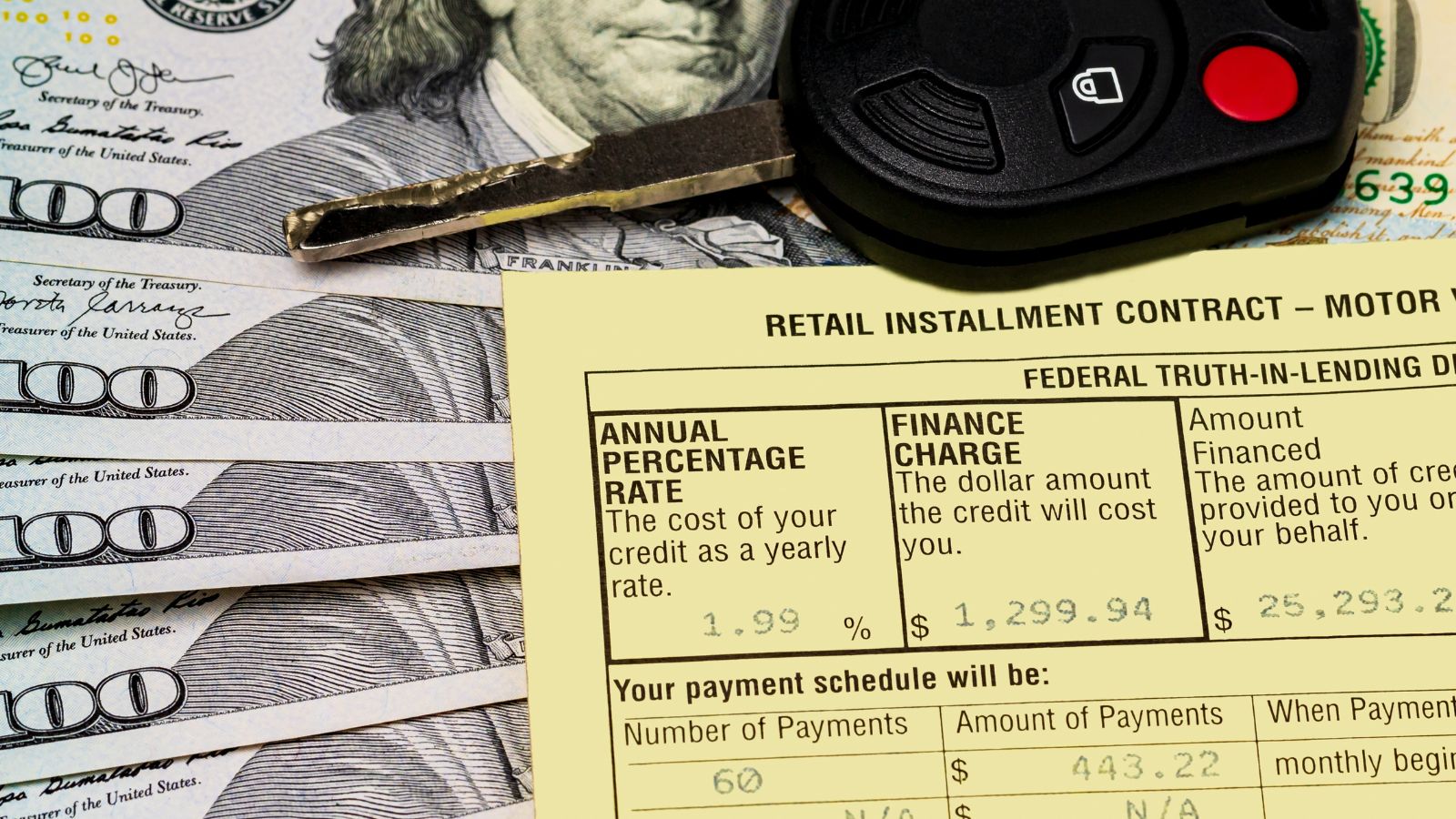
The out-the-door price should be established separately from the cost of borrowing. After that number is fixed, the next questions are the amount financed, annual percentage rate, loan term, finance charge, and total of payments. This separation matters because dealer-arranged financing can contain compensation that is invisible in the vehicle price. The lender may quote the dealership a “buy rate,” while the contract rate offered to the customer can be higher.
A hypothetical $32,000 loan illustrates the effect. At 6 percent for 60 months, the payment is about $619 and total interest is roughly $5,119. At 8 percent for the same term, the payment rises to about $649 and interest to approximately $6,931—around $1,812 more, despite no change in the car. A preapproval from a bank or credit union creates a benchmark, but it does not prevent the dealership from beating the rate. The warning sign is a refusal to disclose APR and total borrowing cost, or an attempt to make a “discounted” vehicle price conditional on financing whose added cost erases the discount.
It Prevents the Trade-In From Hiding a Weak Price

Trade-ins can make a weak purchase price look generous because several numbers move at once. The dealership may offer more for the old car while quietly charging more for the replacement, or show a lower vehicle price while reducing the trade allowance. Asking for the out-the-door price before the trade is appraised separates the two negotiations. The buyer can then compare the purchase price with other dealers and the trade value with independent sale offers or valuation tools.
Imagine one dealer prices the new vehicle at $34,000 and offers $15,000 for the trade, while another prices it at $32,500 but offers $13,500. Before taxes and other effects, the net difference is identical. The first offer feels more flattering because the trade number is higher, yet it is not automatically better. Written, separated figures prevent the “allowance” from becoming emotional camouflage. They also show whether a trade-in tax credit applies in the buyer’s jurisdiction. The fast red flag is a dealer who will quote only a combined “difference to change” and refuses to identify the actual purchase price and actual trade value.
It Shows Whether Old Debt Has Been Rolled Forward

A promise to “pay off the old loan” can sound like the dealership is absorbing debt, but the remaining balance may simply be added to the new financing. That is negative equity: the amount owed exceeds the vehicle’s current value. The out-the-door question, followed by a request for the exact amount financed, reveals whether old debt has been folded into the new car deal.
The Federal Trade Commission gives a straightforward example: a trade-in worth $15,000 still has an $18,000 loan balance, creating $3,000 in negative equity. A dealer may add that $3,000 to the new loan, take it from the down payment, or use a combination of both. The customer still pays it—and may pay interest on it for years. Canadian guidance similarly warns that trading while underwater can produce a larger loan and more interest. A credible worksheet should show the trade value, payoff amount, negative-equity balance, cash down, and new amount financed on separate lines. If the old debt seems to vanish without appearing anywhere, the math needs to be explained before signing.
It Flushes Out Optional Products Early

Optional products often arrive after the vehicle price feels settled, when the buyer is tired and ready to leave. Common examples include service contracts, gap products, credit insurance, paint or fabric protection, tire-and-wheel coverage, VIN etching, rustproofing, and theft-deterrent packages. The itemized out-the-door question brings them forward, where each product can be accepted, declined, or compared rather than quietly embedded in the financing.
The FTC warns that add-ons can cost thousands of dollars. In a 2024 enforcement matter, it alleged that as many as 75 percent of surveyed buyers at three Texas dealerships reported add-ons had been inserted secretly or described as required. That is an allegation tied to a specific case, not a claim about all dealerships, but it shows why line-by-line review matters. Even a $2,000 optional package financed at 8 percent for 72 months would cost about $35 a month and roughly $2,525 in total payments. The monthly effect looks modest; the total is not. A dealer should state the cash price of every add-on and confirm clearly that it is optional.
It Exposes Discounts With Hidden Conditions

Discounts and rebates can be real while still being unavailable to most shoppers. Some offers depend on financing through a particular lender, owning or leasing a competing brand, being a recent graduate, serving in the military, making a large down payment, or choosing one specific unit. Asking for the complete written total requires the dealer to identify which incentives are included and what qualifications must be met.
A useful response lists the regular selling price, each rebate, each eligibility condition, the down payment, and the final amount before and after taxes and licensing. A suspicious response combines every possible incentive into one eye-catching number, then removes several discounts after the buyer arrives. The FTC has specifically warned that low advertised prices may be misleading when major eligibility restrictions or large upfront costs are buried in fine print. Consider a $2,500 discount that requires dealer financing at a higher rate. If the financing adds more than $2,500 over the loan term, the “discount” may not improve the total deal. Price and borrowing cost must be evaluated together, but disclosed separately.
It Creates a Starting Point for the Inspection
A clean out-the-door quote is essential, but it does not prove that a used vehicle is mechanically sound. Once the price is known, the next revealing request is permission for an independent inspection and written confirmation of the warranty status. The FTC requires dealers in the United States to display a Buyers Guide on most used vehicles, showing whether the car is sold “as is” or with warranty coverage. It also stresses that a vehicle-history report is not a substitute for a mechanical inspection.
This creates another fast test of the dealership’s behaviour. A dealer may reasonably set scheduling or insurance conditions, but a flat refusal to permit any independent inspection should raise concern. Suppose a mechanic finds worn brakes, a leaking seal, and tires near replacement, estimating $2,400 in immediate work. A $1,500 “discount” no longer looks generous. The written out-the-door figure provides the starting point; the inspection estimates the car’s near-term real cost. Promises that the dealer will repair identified problems should appear in writing, with clear deadlines and responsibility, rather than depending on a handshake after the contract is signed.
The Dealer’s Response May Be the Fastest Warning

The speed of the out-the-door question comes from the response it produces. A transparent dealership can usually provide a stock-specific quote, list mandatory and optional items, explain financing conditions, and allow the buyer time to review. A problematic one may refuse to send numbers, claim totals can be discussed only in person, change the vehicle, add products at signing, or pressure the buyer to focus exclusively on a payment. The refusal itself becomes useful information before hours are spent at the showroom.
The written quote should be compared with the purchase contract line by line. Price, rebates, fees, add-ons, down payment, trade credit, amount financed, APR, term, and total of payments should match the agreed structure. Buyers should not assume a universal three-day cancellation right after signing; return and cooling-off rules vary, and many dealership sales become difficult to unwind. That makes the pre-signing pause especially valuable. The strongest final sentence is often: “Please print the full agreement so every line can be checked.” A good deal survives that pause. A deal that depends on urgency, fatigue, or disappearing numbers often does not.
22 Things Canadians Do to Their Cars in Spring That Mechanics Hate

Spring brings relief to many Canadian drivers after months of snow, freezing temperatures, and icy roads that put serious strain on vehicles. As temperatures rise across the country, drivers begin washing cars, switching tires, and preparing vehicles for warmer weather and upcoming road trips. However, mechanics across Canada notice the same mistakes every spring when drivers attempt to recover from winter damage. Road salt, potholes, and harsh winter driving conditions often leave vehicles with hidden problems that drivers ignore. Some spring habits even create new mechanical issues that could have been avoided with proper maintenance. Here are 22 things Canadians do to their cars in spring that mechanics hate.

Alanna Rosen is an experienced content writer that focuses on many EV and educational content. Her articles are regularly published on Get CyberTrucked and syndicated on large publications.