
Many drivers make the same well-intentioned move when flashing lights appear: they start digging through the glove box or reaching beneath a seat before the officer reaches the window. The goal is efficiency, yet the movement can resemble concealment or a search for a weapon, especially in darkness or behind tinted glass. That does not make the driver guilty, and nervousness is not proof of wrongdoing. It does mean an ordinary act can be misread during a tense, fast-moving encounter.
These 12 sections explain why pre-emptive rummaging creates suspicion, how courts and public-safety agencies view sudden movement, and what calmer, more visible alternatives can keep a routine stop from becoming unnecessarily tense. Laws and procedures vary, so local requirements and lawful instructions still control.
Rummaging Before the Officer Arrives

The mistake usually begins with good intentions. A driver sees emergency lights, pulls over, and immediately starts searching for a license, registration, or insurance card. In ordinary life, that looks organized. From behind a patrol car, however, the officer may see only a shoulder dipping, an arm disappearing below the window line, or repeated movement toward the console. The Bureau of Justice Statistics estimated that about 12.4 million U.S. residents experienced their most recent police-initiated contact as the driver in a traffic stop in 2022, making this a familiar situation rather than an unusual one.
The safer sequence is less efficient for a few seconds but considerably clearer: stop, settle the vehicle, keep both hands visible, and wait. Consider a driver whose registration is buried under maps in the glove box. Reaching for it before the officer arrives creates an unexplained movement. Saying, “My registration is in the glove box,” after being asked turns the same action into a visible, expected task. The papers do not change; the context does.
Why Hands Matter More Than Intentions
A traffic stop begins with an information imbalance. The driver knows whether the car contains nothing more threatening than groceries and a gym bag. The approaching officer does not. That is why public-safety agencies repeatedly advise motorists to keep their hands on the steering wheel, avoid sudden movements, and remain inside unless directed otherwise. The guidance is not a declaration that every stopped driver is dangerous. It is a practical way to remove uncertainty from the first moments of contact.
Intentions are invisible, while hands are observable. A driver may be reaching for sunglasses, moving a phone off the seat, or trying to quiet a pet. From several car lengths away, those movements can look identical to reaching for or hiding an object. A simple pause prevents that ambiguity. The lesson is not to perform innocence through exaggerated gestures or unnaturally stiff behaviour. It is to make ordinary actions easy to understand. Visible hands, a still cabin, and attention directed toward the officer communicate more effectively than frantic efforts to appear prepared.
“Furtive Movement” Can Become Part of the Legal Story
Courts do not treat every nervous gesture as proof of a crime, and a single movement does not automatically justify a search. They do, however, examine the totality of the circumstances. That can include where a person reached, when the movement occurred, whether it appeared responsive to police presence, and what other facts the officer observed. The legal importance of a gesture therefore depends heavily on context rather than on a universal rule.
A 2025 decision from the U.S. Court of Appeals for the Tenth Circuit illustrates the risk. The court discussed movements made toward the passenger area before officers fully reached the vehicle and concluded that the movement weighed in favour of reasonable suspicion alongside other circumstances. That does not mean grabbing a registration card makes someone legally suspicious everywhere. It shows how a few seconds of unexplained movement may later become part of an officer’s report, a suppression hearing, or an appellate opinion. Waiting until instructions are given keeps an innocent search for paperwork from becoming a disputed fact.
The Pull-Over Itself Sets the Tone

Before hands or documents become an issue, the driver must stop safely. Official guidance commonly recommends activating the turn signal, slowing down, and moving to the right side of the roadway or another safe location. A sudden stop in a travel lane, a sharp swerve onto a narrow shoulder, or continued driving without acknowledgement can create a second layer of uncertainty. The goal is to show recognition of the signal while avoiding a manoeuvre that endangers surrounding traffic.
A calm pull-over is also the first visible sign that the driver is processing the situation rather than fleeing or ignoring it. On a dark highway with a poor shoulder, for example, a driver may reduce speed, activate hazard lights, and continue briefly to a well-lit turnout. Some agencies expressly recognize that a motorist may slowly proceed to a safer or more populated place, particularly when an unmarked vehicle is involved. Once stopped, the vehicle should be placed in park, the engine and radio turned off, and the driver should remain inside unless told otherwise.
Pre-Emptive Paperwork Is Not the Same as Cooperation
Many motorists assume that holding documents out of the window will make the stop faster. Several official driver guides advise the opposite: keep hands visible and wait until the officer requests the license, registration, or proof of insurance. The reason is simple. A wallet can contain numerous items, a glove box can conceal its contents, and an officer approaching from behind cannot know what the driver is retrieving. Cooperation is demonstrated more reliably by following a clear request than by guessing what will be requested next.
There is also no advantage in handing over an entire wallet or opening several compartments at once. Pennsylvania’s driver guidance, for example, tells motorists to provide the requested items rather than the whole wallet. A prepared driver can still be efficient by storing documents together in an accessible location. The best preparation happens before the trip, not after emergency lights appear. A labelled document sleeve reduces searching, but the driver should still wait, explain where it is, and retrieve it only after the movement is expected.
Narrating a Movement Removes the Mystery

One sentence can change how a movement is perceived. Public guidance from several agencies recommends telling the officer where documents are located before reaching for them. “My insurance card is on my phone,” “The registration is in the centre console,” or “My wallet is in my back pocket” gives the officer an opportunity to direct the next step. It also prevents the driver from making a fast, awkward movement while trying to answer a question simultaneously.
The value is predictability, not permission-seeking theatre. A driver does not need to describe every blink or hand adjustment. The important movements are those that take hands out of sight, open a compartment, reach behind a seat, or involve a phone. Imagine a parent with a registration stored beneath children’s toys in a console. Silently digging through the pile may look frantic. Explaining the location first and moving slowly turns the search into a straightforward task. When the officer gives different instructions, the driver should pause and follow those instructions rather than continuing the original motion.
Darkness Magnifies Small Movements
At night, the officer may see a silhouette rather than a clear view of the driver’s hands. Reflections, tinted windows, headrests, and interior clutter can make an ordinary reach difficult to interpret. That is why official traffic-stop guidance often recommends turning on the dome or interior light after stopping. Oklahoma’s Department of Public Safety specifically advises motorists to use interior lighting to help the officer see inside the vehicle, while several other state and county agencies publish similar instructions.
The light should be switched on once the vehicle is safely stopped, not while the driver is still manoeuvring through traffic. After that, stillness matters. A driver searching beneath a seat in a dark cabin may disappear from view almost entirely, even when the missing item is only a dropped insurance card. Keeping hands on the wheel and the cabin illuminated removes much of that uncertainty. It also helps passengers recognize that their movements are visible. The objective is not to flood the cabin with light, but to make routine actions understandable before anyone begins reaching.
Passengers Can Accidentally Escalate the Stop

The driver may be perfectly still while a passenger creates the concern. A friend leaning into the back seat, a teenager opening the glove box, or someone reaching down to silence a phone can draw attention because the officer must account for every occupant. Official guidance from Oklahoma, Pennsylvania, Delaware, and Oregon advises passengers to remain calm, stay in the vehicle, limit movement, and keep their hands in plain view. These instructions reflect the practical reality that the entire cabin is part of the officer’s visual assessment.
Drivers can help without barking orders. A quiet reminder before the officer reaches the window—“Let’s keep our hands visible and wait”—is usually enough. Passengers should not begin collecting documents unless asked, even when they are trying to assist. In one common scenario, a passenger knows the registration is in the glove box and reaches for it automatically. The driver understands the helpful intention, but the officer sees an unexpected hand entering a closed compartment. Calm coordination prevents a favour from looking like an attempt to conceal or retrieve something.
Nervousness Is Human, Not Proof of Guilt
Traffic stops can make truthful people visibly nervous. Hands shake, voices become clipped, eye contact changes, and simple questions suddenly feel difficult. Psychological research has repeatedly warned against treating nervous behaviour as a dependable indicator of deception. People commonly associate gaze aversion, fidgeting, and posture changes with lying, even though those behaviours can also result from fear, stress, communication differences, or the pressure of being evaluated by an authority figure.
Trying too hard to suppress nervousness can make the encounter feel even less natural. A driver who locks both arms rigidly, avoids speaking, or forces constant eye contact may appear more unusual than someone who simply acknowledges the stress. A brief statement such as, “I’m nervous, so I’m going to move slowly,” can provide useful context without becoming an argument or confession. The practical distinction is between involuntary nervousness and unexplained reaching. Shaking hands on the steering wheel remain visible; shaking hands disappearing into a console create uncertainty. Calmness helps, but visibility matters more than performing a perfectly relaxed demeanour.
Clear Communication Reduces Misreading
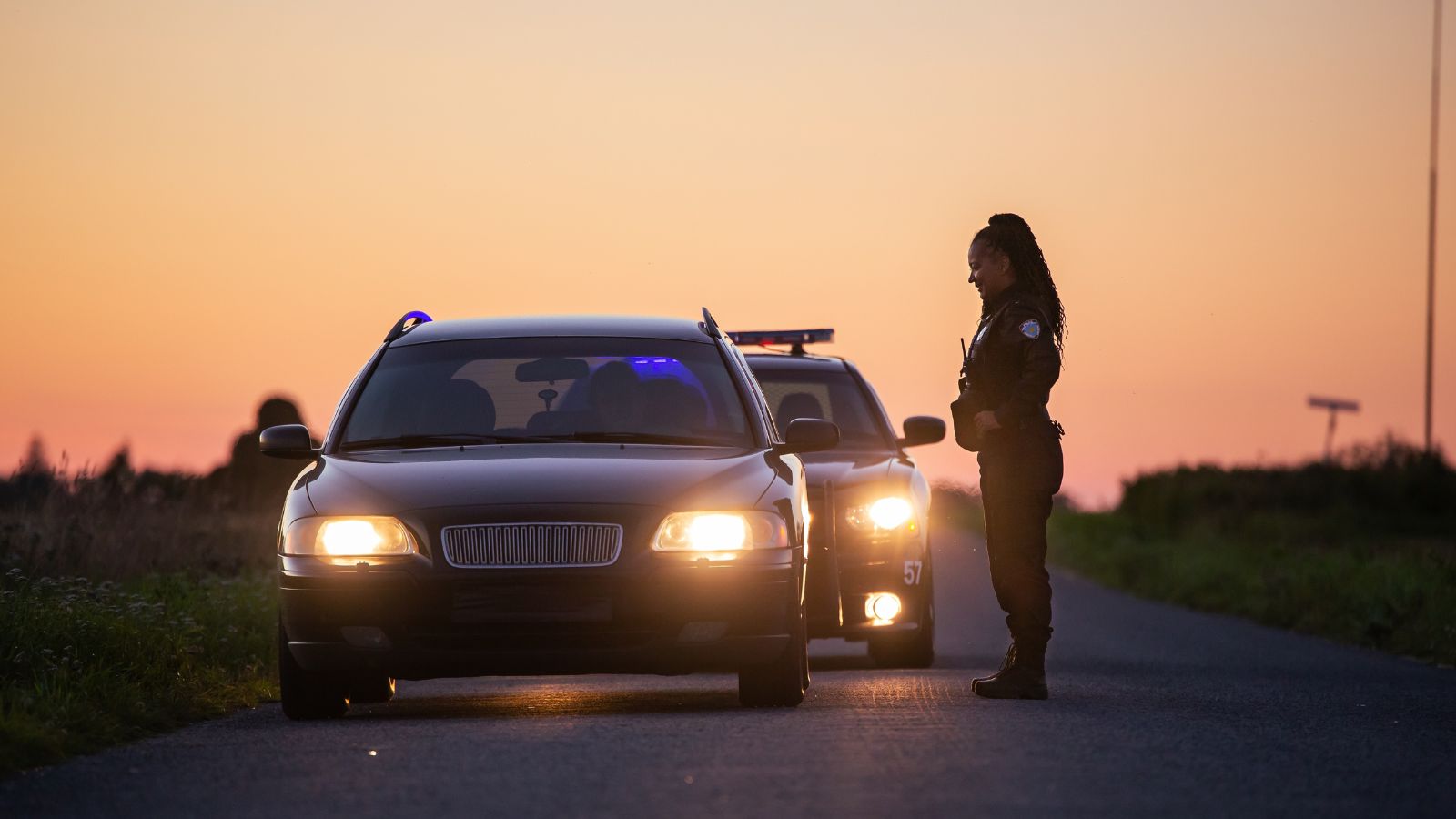
Good traffic-stop communication is plain, brief, and cooperative. The driver can listen to the stated reason for the stop, answer straightforward questions, and ask for clarification when an instruction is unclear. Research on procedural justice has linked respectful treatment and courtesy with greater willingness to comply and cooperate. That principle works in both directions: a professional explanation from the officer and a measured response from the driver reduce the chance that confusion will be mistaken for defiance.
The most useful phrases describe immediate facts rather than launch into a roadside defence. “I need to reach into the console for the registration” is clearer than a long explanation about why the papers were misplaced. “Could you repeat that instruction?” is safer than moving based on a guess. Anyone who needs an instruction repeated or presented differently should state that need before acting. Communication cannot guarantee a pleasant outcome, but it makes each action easier to interpret and leaves fewer opportunities for assumptions to fill the gap. During a tense encounter, clarity is often more valuable than speed.
The Roadside Is the Wrong Place to Litigate the Ticket

A driver may sincerely believe the stop was mistaken or the citation unfair. Arguing at length beside moving traffic rarely resolves that dispute and can prolong an already stressful encounter. Oklahoma’s Department of Public Safety advises motorists to ask respectful questions but not extend the stop by arguing; it directs people who wish to contest a ticket to use the court process. Pennsylvania and King County publish similar guidance. The distinction is important: remaining calm does not require agreeing with the allegation.
A driver can ask why the stop occurred, request clarification about the citation, and note relevant details without turning the exchange into a debate. Afterward, the citation identifies the court, deadlines, and available pleas or hearing procedures. Georgia’s official guidance, for example, explains that motorists may contest a traffic ticket in court and should confirm the assigned date. When the concern involves officer conduct rather than the citation itself, agencies commonly provide complaint procedures. Preserving the dispute for the proper forum prevents frustration from producing sudden gestures, raised voices, or refusals that overshadow the original traffic issue.
A Simple Routine Prevents the Mistake
The most effective strategy is a rehearsed sequence: signal, pull over safely, park, turn off the engine and radio, illuminate the cabin at night, keep hands visible, and wait for instructions. When documents are requested, state where they are, move slowly, and retrieve only what was asked for. Passengers remain still and visible. Questions are brief, and disagreements are saved for the formal process. This routine works because it replaces improvisation with predictability at the exact moment stress makes people more likely to act impulsively.
Most traffic stops do not become searches or arrests. In the Bureau of Justice Statistics’ 2022 data, about 44 percent of stopped drivers received a warning, 43 percent received a ticket, and 9 percent experienced no enforcement action. Those figures are a useful reminder that a stop is often an administrative encounter, even when it feels intimidating. The objective is not to look theatrically innocent. It is to avoid creating unnecessary ambiguity. A driver who waits before rummaging gives both sides a clearer, calmer starting point.
22 Things Canadians Do to Their Cars in Spring That Mechanics Hate
Spring brings relief to many Canadian drivers after months of snow, freezing temperatures, and icy roads that put serious strain on vehicles. As temperatures rise across the country, drivers begin washing cars, switching tires, and preparing vehicles for warmer weather and upcoming road trips. However, mechanics across Canada notice the same mistakes every spring when drivers attempt to recover from winter damage. Road salt, potholes, and harsh winter driving conditions often leave vehicles with hidden problems that drivers ignore. Some spring habits even create new mechanical issues that could have been avoided with proper maintenance. Here are 22 things Canadians do to their cars in spring that mechanics hate.

Alanna Rosen is an experienced content writer that focuses on many EV and educational content. Her articles are regularly published on Get CyberTrucked and syndicated on large publications.