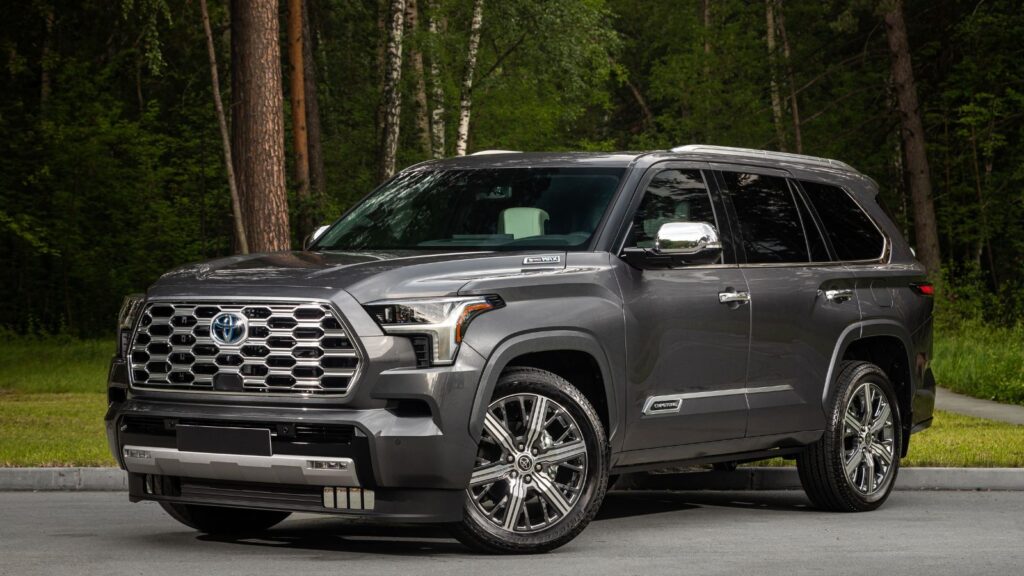
The cost of owning one of Toyota’s largest SUVs has climbed considerably for Canadian buyers. The 2027 Toyota Sequoia now starts at $91,250, representing a $6,310 increase over the previous model year, while the rugged TRD Pro reaches an estimated vehicle price of $113,509 before taxes.
The higher prices arrive alongside meaningful upgrades, including a redesigned exterior, improved towing technology, enhanced safety features, and a new Trailhunter model aimed at outdoor enthusiasts. Toyota is also expanding the equipment offered across its full-size SUV lineup.
For families considering a three-row vehicle, the changes raise an important question: Does the additional technology and capability justify the growing cost of a Sequoia, especially when several configurations now exceed $100,000 before taxes?
The Sequoia’s Starting Price Has Jumped by $6,310
Toyota has increased the Canadian starting price of its 2027 Sequoia SR5 TRD Off-Road to $91,250, compared with $84,940 for the equivalent 2026 model. That represents a $6,310 increase, or approximately 7.4%, in a single model year. For shoppers already stretching their budgets to purchase a full-size SUV, the difference is substantial. The increase also means that Toyota’s least expensive Sequoia is moving closer to the $100,000 threshold once delivery charges, dealer fees, and applicable taxes are included.
The higher entry price comes with additional equipment rather than an unchanged package. The 2027 SR5 TRD Off-Road features a standard 14-inch multimedia touchscreen, replacing the eight-inch display offered on the 2026 version, along with updated safety technology and a digital instrument cluster. It retains serious off-road equipment, including Bilstein shock absorbers, a locking rear differential, and selectable terrain-management systems. For Canadian families who regularly travel with passengers, luggage, or recreational equipment, the Sequoia remains a capable option. However, the new starting price makes comparing equipment and total ownership costs increasingly important.
TRD Pro Now Reaches $113,509 Before Taxes
The 2027 Sequoia TRD Pro carries a starting manufacturer’s suggested retail price of $109,851, but Toyota’s estimated vehicle price reaches $113,509. That higher figure includes freight and pre-delivery inspection, air-conditioning charges, maximum dealer fees, and other applicable charges in Toyota’s pricing calculation. It does not include sales taxes, licensing, insurance, or registration. The distinction matters because the advertised vehicle price is not necessarily the final amount a customer will pay at the dealership. Buyers should request an itemized quote showing every charge before making a financial commitment.
The increase becomes even more striking when compared with the previous model year. Toyota priced the 2026 Sequoia TRD Pro at $100,508 MSRP, with an estimated vehicle price of $105,054. For 2027, the MSRP has risen by $9,343, while the estimated vehicle price has increased by $8,455. Although the new model receives additional equipment, the higher purchase cost could translate into larger monthly payments for households financing their vehicles. With an SUV this expensive, even seemingly modest differences in interest rates, down payments, and financing terms can significantly affect overall affordability.
Eight Canadian Sequoia Configurations Offer Different Levels of Luxury
Toyota is offering eight Sequoia configurations in Canada for the 2027 model year, giving buyers several ways to balance capability, comfort, and price. The Limited starts at $94,000, while the new Trailhunter begins at $95,552. Moving higher, the Platinum carries a $103,800 MSRP, followed by the Capstone at $108,700. Toyota also offers Platinum and Capstone configurations with towing mirrors, starting at $104,150 and $109,050 respectively. The TRD Pro sits at the top of the Canadian pricing ladder with its $109,851 MSRP.
These configurations serve different purposes rather than simply adding progressively more expensive equipment. The Limited emphasizes convenience and comfort, including heated and ventilated front seats and a premium JBL audio system. Platinum models add features such as massaging front seats and additional towing assistance, while Capstone versions focus on luxury materials and refinement. The Trailhunter and TRD Pro prioritize off-road capability. For Canadian buyers, choosing the right configuration involves considering how often the vehicle will carry passengers, tow trailers, or travel on unpaved roads. The most expensive Sequoia is not automatically the best fit for every household.
The New Trailhunter Brings Off-Road Capability Below $100,000 Before Tax
One of the most significant additions for 2027 is the Sequoia Trailhunter, a factory-equipped overlanding model designed for drivers who regularly venture beyond paved roads. With a starting MSRP of $95,552 and an estimated vehicle price of $99,210 before taxes, it sits between the entry-level SR5 TRD Off-Road and the more expensive TRD Pro. The Trailhunter adds Old Man Emu shock absorbers, an aluminum skid plate, front recovery hooks, 18-inch bronze-finished wheels, and 33-inch all-terrain tires. It also features specialized fog lights and distinctive interior and exterior details.
The equipment is aimed at customers who want a vehicle capable of handling challenging terrain without relying entirely on aftermarket modifications. For a family travelling to a remote campsite, additional underbody protection and improved suspension components may be more useful than the luxury features offered on higher-priced trims. Toyota is positioning the Trailhunter as an adventure-oriented alternative rather than a traditional premium upgrade. Its estimated vehicle price remains just below $100,000, although taxes push the final purchase cost beyond that mark. Buyers should also consider how the specialized tires and suspension affect everyday comfort before deciding whether the off-road equipment suits their needs.
TRD Pro Receives Upgraded FOX Suspension and New Styling
The 2027 Sequoia TRD Pro receives several meaningful mechanical improvements intended to strengthen its off-road performance. Toyota has introduced Sequoia-specific FOX QS3 adjustable shock absorbers, allowing suspension damping to be adjusted for different driving conditions. The system is designed to provide greater control and stability when travelling across uneven terrain. Additional equipment includes a locking rear differential, skid plates, Crawl Control, Multi-Terrain Select, and 18-inch forged BBS wheels. These components distinguish the TRD Pro from conventional family-focused SUVs and help explain its premium positioning.
Toyota has also refreshed the TRD Pro’s appearance with standard red front recovery hooks and a new Honeycomb exterior colour. The SUV features a heritage-inspired TOYOTA grille with an integrated LED light bar, a specialized exhaust system, and distinctive interior upholstery with camouflage-pattern accents. For outdoor enthusiasts, the combination of upgraded suspension hardware and dedicated off-road equipment provides practical benefits beyond appearance. However, the $113,509 estimated vehicle price is a significant commitment for a model whose specialized capabilities may be used only occasionally. Buyers primarily interested in the Sequoia’s space and hybrid powertrain may find better value in less expensive configurations.
A 437-Horsepower Hybrid Engine Remains Standard Across the Lineup
Despite the pricing increases and equipment changes, Toyota continues to use the same fundamental powertrain throughout the Sequoia lineup. Every 2027 model features the i-FORCE MAX hybrid system, combining a 3.4-litre twin-turbocharged V6 engine with an electric motor-generator. Together, the system produces 437 horsepower and 583 lb-ft of torque. Unlike a plug-in hybrid, the Sequoia does not require external charging. Its electrified powertrain is designed to deliver strong acceleration and substantial pulling power, making it particularly useful for drivers who regularly transport passengers or heavy recreational equipment.
Toyota reports a maximum Canadian towing capacity of 4,137 kilograms, equivalent to approximately 9,121 pounds. That capability makes the Sequoia suitable for many large recreational trailers, boats, and camping applications, provided all vehicle and trailer weight limits are respected. However, the maximum rating does not necessarily apply to every configuration or loading situation. Passenger weight, cargo, optional equipment, and trailer tongue weight all affect how much a vehicle can safely tow. Canadian buyers should review the specific model’s towing specifications rather than relying exclusively on the advertised maximum. Fuel consumption also remains an important consideration, since hybrid technology does not eliminate the operating costs associated with a large, heavy SUV.
New Towing Technology Is Designed to Make Trailer Handling Easier
Toyota is introducing a collection of advanced towing assistance technologies for the 2027 Sequoia, addressing situations that can make driving a large SUV with a trailer challenging. Automated Trailer Detection uses rear-mounted radar sensors and cameras to identify a connected trailer and estimate its dimensions. The information can then be incorporated into the vehicle’s redesigned Trailer Garage menu. An enhanced Trailer Blind Spot Monitor extends the monitored area beyond the SUV itself, accounting for the additional length of a trailer. This could be particularly valuable when changing lanes on busy Canadian highways.
Another addition is Trailer Lane Trace Assist, which provides steering support intended to help maintain lane positioning under certain conditions while towing. Toyota has also improved Trailer Backup Guide with dynamic on-screen guidelines, a more intuitive control interface, and semi-automated steering assistance. The system is designed to help drivers manage difficult reversing manoeuvres and identify potential jackknife situations. For someone positioning a boat trailer at a crowded launch ramp or backing a camper into a narrow campsite, these features could reduce stress. They remain driver-assistance systems rather than replacements for careful observation, appropriate towing equipment, and safe driving practices. Buyers should confirm which functions are included on their selected trim.
Toyota Safety Sense 4.0 Adds Another Layer of Protection
Safety technology receives a substantial update for 2027, with Toyota Safety Sense 4.0 becoming standard across the Canadian Sequoia lineup. The system includes pre-collision assistance with pedestrian detection, dynamic radar cruise control, lane departure alerts with steering assistance, automatic high beams, road sign recognition, and proactive driving assistance. Toyota has also introduced an Emergency Drive Stop System designed to bring the vehicle to a stop under certain conditions if the driver becomes unresponsive while Lane Tracing Assist is operating. These updates expand the Sequoia’s collection of driver-assistance features compared with the previous model year’s Toyota Safety Sense 2.5.
A particularly notable addition is Advanced Rear Seat Reminder, which uses millimetre-wave radar technology to detect certain movements inside the second and third rows after the vehicle has been parked and the driver has exited. When the system detects movement, it can trigger escalating warnings, including flashing hazard lights, audible alerts, and horn activation. Depending on connectivity and service requirements, notifications may also be delivered to a smartphone. For families regularly transporting young children, the feature adds a potentially valuable safeguard. Nevertheless, Toyota emphasizes that the system has detection limitations and should never replace physically checking the passenger compartment before leaving a parked vehicle.
Interior Technology Improves While Seating Flexibility Remains Important
Inside the 2027 Sequoia, Toyota has made several technology upgrades standard across the lineup. Every Canadian model now includes a 14-inch multimedia touchscreen and a 12.3-inch digital instrument display. The updated multimedia system offers a customizable home screen, while a built-in Drive Recorder can capture 20-second video clips using the vehicle’s exterior cameras. Toyota also includes a 10-year trial for Remote Connect, Safety Connect, and Service Connect, along with a three-month Drive Connect trial. Connected features require appropriate activation, compatible connectivity, and applicable service arrangements.
Passenger accommodation remains central to the Sequoia’s appeal. Three Canadian configurations provide seating for eight people using a second-row bench, while five configurations feature captain’s chairs and seating for seven. The sliding third row and adjustable cargo shelf allow families to change the balance between passenger room and luggage space. That flexibility can be valuable during a long road trip when suitcases, sports equipment, and other belongings compete for storage. However, buyers should inspect the actual cabin layout before purchasing. A seven-passenger luxury configuration may provide greater individual comfort, while an eight-passenger model could be more practical for larger households that regularly transport additional family members.
Rising Prices Make Choosing the Right Sequoia More Important Than Ever
The latest increase is part of a longer upward movement in Canadian Sequoia pricing. Toyota listed the 2025 SR5 TRD Off-Road at $82,965, followed by $84,940 for 2026 and $91,250 for 2027. Across those two model-year changes, the starting MSRP has climbed by $8,285, or approximately 10%. Although equipment and technology have evolved during that period, the numbers illustrate how much more expensive entry into Toyota’s full-size SUV lineup has become. For households postponing a purchase while saving for a larger down payment, rising prices can complicate financial planning.
Toyota expects the 2027 Sequoia to arrive at Canadian dealerships during the fall of 2026. Buyers considering the updated model should compare its equipment and pricing with the preceding model year, particularly when evaluating whether the newest technology delivers meaningful everyday benefits. Asking dealers for complete purchase quotes, checking financing costs, and estimating insurance and fuel expenses can provide a clearer picture of affordability. The Sequoia continues to offer considerable passenger capacity, strong hybrid performance, and specialized towing and off-road equipment. Nevertheless, with premium versions exceeding $110,000 before taxes and other excluded costs, choosing the appropriate configuration has become just as important as choosing the vehicle itself.
