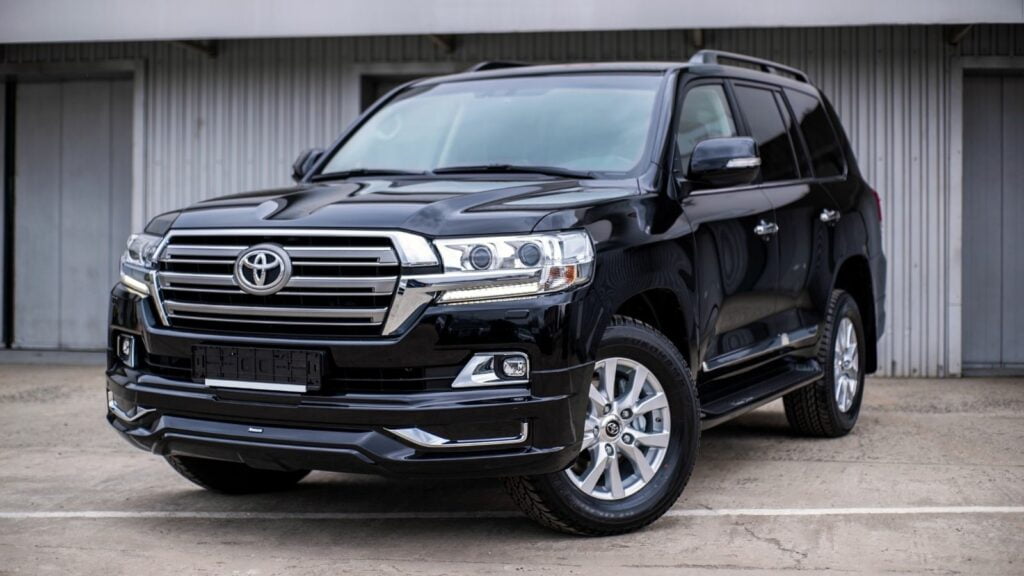
Toyota has issued a Canadian safety recall for 6,721 Land Cruisers after identifying a fuel-system connection that can separate near the fuel tank. The campaign covers certain 2024, 2025, 2026 and 2027 model-year SUVs, and the concern is more serious than a loose fitting: a separation can allow gasoline to leak, potentially stall the engine and create a fire risk if the fuel reaches an ignition source.
Transport Canada published the recall on October 14, 2026, and updated its public record on October 19. Toyota says affected owners will be contacted by mid-December, while dealers will inspect the connection and add a supplemental clamp or replace the resin fuel tube if necessary. Until then, the key question for Canadian owners is whether a specific VIN is included.
A 6,721-Vehicle Recall Spanning Four Model Years
Transport Canada identifies the campaign as recall 2026-497, covering certain Toyota Land Cruisers from model years 2024 through 2027. Toyota Canada says approximately 6,721 vehicles are involved nationally. The wording matters: inclusion of four model years does not mean every Land Cruiser from those years is necessarily part of the campaign. The recall applies to vehicles equipped with the particular fuel-tube connection Toyota has identified as a safety concern.
The government record was originally published on October 14 and updated on October 19, classifying the issue under the vehicle fuel system. That provides Canadian owners with a formal recall identifier they can use when speaking with a dealership. Toyota also directs customers to its VIN-based recall checker because model year alone is not enough to establish whether a particular SUV requires the repair. For families with a recently purchased Land Cruiser in the driveway, that individual VIN check is more meaningful than the broad 2024-2027 date range.
The Defect Sits at a Critical Fuel-Line Connection
The problem involves the connection between a plastic, or resin, fuel tube located at the fuel tank and the main metal fuel tube carrying gasoline toward the engine. Transport Canada says the plastic tube could disconnect from the metal tube. Toyota’s U.S. regulatory filing adds that separation can occur if the retaining clip on the connector becomes lifted. The filing specifically identifies both the resin fuel tube and metal fuel tube as components involved in the campaign.
It is a relatively small connection performing an essential job. If the two tubes separate, gasoline can escape instead of remaining inside the fuel-delivery system. Toyota says fuel may continue leaking until the gasoline engine in the hybrid system shuts off, while Transport Canada says the condition can cause the engine to stall. In practical terms, a clip and connector hidden near the fuel tank can affect both fuel containment and continued engine operation, which explains why regulators are treating the condition as a safety defect rather than ordinary maintenance.
Not Every 2024-2027 Land Cruiser Is Automatically Included
The Transport Canada database lists the 2024, 2025, 2026 and 2027 Toyota Land Cruiser, but its language specifies “certain vehicles.” Toyota Canada similarly describes approximately 6,721 affected vehicles rather than every Land Cruiser sold nationally during those model years. Owners therefore should not assume that their SUV is affected solely because the year appears on the government list—or assume it is clear simply because no obvious problem has appeared.
Toyota’s recommended method is to enter the vehicle identification number into its Canadian recall lookup system. The VIN provides a vehicle-specific answer based on Toyota’s campaign records and is also what a dealership can use when checking recall eligibility. That becomes particularly useful for used Land Cruisers, where a shopper may not know whether earlier recall work has already been completed. Toyota also cautions that recall information can change after an initial filing, making the current VIN record more useful than relying on a screenshot or notice shared online weeks earlier.
The Land Cruiser’s Hybrid System Still Depends on Gasoline
Every current-generation Land Cruiser introduced to Canada uses Toyota’s i-FORCE MAX hybrid powertrain. Toyota brought the model back for 2024 with a turbocharged 2.4-litre four-cylinder gasoline engine working with an electric motor integrated into the eight-speed automatic transmission. The system produces 326 horsepower and 465 lb-ft of torque, making it a performance-oriented hybrid rather than a vehicle designed to operate primarily as an electric SUV.
That distinction helps explain why a conventional-looking fuel-line problem remains important on a hybrid vehicle. The Land Cruiser still carries gasoline and relies on a fuel pump, tank and lines to supply its combustion engine. Toyota says that if the recalled connection separates, fuel can leak until the engine in the hybrid system shuts off. Transport Canada separately warns that the condition can cause an engine stall. The electric portion of the powertrain therefore does not eliminate the fuel hazard at the centre of the recall; this remains a gasoline-delivery safety issue even though the Land Cruiser wears a hybrid badge.
Fire and Engine-Stall Risks Are Both Part of the Concern
Transport Canada identifies two important consequences. Its description says separation of the fuel tube could allow gasoline to leak and cause the engine to stall. Under the safety-risk portion of the recall, the regulator states that a fuel leak can create a risk of fire. Toyota uses similarly direct language, saying leaked fuel in the presence of an ignition source can increase the risk of a fire.
Neither Toyota’s Canadian announcement nor Transport Canada’s public notice contains a blanket instruction telling all affected owners to stop driving or park their vehicles outdoors. Toyota’s corresponding U.S. regulatory filing also does not designate the campaign with “Do Not Drive” or “Park Outside” instructions. That distinction is important, but it does not erase the underlying hazard identified in the recall. The concern is based on what can happen if the connection separates: fuel can escape, engine operation can be interrupted and leaking gasoline can become dangerous if an ignition source is present.
The Dealer Fix Adds Another Layer of Security
Toyota’s remedy is centred on keeping the fuel connection physically secured. A Toyota dealer will inspect the connection first and then install a supplemental clamp intended to prevent it from separating. If the inspection determines that the existing resin fuel tube should not remain in service, technicians will replace that tube and install the supplemental clamp. Toyota Canada says the inspection and required repair will be completed at no cost to affected owners.
That means the precise repair can differ from one Land Cruiser to another. One vehicle may require the additional clamp after its existing connection passes inspection, while another may need a replacement resin tube before that clamp is fitted. The approach is notable because Toyota has chosen to reinforce the connection even though the company has not yet confirmed exactly why the retaining clip can become lifted. Rather than waiting for a definitive root cause, the remedy is intended to prevent the connection from separating along the failure path already identified by Toyota and regulators.
Canadian Owner Notices Are Expected by Mid-December
Toyota announced the Canadian campaign on October 14, but mailed notifications will not necessarily reach affected households immediately. The company says known Canadian owners will be notified by mid-December 2026. In the corresponding U.S. campaign, Toyota’s regulatory filing specifies a phased owner-notification period running from November 29 through December 13, although Canadian owners should rely on Toyota Canada’s instructions and recall system for their vehicles.
The notification schedule does not prevent an owner from checking status earlier. Toyota specifically directs customers to its recall website, where a VIN can be entered to determine whether an active campaign applies. Canadian owners can also call the Toyota Customer Interaction Centre at 1-888-869-6828. For someone preparing for a long-distance winter trip or planning to keep a Land Cruiser for remote travel, checking before the mailed notice arrives can remove considerable uncertainty. A dealership can then advise on the status of the campaign and the required inspection for that specific vehicle.
Toyota Has Not Confirmed Why the Connection Can Fail
One of the most significant details in Toyota’s U.S. safety filing is the uncertainty surrounding the root cause. Toyota states that the cause and circumstances under which the fuel-line connection can develop the problem have not been confirmed. The company also says it cannot estimate what percentage of the recalled U.S. vehicles actually contain the defect. Although the regulatory database displays “1%,” Toyota explicitly explains that the required numerical entry is being used to mean “unknown,” rather than an estimate that only one vehicle in 100 is defective.
The parallel American campaign involves 105,794 Land Cruiser Hybrids from model years 2024 through 2027. Reporting based on Toyota’s investigation chronology says the automaker began investigating after receiving reports in July 2024 and conducted extensive inspections, vibration testing and pressure testing. By early October 2026, Toyota had identified 23 U.S. field technical reports and 64 warranty claims that related or potentially related to the condition. Those U.S. figures provide investigation context but do not represent Canadian incident totals.
The Recall Hits a Land Cruiser Generation That Just Returned to Canada
The timing is notable because the affected generation is still a relatively fresh arrival in Canadian showrooms. Toyota brought the Land Cruiser back to Canada for the 2024 model year after a 35-year absence. The previous generation sold here ended in 1989, making the redesigned 2024 model a highly visible return for one of Toyota’s longest-running and best-known off-road nameplates.
Toyota deliberately combined that heritage with modern hardware. The revived Land Cruiser uses the company’s TNGA-F body-on-frame truck platform and makes the i-FORCE MAX hybrid system standard. The 2027 version continues with 326 net-system horsepower, 465 lb-ft of torque and a rated towing capacity of up to 6,000 pounds. The fuel recall now stretches across every Canadian model year of this returned generation so far—2024, 2025, 2026 and 2027. For a model marketed around durability, towing and travel beyond paved roads, completing a safety inspection involving the fuel system is particularly important.
Some Land Cruisers Were Already Covered by a Separate 2026 Recall
This fuel-system campaign is separate from a Toyota safety recall announced in May 2026 that included certain 2024 and 2025 Land Cruisers. The earlier problem involved the 12.3-inch combination meter, which could fail to display some information during vehicle startup because of a software issue. Toyota said approximately 6,956 vehicles were involved in Canada, but that figure covered Toyota Land Cruiser and Mirai vehicles as well as Lexus UX and GX models; it was not a count of Land Cruisers alone.
Transport Canada assigned that earlier action recall number 2026-261, with a software update serving as the remedy. The existence of separate campaigns reinforces why individual VIN verification is more useful than simply counting recall announcements. A particular Land Cruiser could potentially have more than one campaign associated with it depending on year and configuration. For the latest fuel recall, the key identifier is Transport Canada recall 2026-497. Owners can check their VIN through Toyota Canada, contact the company at 1-888-869-6828 and arrange the free dealer inspection if the vehicle is included.
