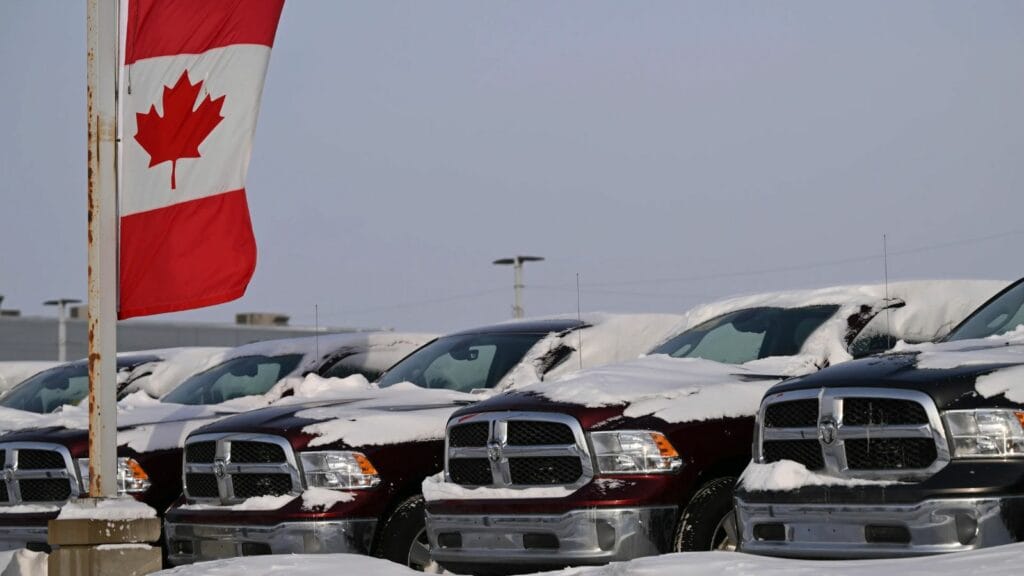
Donald Trump has struck a surprisingly cordial note about Canada at a moment when the country’s auto industry remains under heavy American tariff pressure. Speaking at a campaign rally in Rock Hill, South Carolina, on October 29, the U.S. president said Canada had been treating Washington “extremely nicely lately” and credited his tariffs for the change. The remark arrived just days after reports of renewed discussions on relief for Canadian vehicles and steel—and a day after a Canadian official described progress as limited.
For manufacturers in Ontario, the distinction matters. A warmer presidential comment might suggest room for negotiation, but it has not lifted the 25% U.S. auto duty that continues to affect the non-American content of qualifying vehicles. The stakes extend far beyond the next diplomatic headline.
A Compliment With a Warning Attached
Trump made the comment at a campaign rally for Republican Senate candidate Darline Graham in South Carolina on October 29. His message was not simply that relations were improving. He argued that Washington’s tariffs had forced Canada to change its approach, presenting the tougher trade policy as evidence that his administration was winning concessions. He also referred to steel and aluminum tariffs as a way to encourage businesses to build inside the United States rather than ship products across its borders.
That combination of praise and pressure helps explain why the remark should not be mistaken for a diplomatic breakthrough. Trump was speaking to a political crowd, not announcing a negotiated tariff schedule or signing an agreement with Ottawa. He offered no date for lowering duties on Canadian-built cars and no new terms for automakers. For a supplier deciding where to invest or an employee wondering whether next month’s shifts will run, the practical question remains the same: will the rules at the border change?
Trump’s $90 Billion Claim Needs Context
During the same rally, Trump suggested that the United States had lost $90 billion to Canada in the previous year and portrayed that amount as an unacceptable subsidy. The official trade numbers tell a more complicated story. The Office of the U.S. Trade Representative puts the American goods trade deficit with Canada at US$48.3 billion in 2025, far below the figure Trump cited. The United States also recorded a US$27.7 billion surplus in services trade with Canada that year.
A trade deficit is not, by itself, a payment from one government to another. It measures the difference between imports and exports within a defined category, while the broader relationship also includes investment, services, energy purchases and production shared across the border. Nor does a deficit alone establish whether particular trade restrictions are fair. Trump’s argument resonates politically because factories and jobs are visible, but the $90 billion number should not be presented as an independently verified annual loss or a direct taxpayer subsidy. The distinction matters when tariffs are justified using headline-sized claims.
The 25% Auto Tariff Remains the Central Problem
Under U.S. Section 232 measures, a 25% tariff continues to apply to covered imported automobiles and trucks, with important qualifications for vehicles meeting the Canada–United States–Mexico Agreement’s rules. For qualifying Canadian-built vehicles, documented U.S. content can be excluded from the value subject to that duty. CUSMA-compliant auto and truck parts are not currently subject to the same 25% levy. Those differences matter because North American manufacturers frequently use components from more than one country in a single vehicle.
The exemptions do not make the cost disappear. An automaker must still determine which models meet the origin rules, establish the qualifying U.S. content and price the remaining tariff exposure into its decisions. A vehicle assembled in Ontario with significant American parts can face a different effective duty than one with fewer eligible U.S. components. Equally, a 25% border tariff does not automatically mean a 25% jump in a dealership’s sticker price. Until Washington formally revises the measure, Trump’s complimentary remarks leave the underlying obligation intact.
Canada’s Auto Industry Was Built Around the U.S. Market
More than 90% of Canadian-made vehicles and roughly 60% of Canadian-made auto parts are exported to the United States, according to the Canadian government. Canada produced over 1.2 million passenger vehicles in 2025, and its auto sector supports about 125,000 direct manufacturing jobs and more than 500,000 jobs across the wider economy. Those figures explain why a tariff aimed at imported cars carries such weight in communities where assembly plants anchor local employment.
This is not a business in which every component starts and finishes in the same country. Parts can cross the border repeatedly before a completed vehicle reaches a dealership, making customs rules and delivery schedules central to production planning. Statistics Canada found that motor-vehicle exports to the United States fell 9.6% in 2025. It also noted that retooling and chip shortages contributed to reduced production, so the entire decline cannot simply be attributed to tariffs. Even with that qualification, the industry’s overwhelming dependence on American buyers leaves little room to ignore Washington’s decisions.
Negotiations Have Resumed, but Progress Remains Limited
There is a genuine diplomatic opening behind the friendlier language. Reuters reported on October 26, citing two U.S. and four Canadian sources, that officials were working on possible relief for tariffs on Canadian steel and automobiles. U.S. Commerce Secretary Howard Lutnick and Canada’s minister responsible for U.S. trade, Dominic LeBlanc, had been in regular contact. The discussions were focused on Section 232 duties rather than an immediate rewriting of every trade dispute between the two countries.
Yet on October 28, a Canadian official familiar with the talks characterized progress as limited. Prime Minister Mark Carney had described a slight intensification in discussions, while maintaining that Ottawa would accept only an arrangement serving Canadian interests. Some sources suggested a narrower agreement might be possible before the November 3 U.S. midterm elections; others pointed to unresolved American demands for additional concessions. That is a possibility, not an announced deadline. The gap between negotiators talking and factories receiving tariff relief remains substantial, regardless of how upbeat a campaign speech sounds.
Steel and Aluminum Add Another Layer of Pressure
Automobiles are only one part of the trade confrontation. U.S. Section 232 rules also impose steep duties on steel, aluminum and copper products. Under an April 2026 change, many core metal products face a 50% tariff on their full customs value, while certain derivatives are subject to lower rates, including 25% and 15% categories. These are product-specific rules, not a single uniform rate for everything containing metal. For Canadian metal producers, losing price competitiveness in their largest neighbouring market can disrupt orders long before an auto plant adjusts its output.
There is also a separate U.S. Section 338 tariff regime targeting a range of Canadian goods outside the core automotive duties. Its additional 50% levies, introduced in August and subsequently modified, do not mean all Canadian-made cars face a second blanket 50% charge. The distinction is essential when discussing potential relief. A bargain on cars alone would leave metal suppliers exposed; a deal on steel alone might do little for an assembly line still paying an auto tariff. That is why negotiators are treating the sectors together.
Ottawa Has Not Dropped Its Own Countertariffs
Canada has maintained a 25% countertariff framework on certain U.S.-built vehicles since April 9, 2025. It applies to vehicles that do not qualify under CUSMA and to the non-Canadian, non-Mexican portion of qualifying vehicles imported from the United States. Ottawa also operates a remission framework that can give eligible Canadian automakers limited relief tied to domestic production and investment. The policy is designed to answer U.S. pressure without treating every imported vehicle in exactly the same way.
Canada broadened its response after Washington imposed another round of duties in August 2026. Countertariffs effective September 8 cover approximately C$27.6 billion in U.S. goods, with rates of 15%, 25% or 50% depending on the product. Steel, aluminum, dairy, appliances and electronics are among the targeted categories. These measures give Ottawa bargaining leverage but also create real costs for importers dealing with affected merchandise. If a bilateral deal emerges, negotiators will need to decide how reciprocal duties are removed, reduced or retained—not merely exchange friendlier public statements.
Carney Is Trying to Reduce Canada’s Dependence
Carney’s longer-term strategy is not limited to persuading Trump to back away from tariffs. Statistics Canada reported that 71.7% of Canadian merchandise exports went to the United States in 2025, down from 75.9% the year before. Ottawa has set a goal of doubling exports to non-U.S. markets over the coming decade. The ambition reflects a vulnerability that became impossible to overlook once access to Canada’s largest customer could no longer be taken for granted.
That search for alternatives was visible at the October 29 Canada–European Union summit in Montreal. European Commission President Ursula von der Leyen advocated a much closer relationship, including the idea of Canada as an “associate member,” although that undefined label met resistance among EU governments and was omitted from the joint declaration. More cooperation on technology, energy and security could diversify Canada’s options, but it cannot instantly replace North America’s integrated car industry. A vehicle designed around American distribution, suppliers and regulations is not easily redirected to a distant market simply because a political relationship has improved elsewhere.
Ontario Workers Are Already Living With the Uncertainty
At Stellantis’s Windsor Assembly Plant, the trade fight has translated into an immediate change in the work calendar. The company scheduled production downtime for the weeks of October 19, October 26 and November 2, citing market conditions that included consumer demand and tariffs. Unifor Local 444 represents roughly 4,500 workers at the facility. For families whose routines revolve around plant shifts, a presidential compliment does not restore a cancelled production week or answer when steady hours will return.
Windsor is not the only community looking for firmer answers. Stellantis has also sought to sell its idled Brampton assembly facility, while Unifor has pressed to preserve vehicle manufacturing and jobs there. The dispute has become a major point of contention in contract negotiations. Not every factory problem can be traced to tariffs alone—vehicle demand, changing product plans and investment decisions also matter. But uncertainty about cross-border costs makes already difficult choices harder. That is the human consequence behind a trade policy debate often expressed in percentages and billions.
American Car Buyers Are Not Insulated From the Costs
Tariffs are paid at the border by the importer of record, but the eventual burden can be shared among businesses, suppliers and customers. Research published by economists at the Federal Reserve Bank of New York in 2026 found that higher U.S. tariffs affected the prices of domestic goods as well as imported ones. Their broad consumer-goods analysis estimated that roughly a quarter of a tariff increase passes through to retail prices over about a year, with part of the effect arriving indirectly through higher input costs.
That finding is not a specific forecast that Canadian-made cars will rise by exactly one-quarter of the 25% auto tariff. Vehicle prices depend on model content, manufacturers’ margins, competition, inventory, financing and exchange rates. Still, the basic mechanism is familiar to the auto industry: imported components raise production expenses even for factories physically located in the United States. Some costs can be absorbed temporarily, while others are reflected in fewer discounts or higher prices. Buyers and workers on both sides of the border therefore have a stake in whether tariff relief becomes real.
The Next Test Will Be a Decision, Not Another Quote
A measurable breakthrough would have to show up in official U.S. tariff rules, company import costs and the terms confirmed by both governments. For automakers, the key questions are whether the 25% Section 232 duty is reduced or removed, how U.S.-content calculations are handled, and whether relief extends to steel and parts. Trump has previously threatened to raise Canadian steel and auto tariffs to 50% from January 1, 2027, according to Reuters. That remains a threatened future increase, not the duty currently in force on Canadian vehicles.
The broader North American trade framework is unsettled too. At the July 1, 2026 review of CUSMA, Washington declined to extend the agreement in its existing form. It remains in force, however, and annual reviews will continue; the United States has already sought public comments for the 2027 review. The immediate question is whether the latest talks deliver enforceable relief. Until then, “extremely nicely” describes Trump’s assessment of Canada’s behaviour—not a change in what manufacturers pay at the border.
