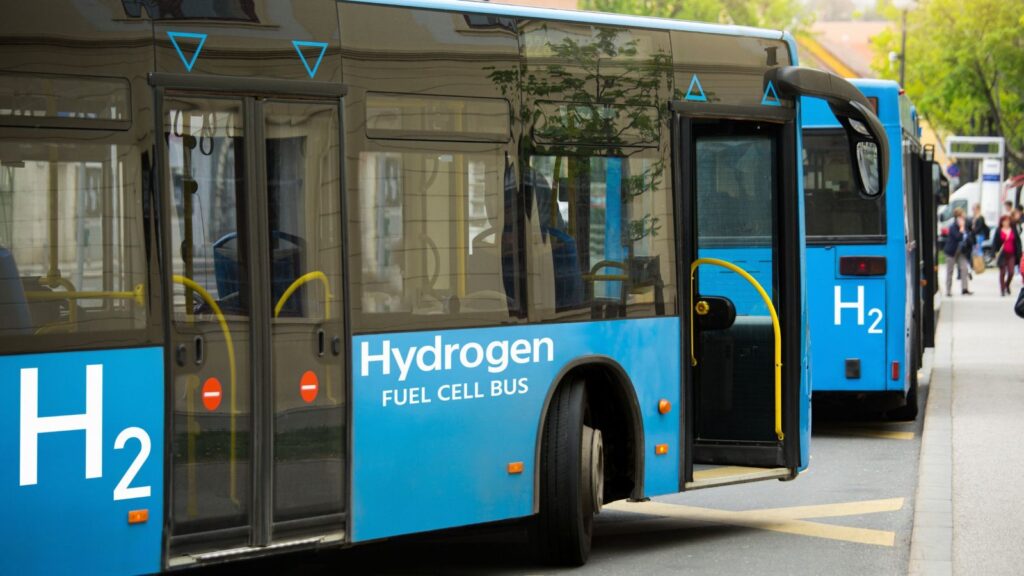
For public transit operators, the success of a new bus depends on more than its ability to run without diesel. Reliability, maintenance costs, passenger capacity and performance during harsh weather can determine whether new technology becomes a practical replacement for conventional vehicles.
Vancouver-based Ballard Power Systems is taking another step toward that goal with its next-generation FCmove-SC hydrogen fuel-cell engine. On November 5, 2026, the company announced that the system would make its series-production debut in Solaris’s redesigned Urbino 12 hydrogen bus.
With 40% fewer components, improved power density and an engineering design focused on reducing operating costs, the new system represents an important development for Canadian hydrogen technology. Its commercial success, however, will depend on whether these improvements translate into measurable savings for transit agencies.
A New Stage for Ballard and Solaris
The November announcement marks a shift from launching a new product to preparing it for integration into commercially manufactured vehicles. Ballard introduced the FCmove-SC in 2025, and Solaris selected the technology for its second-generation hydrogen bus platform in May 2026. The companies also extended their long-term supply agreement through 2029, reinforcing a partnership that has already supported hydrogen bus deployments across Europe.
That relationship matters because transit agencies generally want established suppliers capable of supporting vehicles throughout their operating lives. In April 2024, Ballard announced an agreement covering 1,000 fuel-cell engines for Solaris through 2027, combining existing orders with additional commitments. The latest announcement brings a newer engine into that relationship. However, Ballard has not disclosed a specific FCmove-SC production volume, initial delivery date or new contract value. The development confirms a series-production integration milestone rather than a completed large-scale fleet rollout.
Why 40% Fewer Parts Could Make a Difference
One of the most significant improvements in Ballard’s FCmove-SC is its 40% reduction in total component count compared with the previous generation. Importantly, that reduction applies to the fuel-cell module, not the entire Solaris bus. The redesigned system incorporates an internal DC/DC converter and power controller, consolidating functions that would otherwise require additional equipment and connections. This architecture is intended to simplify installation while reducing the complexity of maintenance and diagnostics.
For transit operators, the practical implications could be substantial. Maintenance teams working on large bus fleets must manage inspections, component replacements and unexpected mechanical problems without disrupting scheduled services. A system with fewer components and connections potentially gives technicians fewer failure points to investigate. However, fewer parts do not automatically guarantee a proportional reduction in repair costs or downtime. Ballard has not published actual maintenance savings for the newly integrated FCmove-SC, making real-world fleet performance the next important measure of its success.
A More Compact Engine With Greater Power Density
The FCmove-SC combines a smaller, more integrated design with performance improvements aimed at demanding city transit operations. According to Ballard’s November specifications, the system delivers up to 80 kilowatts of rated power and reaches 57% peak fuel efficiency. The company also reports a 57% increase in volumetric power density, helped by the integration of electrical conversion equipment. This means more power-generating capability can fit within a smaller overall system volume.
For bus manufacturers, compact equipment creates additional flexibility when arranging electrical systems, cooling components and passenger space. It can also make incorporating fuel-cell technology into standardized vehicle platforms easier. However, Ballard’s earlier September 2025 materials described a 25% power-density improvement, while the latest announcement gives 57% without explaining the revised comparison. Both figures are company-reported specifications. The central question for transit operators will be whether the more compact design maintains dependable power delivery throughout years of demanding daily operation.
Solaris Redesigns Its Hydrogen Bus Around Passenger Space
Passengers may never notice which company supplies a bus’s fuel cell, but they can notice whether there is room to sit. The new Solaris Urbino 12 hydrogen uses the unified platform developed for Solaris’s latest Urbino buses. Its design removes the conventional engine tower, freeing room for additional seating near the rear. Roof-mounted components can also be arranged more flexibly, an approach Solaris says makes important systems easier for technicians to reach.
Solaris publicly presented the new-generation model at the TRANSEXPO public transport exhibition in Kielce, Poland, in October 2026, before Ballard’s November announcement. The vehicle shows how fuel-cell technology can shape an entire bus rather than simply replace a diesel engine. Transit agencies weigh passenger space, accessibility and maintenance access alongside powertrain performance. An extra seat matters on a crowded commute, while better access to roof equipment matters when the vehicle returns to the depot. Solaris has not specified how many additional seats result from this particular hydrogen-bus configuration.
How the Hydrogen System Powers the Bus
Despite its description as a hydrogen engine, the FCmove-SC does not burn hydrogen in a conventional combustion process. Instead, its fuel-cell stack combines hydrogen with oxygen from the air to generate electricity, producing water and heat as byproducts. In the redesigned Solaris bus, that electricity powers a centrally mounted traction motor. The result is an electrically driven vehicle whose onboard energy comes primarily from hydrogen rather than a large externally charged battery.
A supporting traction battery still plays a valuable role. It can supply extra power when the driver accelerates away from a stop and store electricity recovered during braking. On an urban route with repeated stops, that division of work lets the fuel cell provide energy while the battery handles changing power demands. It also explains why the module’s 80-kilowatt rating should not be mistaken for the traction motor’s total output. The hydrogen system and battery operate together as parts of a larger powertrain.
Better Heating and Cold-Weather Performance
Heating is a serious engineering concern for a city bus, particularly on winter routes where doors open constantly and passengers need a warm cabin. Ballard says the FCmove-SC raises the maximum radiator outlet temperature from 60°C to 75°C. That change can reduce cooling-system demands and make more waste heat available for passenger heating. The engine is also specified to start from frozen conditions at temperatures as low as −30°C, a potentially useful attribute for cold-climate transit systems.
Research published in the journal Energy in October 2026 highlights the wider challenge: fuel-cell buses must maintain stack temperature and cabin comfort without wasting energy on auxiliary heating. Ballard’s warmer coolant could help vehicle designers manage that balance, but the claimed benefit depends on the finished bus’s heating architecture and actual weather conditions. A laboratory freeze-start rating is not the same as guaranteed winter reliability across an entire fleet. Operators will want service records from cold mornings, not simply a temperature printed on a specification sheet.
A 25,000-Hour Lifespan and Improved Safety Design
Ballard assigns the FCmove-SC a specified operating life exceeding 25,000 hours, positioning it for the repeated daily duty cycles expected of public buses. Those hours refer to the fuel-cell system’s design specification, not a promise that every installation will operate without repair. Routine work can still include inspections and servicing of filters, sensors, pumps and other supporting equipment. Reducing unnecessary maintenance remains valuable because a transit bus generates no service for passengers while it is parked awaiting repairs.
Safety is another part of the redesign. Ballard says revised geometry inside the fuel-cell stack enclosure adds passive protection against hydrogen-related hazards. Unlike a measure that depends entirely on software responding to a warning, passive protection is built into the physical arrangement. That does not eliminate the need for appropriate detection, ventilation, maintenance or operating procedures. For agencies considering unfamiliar technology, credible safety engineering must be supported by training and consistent performance over years of daily operation.
Ballard’s Global Bus Experience Supports the New Engine
The FCmove-SC is new, but Ballard’s presence in hydrogen transit is not. In its November announcement, the company said Ballard-powered buses worldwide now number more than 2,500 and have collectively travelled over 300 million kilometres. Those figures cover the broader installed fleet, not the new module alone. Solaris brings its own experience: the Polish manufacturer reported delivering 306 hydrogen buses during 2025, demonstrating that its involvement extends beyond prototype vehicles.
That operating history informs Ballard’s Fleet360 service offering, which combines remote monitoring, performance analytics, maintenance planning and technical support. In practical terms, a maintenance team could use operating data to investigate a developing issue before it sidelines a bus during a busy shift. However, Ballard says Fleet360 coverage and availability are negotiated separately with the vehicle manufacturer for each fleet. The reported global mileage provides valuable context, but it cannot substitute for independent long-term reliability data from Solaris buses equipped specifically with the FCmove-SC.
Hydrogen Costs Remain a Major Challenge
A hydrogen bus can produce no carbon dioxide at the tailpipe while still carrying an environmental footprint from the hydrogen it consumes. The International Energy Agency’s 2026 assessment found that worldwide hydrogen production remained dominated by fossil fuels, with low-emissions production reaching almost one million tonnes in 2025. That was a small fraction of global hydrogen demand, which exceeded 100 million tonnes. A cleaner bus therefore also needs a credible plan for sourcing lower-emissions fuel.
Cost presents a parallel challenge. A 2025 peer-reviewed assessment of urban bus technologies found that battery-electric buses generally remained the more economical choice when hydrogen stayed expensive, although cheaper hydrogen could improve fuel-cell competitiveness. Refuelling arrangements, daily distances, electricity infrastructure and depot constraints can all change the calculation for individual operators. Ballard’s 40% component reduction may improve the bus’s ownership economics, but it cannot by itself control hydrogen prices or deliver a refuelling network. Those wider conditions will help determine adoption.
What the Milestone Means for Canada’s Hydrogen Industry
For British Columbia, the announcement puts a locally headquartered technology developer into another European vehicle programme. Ballard’s corporate headquarters are in Burnaby, part of Metro Vancouver, even though its announcements are commonly issued from Vancouver. Solaris is not its only partner for the FCmove-SC: British bus builder Wrightbus selected the same module for a new double-decker hydrogen platform, with series production scheduled for 2027. Those agreements broaden the engine’s potential market beyond one bus model.
North America offers a separate route to commercial growth. In March 2026, Ballard announced an agreement involving 500 FCmove-HD+ engines for New Flyer buses, a different module from the FCmove-SC. Taken together, the relationships show continuing interest in fuel-cell transit, but they do not establish sales or local employment gains from the latest engine. The next measures of progress will be production deliveries, dependable fleet operation and transparent evidence of operating costs. For Ballard, the manufacturing milestone is important; repeatable results will matter more.
