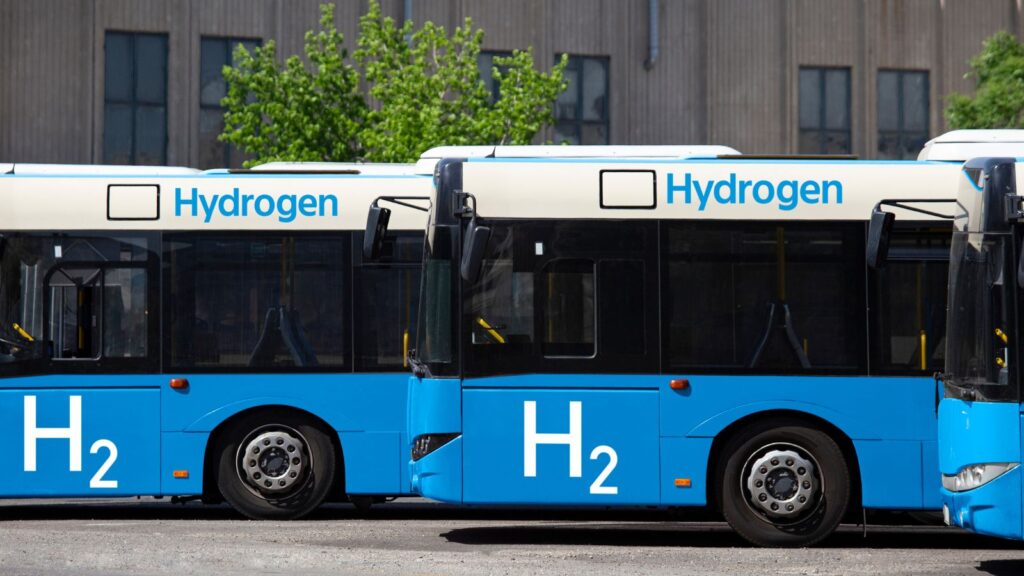
A quieter, cleaner city bus is only part of the promise of hydrogen technology. Behind the scenes, transit operators also need vehicles that can withstand long working days, operate reliably in difficult weather, and spend less time in maintenance shops.
British Columbia-based Ballard Power Systems is taking another step toward those goals with a redesigned hydrogen fuel-cell engine.
On November 5, 2026, the company announced that its FCmove-SC engine will make its series-production debut in the next-generation Solaris Urbino 12 hydrogen bus. The new system features 40% fewer components than its predecessor, improved thermal management, and a more compact architecture.
For the Canadian manufacturer, the development represents an important commercial milestone. For transit agencies, the bigger question is whether these improvements can make hydrogen buses more affordable and practical over years of daily operation.
A Production Milestone Years in the Making
Ballard’s latest announcement follows more than a year of development and commercial negotiations. The company introduced the FCmove-SC in September 2025 ahead of its appearance at Busworld Europe in Brussels. The engine was developed specifically for urban transit applications, where frequent stops, demanding schedules, and high passenger loads place considerable pressure on propulsion systems. In May 2026, Polish bus manufacturer Solaris formally selected the engine for its second-generation hydrogen platform and extended its supply relationship with Ballard through 2029.
The November announcement takes that relationship further by confirming the engine’s integration into the series-production version of the new Solaris Urbino 12 hydrogen bus. That distinction matters. A manufacturer selecting a component is different from designing it into a vehicle intended for regular commercial production. However, Ballard has not disclosed a specific production volume, initial delivery schedule, or new contract value for the FCmove-SC in the November announcement. The milestone is significant, but the scale of the initial rollout remains to be established.
Why Having 40% Fewer Parts Could Make a Big Difference
One of the most important improvements in Ballard’s FCmove-SC is also among the least visible. According to the company, the new engine contains 40% fewer components than its previous generation. For a transit agency operating dozens of buses, simpler machinery could mean fewer components to inspect, troubleshoot, replace, or maintain. A relatively small reduction in workshop time per vehicle can become meaningful when repeated across an entire fleet throughout the year.
The design also brings the DC/DC converter and power controller inside the fuel-cell module, reducing the number of external connections. This can make it easier for vehicle manufacturers to integrate the system and for technicians to identify problems. Consider a bus that develops an electrical fault before its morning departure. Simplified connections and clearer diagnostics could help mechanics locate the issue more efficiently. However, fewer parts do not automatically guarantee 40% lower maintenance costs. Those savings will need to be demonstrated through actual service records, warranty claims, and operating experience.
How the New Hydrogen Bus Actually Works
Despite being described as a hydrogen engine, the FCmove-SC does not burn hydrogen in the way a conventional engine burns diesel. Instead, it uses a proton-exchange membrane fuel cell to combine hydrogen with oxygen from the surrounding air through an electrochemical process. The reaction generates electricity, along with water and heat. That electricity powers the bus’s electric propulsion system, allowing the vehicle to operate without the exhaust emissions associated with conventional diesel buses.
The Solaris Urbino 12 hydrogen also carries a supporting traction battery, making the vehicle a hybrid of two electric energy sources. The fuel cell supplies the primary energy, while the battery provides additional power when demand increases, such as during acceleration. Regenerative braking allows energy that would otherwise be lost while slowing down to be recovered and stored. This arrangement is especially relevant to city buses, which may accelerate and brake hundreds of times during a working day. The system is designed to balance power demands rather than forcing the fuel cell to handle every sudden change alone.
An 80-kW Engine Built for Long Operating Hours
Ballard’s latest specifications place the FCmove-SC’s rated output at up to 80 kilowatts, with peak fuel-cell efficiency of 57%. The company also specifies a service lifetime exceeding 25,000 operating hours. These figures reflect the demands of public transportation, where vehicles may spend much of their working lives on the road rather than parked. For operators, durability is particularly important because replacing or overhauling major propulsion components can create significant costs beyond the price of the equipment itself.
The 57% efficiency figure refers to the fuel-cell system at its peak operating efficiency, not the overall efficiency of the bus from hydrogen production to movement. Similarly, the specified operating lifetime should not be treated as a guarantee that every engine will operate for 25,000 hours without service or repairs. Actual durability depends on operating conditions, maintenance, and component performance. Ballard’s engineering improvements are intended to make the system more reliable throughout its life, but the new generation must still establish its own performance record in commercial service.
Solaris Redesigns Its Bus to Create More Passenger Space
The new Solaris Urbino 12 hydrogen is more than an existing vehicle fitted with a different fuel-cell engine. Solaris has developed the model around a unified architecture shared with its latest Urbino buses. The company displayed the new-generation hydrogen model at TRANSEXPO in Poland in October 2026, highlighting a layout that eliminates the conventional rear engine tower. Removing that structure creates additional space for passenger seating while allowing important components to be arranged more flexibly on the roof.
For transit agencies, this offers practical advantages beyond appearance. Additional seating can improve passenger comfort on busy routes, while easier access to roof-mounted systems can help maintenance teams perform inspections and repairs. Space is particularly valuable in a standard urban bus, where manufacturers must accommodate passengers, accessibility equipment, batteries, hydrogen tanks, and electrical systems. The updated layout demonstrates how advances in propulsion technology can influence the design of an entire vehicle. Ballard’s smaller integrated engine contributes to that approach, although the additional seating results from Solaris’s broader platform redesign.
A More Compact Engine With Higher Power Density
Ballard says the latest FCmove-SC design delivers a 57% increase in volumetric power density through its integrated electrical architecture. In practical terms, volumetric power density describes how much power a system can provide relative to the space it occupies. A higher figure can give bus manufacturers greater flexibility when determining where to position equipment. Integrating the electrical converter and controller into the module also reduces the number of separate components that must be connected and accommodated elsewhere in the vehicle.
There is an important distinction between making a fuel-cell engine more compact and making a bus substantially more energy-efficient. Ballard’s original 2025 unveiling described a 25% improvement in volumetric power density, while its November 2026 announcement cites 57%. The public summaries do not provide enough detail to directly reconcile those two figures. Neither should be interpreted as an equivalent reduction in hydrogen consumption. The clearer engineering takeaway is that Ballard has redesigned the fuel-cell package to simplify installation, increase packaging efficiency, and provide manufacturers with a more integrated propulsion component.
Better Heat Management Could Improve Winter Performance
Temperature management is one of the less obvious challenges facing hydrogen-powered buses. Fuel cells generate heat while producing electricity, and that heat must be managed to protect the system and maintain performance. Ballard has increased the FCmove-SC’s maximum radiator outlet temperature from 60°C to 75°C. According to the manufacturer, this improvement can reduce cooling requirements and make more waste heat available for passenger cabin heating, potentially reducing the energy needed from separate heating equipment.
Cold-weather performance is particularly relevant for Canadian transit operators and European cities that experience harsh winters. Ballard says the FCmove-SC can perform a freeze-start at temperatures as low as −30°C. That capability could help vehicles operate in demanding climates without requiring the same external starting assistance as some earlier systems. Research into fuel-cell bus thermal management has also demonstrated potential energy savings from recovering heat for cabin heating. However, reliable cold starts do not guarantee trouble-free winter service. Heating demand, hydrogen delivery, maintenance conditions, and other vehicle components still influence overall reliability.
Safety Improvements Go Beyond Traditional Monitoring Systems
Hydrogen presents specific safety considerations because it is highly flammable and requires appropriate storage, ventilation, and leak-detection systems. Ballard says the FCmove-SC incorporates a redesigned enclosure around its proton-exchange membrane fuel-cell stack. The new internal geometry is intended to provide passive protection against hydrogen-related risks, meaning some protective functions are built directly into the physical design rather than depending exclusively on electronic monitoring and active controls.
This approach is significant because safety must remain effective across a wide range of operating and maintenance conditions. The U.S. Department of Energy notes that hydrogen disperses rapidly when released into open air, but its low ignition energy and wide flammable range demand careful engineering. For transit operators, the safety equation extends beyond the bus itself. Maintenance facilities need appropriate ventilation, detection systems, procedures, and trained personnel. Ballard’s redesigned enclosure could strengthen protection at the component level, but it does not eliminate the need for comprehensive vehicle safety systems, regulatory compliance, or maintenance training.
Remote Monitoring Becomes Part of the Ownership Experience
The new engine is also designed to support remote diagnostics, reflecting a broader shift toward monitoring vehicle health before problems become serious enough to interrupt service. Ballard has expanded its fleet-support offerings through Fleet360, which combines performance monitoring, data analysis, maintenance planning, and technical expertise. The approach is intended to help fleet managers understand equipment condition, anticipate maintenance requirements, and plan repairs rather than relying entirely on reactive service.
For a transit operator managing buses across multiple depots, these capabilities could be valuable. A maintenance manager might use performance trends to identify a fuel-cell module requiring attention before assigning it to a demanding route. Ballard introduced a more comprehensive Fleet360 program for new FCmove-HD+ modules in North America in October 2026, including certain service guarantees and support options. Those specific guarantees should not be assumed to apply automatically to the new FCmove-SC. Ballard says the availability and scope of Fleet360 services for individual fleets depend on separate agreements coordinated with vehicle manufacturers.
An Established Partnership Gives Ballard a Commercial Advantage
The Solaris relationship gives Ballard something that many emerging clean-transportation technologies struggle to obtain: an established customer with experience deploying hydrogen buses. In April 2024, Ballard announced a long-term agreement covering 1,000 fuel-cell engines for Solaris through 2027. The agreement combined approximately 300 previously ordered engines with 700 additional units. Those commitments involved earlier FCmove-HD and HD+ systems, rather than representing 1,000 new orders for the FCmove-SC.
The relationship expanded in May 2026 when Solaris selected the redesigned engine and the companies extended their agreement through 2029. Ballard reported in November that its technology had powered more than 2,500 fuel-cell buses worldwide, accumulating over 300 million kilometres of operation. These company-reported figures demonstrate a substantial history of field deployment, although they describe the broader Ballard fleet rather than the newest engine. That distinction is important: experience from older products can guide improvements, but customers will still want evidence that the FCmove-SC delivers stronger performance under comparable operating conditions.
Hydrogen Buses Still Face a Difficult Cost Comparison
Engineering improvements alone will not determine whether hydrogen buses become widespread. Transit agencies must evaluate vehicle purchase prices, fuel costs, infrastructure requirements, maintenance, and long-term reliability. A peer-reviewed 2025 assessment of electric bus deployment found that battery-electric buses generally achieved better energy efficiency than hydrogen fuel-cell buses in real-world comparisons. The review also highlighted the higher capital and fuel costs that have historically challenged hydrogen fleet economics.
One California operating-cost comparison discussed in that research estimated approximately US$1.01 per kilometre for battery-electric buses and US$1.56 per kilometre for fuel-cell buses, including fuel and maintenance but excluding vehicle purchase costs. Those figures reflect the fleets and conditions studied, not projected costs for Ballard’s new engine. Hydrogen buses can offer advantages on longer routes and in certain high-utilization operations where charging schedules become challenging. Nevertheless, Ballard must demonstrate that simpler components, improved durability, and reduced maintenance requirements can narrow the overall cost gap rather than merely improve individual technical specifications.
Hydrogen Supply and Canada’s Transit Plans Will Shape What Happens Next
The environmental benefits of hydrogen transportation also depend on how the hydrogen is produced. Fuel-cell buses emit no harmful exhaust pollutants during normal operation, but hydrogen production can create substantial emissions when fossil fuels are used without effective carbon capture. The International Energy Agency reported that low-emissions hydrogen accounted for less than 1% of global production in 2025 and expected that share to exceed 1% in 2026. Hydrogen availability, production costs, and refuelling infrastructure therefore remain major considerations for fleet operators.
The development comes as Canada continues investing in zero-emission transit. On October 29, 2026, Ottawa announced up to $15 million in planning and advisory support to help municipalities and transit agencies prepare for zero-emission bus deployment. Ballard, headquartered in Burnaby near Vancouver, could benefit from broader adoption of hydrogen transportation, although its latest Solaris announcement does not establish any new Canadian bus deployment. The company’s next-generation engine has also been selected for Wrightbus’s future hydrogen double-decker platform, with production planned for 2027. Ultimately, the FCmove-SC’s success will be measured through delivered vehicles, reliable daily service, and documented operating savings.
