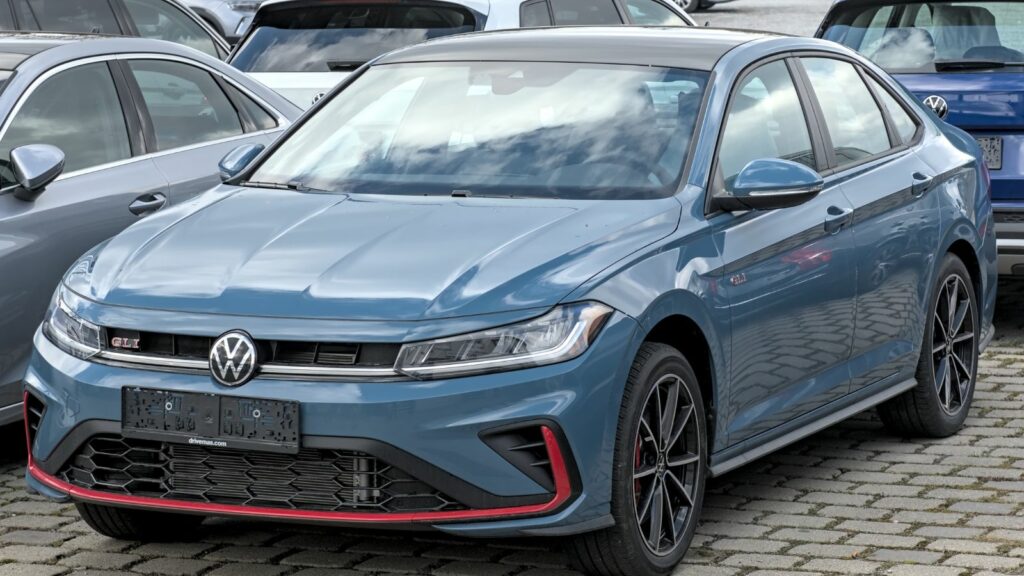
Volkswagen-backed Jetta has put a striking new number into the global electric-vehicle conversation: 80,800 yuan, or about US$11,990. That is the opening pre-sale price of the new Jetta M6 in China, a battery-electric sedan with up to 555 kilometres of advertised CLTC range and an official launch planned for mid-October.
The figure stands out even more from a Canadian perspective. Statistics Canada’s July sales data work out to roughly C$57,249 in new-vehicle sales value per unit, while the M6’s Chinese starting price converts to about C$16,960 at the Bank of Canada’s September 25 exchange rate. That does not mean Canadians could buy one for C$17,000. Import rules, certification, tariffs, distribution costs and incentive eligibility all matter. Still, the gap helps explain why inexpensive Chinese EVs are attracting so much attention.
A US$11,990 Pre-Sale Price Changes the Conversation
Jetta opened pre-sales for the M6 in China on September 28, with three versions priced from 80,800 yuan to 99,800 yuan. The entry-level 465 Pro carries the headline-grabbing price, while the 555 Max rises to 90,800 yuan and the 555 Ultra tops the initial range at 99,800 yuan. The model is expected to make its formal market debut in China around the middle of October. Jetta is also offering a collection of pre-sale perks, including a deposit credit and charging-equipment options.
That pricing matters because this is not an experimental microcar built simply to achieve the lowest possible sticker price. The M6 is Jetta’s first production battery-electric model and represents a major strategic shift for a brand that has traditionally concentrated on affordable gasoline vehicles. Even the most expensive pre-sale version remains below 100,000 yuan. For Volkswagen and FAW, that positions the M6 directly in one of China’s most intensely contested areas: affordable electric transportation for mainstream households rather than luxury EV buyers.
The M6 Is Much More Substantial Than Its Price Suggests
The M6 measures 4,806 millimetres long and rides on a 2,820-mm wheelbase, dimensions that put it well beyond the proportions many people associate with a bargain-basement electric runabout. Depending on configuration, it is listed at 1,868 or 1,895 mm wide and 1,500 mm tall. The car uses a single front-mounted electric motor, with output choices of 113 kW and 145 kW. Jetta says the available configurations deliver 465 or 555 kilometres of range under China’s CLTC test cycle.
The interior also illustrates how competitive the Chinese market has become. The M6 includes a digital instrument display and a 15.6-inch 2.5K central screen, with multiple exterior and interior colour choices. Its driver-assistance hardware uses Horizon Robotics’ Journey 6M chip, supporting navigation-assisted functions for urban roads and highways. CALB supplies the battery cells. Those specifications do not automatically make the M6 equivalent to a more expensive Canadian vehicle, and its CLTC range should not be treated as a Canadian-certified figure. They do, however, show how much equipment Chinese-market manufacturers are now attempting to deliver below the 100,000-yuan level.
Jetta Means Something Different in China
Canadian drivers generally know Jetta as Volkswagen’s long-running compact sedan. In China, however, Jetta has operated as its own vehicle brand since 2019 under the FAW-Volkswagen partnership. Volkswagen originally created the standalone brand to reach younger and first-time customers who wanted the familiarity associated with Volkswagen engineering but were shopping in lower-priced portions of the Chinese market. Its initial range included sedans and SUVs produced through FAW-Volkswagen.
The strategy is now being rewritten around electrification. Volkswagen said in April that Jetta would introduce four new-energy vehicles by 2028, with the first arriving in 2026. Industry reports indicate the broader product plan calls for five new models by 2028, four of them classified as new-energy vehicles. Jetta has also been given greater organizational independence through FAW Volkswagen Jetta Automotive Technology Co. Ltd. The M6 therefore is not simply an electric version of the familiar North American Volkswagen Jetta. It is the first battery-electric product in a much broader China-focused brand transformation.
Volkswagen Is Being Forced to Move Faster in China
The M6’s low price makes more sense when viewed against Volkswagen’s situation in China. The company has described its current strategy as “In China, for China,” relying more heavily on local engineering, suppliers, software development and partnerships. Volkswagen Group said in April that more than 20 electrified vehicles were scheduled to reach the Chinese market during 2026 alone, with the group targeting approximately 50 electrified models by 2030.
That urgency reflects an exceptionally difficult market. Volkswagen China chief Ralf Brandstaetter said in September that China’s passenger-car market could contract by about 20% in 2026. Domestic vehicle sales had fallen for 11 consecutive months through August, even as exports remained strong. Volkswagen, BMW and Mercedes-Benz had already reported steep Chinese sales declines earlier in the year as domestic manufacturers intensified competition. In that environment, an aggressively priced Jetta EV is more than an affordability play. It is part of Volkswagen’s attempt to remain relevant in a market where local brands have dramatically compressed development cycles, equipment expectations and acceptable price points.
Canada’s Vehicle Price Gap Is Genuinely Large
Statistics Canada reported 176,156 new motor vehicles sold in July 2026 with a combined sales value of approximately C$10.085 billion. Dividing those figures produces an average of about C$57,249 per vehicle. AutoTrader’s second-quarter data pointed in a similar direction, reporting an average new-vehicle price of C$63,016 in June. Even used vehicles remained expensive by historical standards, with AutoTrader putting its June average at C$36,690.
For comparison, the M6’s US$11,990 starting figure translates to roughly C$16,960 using the Bank of Canada’s September 25 rate of C$1.4145 per U.S. dollar. That means its converted Chinese-market price is less than one-third of Statistics Canada’s July average new-vehicle sales value. The comparison has obvious limitations: one figure is the price of a particular entry-level EV sold in China, while the Canadian number covers everything from inexpensive sedans to costly pickups and luxury SUVs. Even so, the magnitude of the gap helps explain the continuing debate around whether additional low-cost EV imports could put downward pressure on Canadian vehicle prices.
The Chinese Price Would Not Simply Become a Canadian Sticker Price
A direct currency conversion is not a realistic prediction of what the M6 would cost in Canada. Any manufacturer bringing a Chinese-market vehicle here commercially would need a compliant Canadian specification, an importer, logistics and parts support, warranty infrastructure, dealer or direct-sales operations and other distribution expenses. Transport Canada requires vehicles imported for sale to comply with applicable Canada Motor Vehicle Safety Standards. Commercial importers also carry responsibilities involving compliance records and recalls.
There is a tariff consideration as well. Chinese EVs admitted under Canada’s current quota face a 6.1% most-favoured-nation tariff. Applied purely as an illustration to the M6’s roughly C$16,960 converted price, 6.1% would add about C$1,035 before shipping, certification, taxes and other expenses were considered. That arithmetic demonstrates why even an extraordinarily cheap vehicle at the factory or domestic-market level cannot simply be assigned the same price overseas. The more important question is whether the underlying production economics leave enough room for an importer to absorb those additional costs while still reaching Canada at a significantly lower price.
Canada Has Reopened the Door to Chinese EV Imports
Canada’s current policy is considerably different from the one introduced in 2024. The previous 100% surtax on Chinese-made EVs was repealed effective March 1, 2026. Under the new Canada-China arrangement, as many as 49,000 Chinese-origin electric vehicles can enter during the first quota year at the regular 6.1% most-favoured-nation tariff. The quota subsequently increases by 6.5% annually, while an increasing portion is eventually reserved for lower-priced EVs.
The program is tightly controlled rather than an unrestricted opening of the market. Global Affairs Canada requires shipment-specific import permits, and the quota continues to be administered on a first-come, first-served basis. Government data updated September 25 showed that 15,763 of the 49,000 available vehicles had been counted against the first-year quota, leaving 33,237. That creates a possible pathway for more Chinese-built EVs to reach Canadian dealerships, but it does not guarantee that any particular brand or model will arrive. An automaker still needs to choose Canada, meet Canadian standards and establish the commercial structure required to sell and support its vehicles.
Federal EV Rebates Would Not Automatically Make the M6 Cheaper
Canada’s Electric Vehicle Affordability Program returned federal purchase incentives in February 2026. For an eligible battery-electric or hydrogen fuel-cell vehicle, the maximum 2026 incentive is C$5,000. The program generally requires a final transaction value of C$50,000 or less, although Canadian-made EVs are exempt from that price ceiling. The available incentive gradually declines in later years under the program’s current structure.
There is another condition that is particularly relevant to vehicles such as the Jetta M6: eligible vehicles must be manufactured in Canada or in a country that has a free-trade agreement with Canada. A Chinese-built M6 therefore would not qualify for the federal EVAP incentive merely because its price fell comfortably below the C$50,000 limit. That creates an unusual situation in which Canada can now admit a limited number of Chinese EVs under the new import quota, yet the federal consumer incentive has separate country-of-origin requirements. An inexpensive Chinese model could consequently compete primarily on its underlying price rather than by combining a low sticker price with the full federal rebate.
Canadians Are Buying More EVs, but Affordability Still Matters
Electric-vehicle demand in Canada showed renewed momentum through the middle of 2026. Statistics Canada recorded 21,876 new zero-emission vehicle sales in June, up 56.1% from a year earlier and equal to 11.5% of all new vehicle sales that month. In July, 18,920 ZEVs were sold, a 36% year-over-year increase and 10.7% of the new-vehicle market. Statistics Canada’s ZEV category includes both battery-electric and plug-in hybrid vehicles.
At the same time, affordability remains one of the industry’s biggest constraints. AutoTrader reported that overall new-vehicle prices declined 2.2% year over year during the second quarter, yet EV prices moved higher rather than lower. The company also found weaker purchasing activity among subprime consumers, a group particularly exposed to higher borrowing and living costs. This is the environment in which a vehicle such as the M6 attracts attention. Canadians may be showing renewed interest in electrified vehicles, but a large portion of the market still faces a difficult basic equation: the vehicles offering the technology buyers want often remain much more expensive than household budgets comfortably allow.
A Canadian Jetta M6 Remains Unconfirmed
Nothing in Jetta’s September 28 announcement confirms that the M6 is headed to Canada. The pre-sale program, prices, specifications and planned mid-October launch all apply to the Chinese market. Volkswagen’s public statements about Jetta’s electrification strategy have likewise emphasized China and, separately, selective international expansion into markets such as Central Asia. A Canadian sales program, Canadian pricing and Canadian certification have not been announced for the M6.
That distinction matters because the most interesting part of the story may not ultimately be this specific car. The M6 demonstrates what Volkswagen and its Chinese joint venture believe is commercially necessary in one of the world’s toughest EV markets: a reasonably large electric sedan, substantial digital equipment and advertised range approaching 555 kilometres at a price beginning below 81,000 yuan. Canada now has a regulated route through which some Chinese-built EVs can enter, and Ottawa explicitly plans to increase the share reserved for lower-priced models over time. Whether the M6 itself ever arrives remains unknown, but the price pressure represented by vehicles like it is becoming increasingly difficult for higher-cost markets to ignore.
