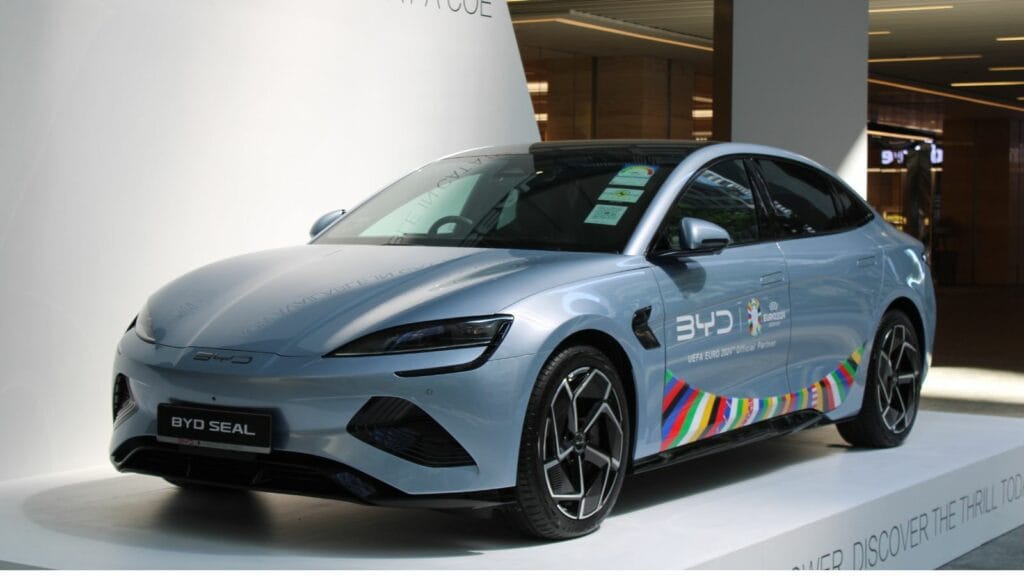
The next Canadian EV bargain may come with an unexpected question at the border. As Chinese-built electric vehicles become more realistic options for Canadian buyers, a growing U.S. national-security crackdown on connected-car technology is creating uncertainty for anyone who regularly drives south for shopping, flights, work trips, family visits, or winter travel.
The concern is not simply where a vehicle is assembled. Washington is increasingly focused on the software, sensors, communications systems, and data pathways inside modern vehicles. That makes the issue more complicated than a tariff dispute. For Canadians, the biggest risk is not that Chinese EVs cannot be sold in Canada. It is that a vehicle legal to buy and drive at home could one day face restrictions, extra scrutiny, or unresolved questions when crossing into the United States.
A Border Problem Hiding Inside A Car Purchase
For many Canadians, the U.S. border is not a distant legal abstraction. It is part of ordinary life. Families in southern Ontario drive to Buffalo for flights, shoppers cross for deals, snowbirds head south for weeks or months, and business owners regularly move between Canadian and American clients. A car that cannot reliably cross the border would not just be inconvenient. It could lose a major part of its practical value.
That is why the emerging Chinese EV question matters. The United States has already finalized connected-vehicle rules aimed at Chinese and Russian-linked software and hardware. U.S. officials have also acknowledged uncertainty about how those rules might apply to Chinese vehicles owned by Canadian consumers and driven temporarily across the border. That does not mean every Chinese-built EV in Canada will be refused entry. It means the legal gap is real enough that buyers should treat cross-border usability as part of the purchase decision.
Washington’s Concern Is The Computer, Not Just The Badge
The modern EV is less like an old gasoline car and more like a rolling network device. It can include cellular connections, cameras, microphones, driver-assistance software, over-the-air updates, mapping systems, cloud accounts, and detailed location histories. U.S. regulators argue that those systems could create security risks if they are designed, supplied, maintained, or controlled by companies subject to the jurisdiction of a foreign adversary government.
This is why the U.S. rules focus on “connected vehicles” and key systems such as vehicle connectivity software, vehicle connectivity hardware, and automated driving systems. The rules are not aimed only at cheap cars or unfamiliar brands. They can also affect global automakers with Chinese ownership links, Chinese-developed software, or China-linked supply chains. In practical terms, a Canadian buyer may see a stylish, affordable electric crossover. A U.S. regulator may see a mobile data platform capable of collecting movement patterns, personal information, and operational data.
Canada Has Opened A Narrow Door For Chinese-Built EVs
Canada’s policy has shifted. The earlier 100 per cent surtax on Chinese-made EVs created a major barrier for imports, but Ottawa later moved to a quota-and-permit system. Under the current framework, eligible Chinese-origin EVs can enter Canada under an annual quota, with permits required for covered imports. The first-year quota is 49,000 vehicles, and the first six-month tranche was set at 24,500 vehicles on a first-come, first-served basis.
That creates a very different Canadian market than the one that existed when Chinese EVs were mostly theoretical for consumers. Brands that once looked blocked by tariff math may now have a clearer route into Canada, especially if they can work through recognized import channels and dealership plans. For buyers, the appeal is obvious: Chinese automakers have become global leaders in EV scale, battery integration, and lower-cost models. But the Canada-U.S. policy split creates a strange possibility: Ottawa may allow a vehicle in, while Washington may still question whether that same vehicle can enter the U.S.
Prices Could Make The Risk Easy To Ignore
The reason this story will matter to everyday buyers is price. China is the world’s largest EV market, and Chinese automakers have built enormous scale. That scale has helped bring down costs, speed up model launches, and push more affordable EVs into markets outside China. If brands such as BYD, Geely-linked marques, Chery, XPeng, or others expand in Canada, some shoppers may finally see electric vehicles priced closer to mainstream gasoline crossovers.
That could be powerful in Canada, where EV affordability remains a barrier for many households. A family comparing a high-priced domestic EV against a lower-cost Chinese-built model may focus on monthly payments, range, winter performance, charging speed, and warranty coverage. The border issue can feel secondary until it suddenly becomes personal. A vehicle that saves thousands upfront could become a headache if it creates uncertainty for U.S. road trips, airport runs, resale value, insurance underwriting, or corporate fleet policies.
The Road-Trip Question Is Still Unsettled
Under ordinary U.S. vehicle-import rules, non-residents can temporarily bring foreign-registered vehicles into the United States for personal use, subject to conditions such as time limits and restrictions on resale. That is why Canadians routinely drive Canadian-plated vehicles across the border without thinking of it as a formal import. The connected-vehicle rules complicate that familiar pattern because they were built around national-security concerns, not just emissions, safety labels, or customs duties.
The unresolved question is whether a Canadian-owned Chinese EV would be treated like any other temporary foreign vehicle or whether connected-vehicle restrictions could eventually trigger a different approach. U.S. Trade Representative Jamieson Greer has publicly said it was unclear how Chinese vehicles operated by Canadian consumers would be handled at the border. That single point is the heart of the story. There is no clear public answer yet, and uncertainty alone can affect buying decisions before any border officer ever turns a vehicle around.
Volvo Shows How Exemptions May Work
The Volvo example shows that the U.S. system may not operate as a simple blanket ban in every case. Volvo, majority-owned by China’s Geely, received U.S. approval to keep selling connected vehicles in the American market after going through a specific authorization process. That suggests ownership links alone may not automatically decide every outcome if a company can satisfy U.S. officials on governance, technology controls, data security, and supply-chain compliance.
But Volvo is also a warning for newer Chinese brands. A global automaker with decades of U.S. presence, established compliance teams, American operations, and a trusted brand reputation still needed special approval. A new entrant selling Chinese-designed EVs into Canada may face a much steeper path if it wants U.S. compatibility or border confidence. Canadian buyers should not assume that because one China-linked automaker received authorization, every Chinese-origin vehicle will be treated the same way.
What Canadian Buyers Should Ask Before Buying
The smartest buyers will treat U.S. access as a practical checklist item, not a political opinion. Before signing, consumers should ask whether the vehicle is built in China, whether the automaker is subject to U.S. connected-vehicle restrictions, whether the model has any U.S. authorization, and whether the company has issued written guidance on cross-border travel. Dealers should be pressed for answers in writing, especially for buyers who regularly visit the United States.
There is also a resale angle. A Chinese EV may be an excellent city vehicle for someone who never crosses the border. It may be a risky choice for a family that drives to Florida every winter or uses U.S. airports several times a year. The issue is not whether Chinese EVs are good or bad. Many are technologically advanced and globally competitive. The issue is whether the vehicle fits a Canadian lifestyle tied to a border that is becoming more sensitive to software, data, and national-security rules.

Alanna Rosen is an experienced content writer that focuses on many EV and educational content. Her articles are regularly published on Get CyberTrucked and syndicated on large publications.