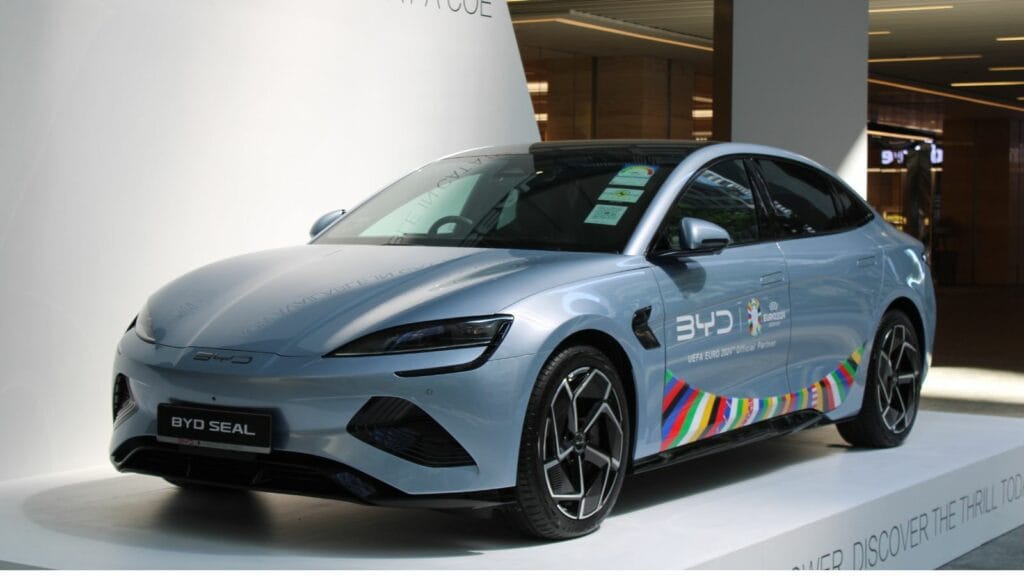
The global auto race has reached Canada’s doorstep, and this time the stakes are bigger than a new badge on the road. BYD, the Chinese electric-vehicle giant, says it wants to become the world’s largest automaker within five years — a direct challenge to Toyota’s long-held global lead. At the same time, Canada is testing a more cautious opening to Chinese-made EVs after previously walling them off with a 100 per cent surtax.
For Ottawa, the issue is not only whether Canadians should get access to cheaper electric vehicles. It is also about protecting auto jobs, managing pressure from Washington, rebuilding trade ties with China, and deciding how much room Canada has to act independently in a deeply integrated North American auto market.
BYD’s Ambition Lands at a Sensitive Canadian Moment
BYD’s chairman, Wang Chuanfu, has put a bold target on the table: becoming the world’s No. 1 automaker by scale within five years. That is not a vague marketing line. It is a direct challenge to Toyota, which remained the world’s top-selling automaker in 2025 while BYD ranked sixth globally. BYD has already become a dominant force in electric and plug-in hybrid vehicles, selling millions of new-energy vehicles and using its battery technology, lower-cost manufacturing, and fast-growing exports to move beyond China.
Canada matters because the country is no longer completely sealed off from Chinese EVs. A managed import quota now gives Chinese-made electric vehicles a pathway into the Canadian market at a much lower tariff than before. That does not mean BYD showrooms will suddenly appear on every suburban auto mall. But it does mean Canada is becoming part of a global test: whether Chinese EV makers can move from being export challengers to mainstream household brands in countries that have strong legacy dealers, strict safety standards, and politically sensitive auto jobs.
Canada Has Shifted From a Wall to a Gate
Canada’s policy has changed sharply in less than two years. In 2024, Ottawa moved in step with Washington and imposed a 100 per cent surtax on Chinese-made electric vehicles, arguing that Canada needed to protect workers and domestic industry from unfair, state-backed competition. That approach effectively kept most Chinese EVs out of the market. In 2026, Canada replaced that wall with a controlled gate: a quota system allowing 49,000 Chinese-origin EVs in the first year at the regular 6.1 per cent most-favoured-nation tariff.
The design is intentionally cautious. The first six months of the quota year, running from March 1 to August 31, 2026, provides space for 24,500 vehicles on a first-come, first-served basis. Ottawa also held consultations on how the quota should be allocated longer term, including whether import access should be linked to Canadian investment, jobs, supply-chain partnerships, or affordability. That is the heart of the debate. Canada is not simply asking whether Chinese EVs should enter. It is asking what China, and companies such as BYD, must bring to Canada in return.
Why Toyota Is the Benchmark BYD Wants to Beat
Toyota is not just another company in this contest. It is the global volume champion and one of the most trusted automotive names in Canada. In 2025, Toyota Motor sold roughly 11.3 million vehicles globally, maintaining its place as the world’s top-selling automaker. Toyota Canada also had a record year, with Toyota and Lexus combining for nearly 250,000 vehicles sold. Its electrified sales were especially important, with hybrids and plug-in models accounting for a large share of its Canadian momentum.
That matters because BYD is not trying to beat a weak incumbent. It is trying to challenge a company that has built decades of trust around reliability, resale value, dealer coverage, and practical vehicles such as the RAV4, Corolla, Camry, and Lexus NX. In Canada, Toyota’s strength is not only its technology. It is the feeling many buyers have when they hand over a deposit: the assumption that the vehicle will start in February, hold its value, and be supported by a nearby dealer. For BYD, matching Toyota on price may be easier than matching Toyota on confidence.
The Affordability Argument Is Hard to Ignore
The strongest case for opening the door to Chinese EVs is affordability. Canada’s EV market cooled in 2025 after incentives changed, economic uncertainty grew, and many consumers became more cautious about high upfront prices. Federal data shows that light-duty EV market share fell from its 2024 peak, while zero-emission vehicle sales weakened through much of 2025 before recovering late in the year. For families already dealing with higher mortgage payments, food bills, insurance costs, and rent, a lower-priced EV is not a climate talking point. It is a monthly payment question.
Chinese EV makers have become globally important partly because they compete aggressively on cost. BYD’s model range in other markets stretches from small city cars to sedans, SUVs, plug-in hybrids, and premium vehicles. If similar lower-cost models eventually entered Canada in meaningful numbers, they could pressure established automakers to rethink pricing, equipment levels, and entry trims. That could help consumers who have been priced out of EV ownership. It could also make the broader auto market more competitive at a time when the average new vehicle still feels out of reach for many households.
Ottawa’s Industrial Bargain Is About Jobs, Not Just Cars
Canada’s auto sector is too large to treat this as a simple consumer-price story. The industry directly employs more than 125,000 people, supports hundreds of thousands more through suppliers, dealers, parts, logistics, and aftermarket work, and contributes billions of dollars to GDP. Ontario’s auto corridor is built around assembly plants, parts suppliers, tool-and-die firms, battery investments, and communities where a shift in production can hit local restaurants, hockey sponsorships, mortgages, and municipal budgets.
That is why Ottawa’s quota policy includes language about attracting investment, protecting workers, and building a domestic EV supply chain. The federal government has signalled that Chinese EV access should ideally come with Canadian benefits, not just imported vehicles rolling off ships. The difficulty is timing. Consumers want lower prices now. Workers want long-term production certainty. Automakers want clear rules. China wants market access. Washington wants security alignment. Canada is trying to satisfy all of those priorities at once, which is why the quota looks less like free trade and more like a negotiated industrial bargain.
Washington Still Shapes Canada’s Room to Move
Canada can change its tariff policy, but it cannot escape geography. The Canadian and American auto industries remain deeply integrated, with Canadian-built vehicles and parts heavily tied to the U.S. market. That makes any Canadian opening to Chinese EVs politically sensitive in Washington, especially as the U.S. moves to restrict Chinese-connected vehicle software and hardware on national-security grounds. Even if a Chinese automaker sold vehicles legally in Canada, that would not automatically make those vehicles acceptable for sale or movement into the U.S. market.
This is where the debate becomes bigger than tariffs. Modern vehicles are rolling computers, filled with cameras, sensors, connectivity systems, software updates, navigation data, and driver-assistance technology. The U.S. has framed Chinese connected-vehicle technology as a potential security risk, not merely a trade issue. Canada must decide how closely to follow that approach while also trying to diversify trade beyond the United States. In practical terms, Ottawa is attempting a narrow path: enough openness to lower prices and improve China relations, but not so much that it damages North American auto integration.
Consumers May Win, but Trust Will Be the Test
For Canadian drivers, the first question will be simple: is the vehicle good, safe, serviceable, and priced right? A low sticker price can attract attention, but long-term adoption depends on parts availability, warranty support, winter performance, charging compatibility, safety compliance, software transparency, and resale value. Toyota, Honda, Hyundai, Kia, Ford, GM, and Tesla all learned that the Canadian market rewards persistence as much as flash. A brand can win headlines quickly, but winning family driveways takes years.
BYD has advantages that should not be dismissed. It makes its own batteries, sells at enormous scale, and has expanded quickly in markets such as Europe, Australia, Brazil, and Britain. It has also shown that Chinese automakers can compete beyond the ultra-cheap segment. Still, Canada is a demanding market. A commuter in Mississauga, a nurse in Laval, a contractor in Calgary, and a family in Prince George may all judge the same EV differently. Price opens the conversation. Dealer support, cold-weather credibility, and trust decide whether the keys actually change hands.
The Next Policy Move Could Decide How Wide the Door Opens
The next major question is how Canada administers the quota after the first six-month period. Ottawa’s consultation asked whether access should be based on first-come, first-served imports, annual allocations, investment commitments, price thresholds, or penalties for unused quota. Those details matter. A quota that rewards cheap imports could prioritize affordability. A quota tied to Canadian investment could push companies toward local partnerships. A quota dominated by existing global automakers could limit the impact of new Chinese brands. Each option produces a different market.
For BYD, Canada is not large enough to decide whether it catches Toyota globally. But it is symbolically important because it sits inside North America, beside the world’s most protected major auto market. If BYD can build trust in Canada under tight rules, it strengthens the case that Chinese EV makers can adapt to markets with high standards and political resistance. If the rollout stalls, Canada may remain a small side door rather than a true opening. Either way, Toyota’s crown is no longer being challenged only in China. The contest is spreading to every country trying to balance cheaper clean cars, domestic jobs, and geopolitical risk.
The Bigger Question Is What Canada Wants Its Auto Future to Be
Canada’s Chinese EV debate is ultimately a question about strategy. One path prioritizes cheaper vehicles and faster EV adoption, accepting that global competition may force uncomfortable changes on domestic manufacturers. Another path focuses on protecting jobs, preserving North American alignment, and keeping potentially risky technology at a distance. A third path tries to blend both: managed access for Chinese vehicles, strict security and safety rules, and investment requirements that tie market entry to Canadian economic benefits.
That third path is the hardest, but it is also the one Ottawa appears to be testing. BYD’s global ambition gives the debate urgency because this is not a fringe automaker trying to make noise. It is one of the companies most likely to reshape the next decade of car buying. Toyota still has the crown, the reputation, and the Canadian customer base. BYD has speed, scale, and cost pressure on its side. Canada now has to decide whether opening the door to that competition is a threat, an opportunity, or both at the same time.

Alanna Rosen is an experienced content writer that focuses on many EV and educational content. Her articles are regularly published on Get CyberTrucked and syndicated on large publications.