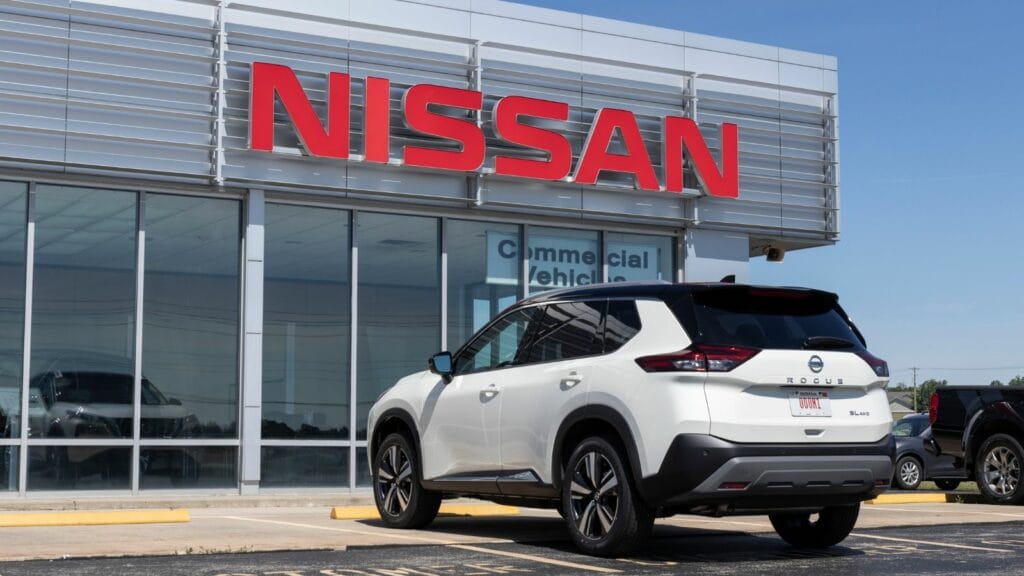
Canada’s new-vehicle market is becoming a contest between new technology and household math. Nissan is stepping into that squeeze with the 2027 Rogue Hybrid e-POWER, a compact SUV that uses electric motors to drive the wheels but still refuels at a gas station. Its arrival comes after Nissan Canada said tariffs on U.S.-produced models weighed on its first-half 2026 results, even as Rogue sales moved in the opposite direction.
That makes the timing especially relevant: Nissan is adding a hybrid to its strongest Canadian nameplate while buyers face expensive vehicles, meaningful borrowing costs and a complicated tariff landscape. The company presents the Rogue Hybrid as part of a broader strategy to offer more powertrain choices, not as a product created specifically in response to tariffs. Still, trade policy is changing the economics around which vehicles can be imported, stocked and priced competitively.
Rogue Is Carrying Nissan’s Hybrid Push
Nissan does not have to guess whether Canadians still want the Rogue. In the first half of 2026, Nissan Group sales in Canada fell 13.9 per cent from a year earlier, yet Rogue sales rose 6.18 per cent to 20,011 units. The contrast became even sharper in the second quarter: Nissan sold 10,891 Rogues, up 22.63 per cent year over year, making it the brand’s best-selling model. That gives Nissan a familiar, high-volume platform on which to introduce a new kind of electrified drivetrain rather than asking shoppers to embrace an unfamiliar niche vehicle.
Nissan executives also see a broader change in buyer preferences. When the 2027 Rogue Hybrid was unveiled in September, Nissan Americas chairman Christian Meunier said hybrid powertrains were increasingly becoming the choice of customers in Canada and the United States and that the trend was expected to accelerate. The company will initially bring the Rogue Hybrid to Canada in limited SR form in fall 2026, followed by the broader SV, SR and Platinum range in early 2027. In practical terms, Nissan is placing hybrid technology at the centre of one of its most important North American products.
The Price Ladder Shows Why the Middle Matters
The Rogue lineup now illustrates the affordability challenge unusually well. The 2026 gasoline Rogue starts at an MSRP of CA$34,848. The 2027 Rogue Hybrid will eventually start at CA$39,998 in SV AWD form, while the 2026 Rogue Plug-in Hybrid starts much higher at CA$58,698. Those prices create three distinct steps for shoppers: conventional gasoline, a non-plug e-POWER hybrid, and a plug-in model capable of travelling an estimated 61 kilometres on electricity before relying on gasoline for longer trips.
There is an important launch detail, however. The CA$39,998 Hybrid SV is scheduled for early 2027, not the first wave of deliveries. Nissan says the Rogue Hybrid arriving in fall 2026 will initially be the SR AWD at CA$47,998, with the less expensive SV and the Platinum joining later. That distinction matters when affordability is the headline. A family shopping this fall will not immediately see the lowest advertised hybrid price on a dealer lot. Once the full range arrives, though, e-POWER will occupy a clear middle position between the gasoline Rogue and the substantially more expensive plug-in version.
e-POWER Feels Electric Without Needing a Plug
Nissan’s e-POWER system takes a different route from the parallel hybrids many Canadians already know. Two electric motors drive the Rogue Hybrid’s wheels directly, while a 1.5-litre turbocharged gasoline engine works as a generator rather than mechanically driving the wheels. There is no conventional transmission and no charging cable. Energy recovered through regenerative braking and produced by the engine is stored in a lithium-ion battery, allowing the vehicle to deliver the immediate response associated with electric motors while retaining the refuelling routine of a gasoline vehicle.
For the 2027 Rogue Hybrid, Nissan says every trim will have dual-motor electric all-wheel drive and a combined system output of 225 horsepower. The company’s internal testing targets fuel consumption of 5.9 L/100 km in the city, 6.5 on the highway and 6.2 combined, although official Natural Resources Canada figures were not yet available when Nissan published those estimates. The technology itself is not new globally: Nissan says nearly two million e-POWER-equipped vehicles have been sold in 68 countries since 2016. For a household without convenient home charging, that makes the system easier to fit into an existing routine.
Canadian Buyers Are Moving Toward Hybrids
The Rogue Hybrid is arriving as Canadian registration data show strong momentum for electrified vehicles, especially conventional hybrids. Statistics Canada counted 547,673 new motor vehicle registrations in the second quarter of 2026, the highest second-quarter total since 2019. Compared with the same period in 2025, registrations of hybrid electric vehicles jumped 39.5 per cent, the largest increase among fuel types. Battery-electric registrations were close behind, rising 37.4 per cent, while plug-in hybrids increased 8.0 per cent. Gasoline registrations, by contrast, declined 7.3 per cent.
Those numbers complicate any simple claim that Canadians are abandoning EVs for hybrids. Battery-electric demand also grew strongly, and zero-emission vehicles — a Statistics Canada category that includes battery EVs and plug-in hybrids but not conventional hybrids — accounted for 10.7 per cent of all new registrations in the quarter. The more useful takeaway is that the market is becoming more varied. Some households want full electric driving, some want a plug-in compromise, and others want fuel savings without changing how or where they refuel. Nissan’s expanding Rogue lineup is built around that fragmentation rather than a single technology winning every buyer.
Tariffs Are Already Affecting Nissan’s Canadian Sales
Trade policy is no longer an abstract issue for Nissan Canada. Since April 9, 2025, Canada has imposed a 25 per cent tariff on non-CUSMA-compliant vehicles imported from the United States and on the non-Canadian and non-Mexican content of CUSMA-compliant vehicles imported from the United States. Ottawa also created a remission framework that can provide relief under specified conditions. That means the actual tariff exposure of an individual vehicle can depend on origin, regional content and remission treatment rather than a simple 25 per cent charge applied uniformly to every U.S.-built model.
Nissan Canada directly linked that environment to its 2026 results. In reporting second-quarter sales, company president Steve Rhind said overall first-half performance continued to reflect the temporary impact of tariffs on U.S.-production models. Nissan also said imports of Pathfinder, Murano and Frontier had resumed during the quarter. That context helps explain why powertrain strategy and sourcing strategy are increasingly connected. Tariffs can affect not only the sticker price of a vehicle but also which models an automaker chooses to import in volume, how much inventory dealers receive and where a product sits relative to competing vehicles built elsewhere.
Japanese Assembly Changes the Tariff Exposure
The 2027 Rogue Hybrid has one important sourcing difference from the U.S.-production models Nissan identified as tariff-affected: Nissan says the new hybrid will be assembled at Nissan Motor Kyushu in Japan. Canada’s current 25 per cent auto countermeasure specifically targets vehicles imported from the United States, so a Japan-assembled Rogue Hybrid is outside that particular U.S.-origin surtax. That does not mean trade costs disappear, but it changes which tariff rules are relevant to the vehicle before it reaches a Canadian dealer.
Canada’s 2026 Customs Tariff lists non-plug gasoline-electric hybrid crossovers under a 6.1 per cent most-favoured-nation rate, while CPTPP tariff treatment is listed as free for qualifying originating vehicles. Japan is a CPTPP member, and Canada’s current tariff schedule therefore offers a potentially important distinction for qualifying Japanese-origin vehicles. The qualification point matters: assembly location alone does not establish that every shipment satisfies all rules of origin. Even so, Japanese production gives Nissan a different exposure from U.S.-assembled vehicles at a time when cross-border auto tariffs have become a material business risk.
Monthly Payments Still Define Affordability
Even a competitively priced hybrid has to fit into a Canadian household budget. AutoTrader reported that the average new vehicle price in Canada was CA$62,830 in the first quarter of 2026. That was 2.7 per cent lower than a year earlier, but the average monthly new-vehicle payment was still CA$915. Financing remains meaningful as well: Bank of Canada data show the average rate on newly advanced auto loans at chartered banks was 6.55 per cent in June 2026. For many shoppers, the monthly obligation can matter more than the headline MSRP.
The eventual Rogue Hybrid SV starts at CA$39,998, while Nissan lists a CA$42,845 selling price that includes specified freight, air-conditioning charges and certain dealer fees but excludes taxes, licensing and insurance. It also receives no federal Electric Vehicle Affordability Program rebate because conventional, non-plug hybrids are not eligible. In 2026, the federal program offers up to CA$5,000 for eligible battery-electric and fuel-cell vehicles and up to CA$2,500 for eligible plug-in hybrids. Nissan therefore has to make the e-POWER value proposition work largely through purchase price, fuel consumption, equipment and convenience rather than a federal purchase incentive.
Nissan Is Expanding Choice, Not Abandoning EVs
The hybrid push sits inside a broader Nissan strategy rather than replacing its battery-electric plans. In April 2026, Nissan said it would streamline its global portfolio from 56 models to 45 while expanding powertrain choices within those models. The company described e-POWER as a way to extend electrification and as a natural bridge toward fully electric vehicles, alongside plug-in hybrids, range-extender systems and battery EVs. The Rogue now demonstrates that strategy in one nameplate, with gasoline, plug-in hybrid and e-POWER choices occupying different price and use cases.
Nissan Canada is simultaneously trying to lower the entry price for full electric driving. In September it priced the 2027 LEAF S at CA$34,998 and said the model qualifies for the federal EV affordability incentive, bringing its MSRP below CA$30,000 after the 2026 incentive. The result is less a single bet on hybrids than a bet on optionality. In a market shaped by tariffs, financing costs, charging access and rapidly changing technology, Nissan is trying to give households several ways to electrify. The Rogue Hybrid may be the most strategically important of those choices because it combines the brand’s strongest-selling Canadian SUV with a drivetrain that asks buyers to change fewer daily habits.
