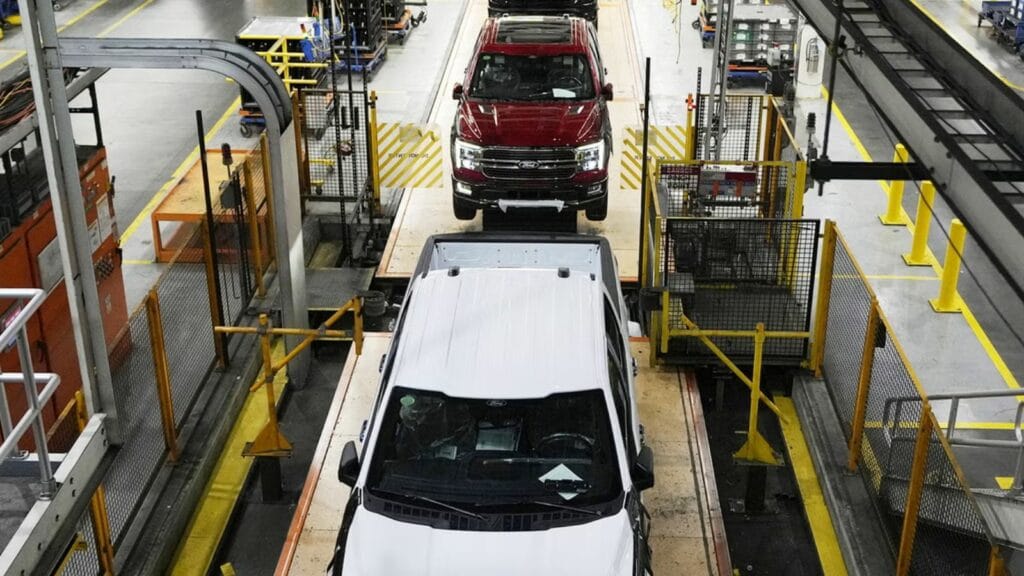
Canada’s new-car market is quietly becoming less American-made. Vehicles assembled in the United States accounted for 28.4% of Canadian new-vehicle sales during the first half of 2026, down from 35.4% a year earlier and well below the roughly 40% share they held for several years before the tariff dispute intensified.
That does not necessarily mean Canadian drivers suddenly rejected American brands. The more important change is happening behind dealership doors. Automakers are altering which factories supply Canada, redirecting vehicles from Mexico, Japan, South Korea and other locations when doing so reduces tariff exposure. The badge on the grille may look familiar, but the country stamped on the build sheet increasingly determines whether a model makes economic sense in Canada.
The U.S. Share Has Fallen Fast
The speed of the shift is what makes the latest numbers stand out. J.D. Power Canada data show U.S.-assembled vehicles represented 28.4% of Canadian new-vehicle sales in the first six months of 2026, compared with 35.4% during the same period in 2025. Before the current trade disruption, American plants had supplied roughly 40% of Canadian sales from 2021 through the first quarter of 2025. Losing seven percentage points in only a year represents a substantial change in a mature market where factory sourcing patterns normally move more gradually.
Import data tell a similar story from a different angle. DesRosiers Automotive Consultants reported earlier in 2026 that the U.S. share of Canadian light-vehicle imports had declined to 43.7% by dollar value from 49.1% a year earlier. A U.S. government proclamation also calculated that American motor-vehicle exports to Canada fell roughly 22% between comparable April-to-February periods. Different datasets measure different things, but all point toward a smaller U.S. role.
The Tariff Is Changing the Math Before a Buyer Arrives
Canada’s auto countermeasure has been in place since April 9, 2025. Ottawa applies a 25% tariff to non-CUSMA-compliant vehicles imported from the United States. For qualifying CUSMA vehicles, the 25% charge applies to the portion that is neither Canadian nor Mexican content. Those measures were introduced in response to U.S. tariffs imposed on Canadian automotive exports and remain in force in September 2026.
That makes assembly location a much bigger consideration for manufacturers. An automaker deciding whether to send an SUV to Canada from an American factory or an alternative plant now has to consider tariff treatment alongside transportation costs, production capacity and exchange rates. The result can be invisible to the customer. A familiar nameplate might remain in Canadian showrooms while its supply switches from an American assembly line to one in Mexico, Japan or South Korea. In other cases, a company may reduce allocations or suspend a model altogether because there is no practical alternative production source.
Mexico Is Picking Up More of the Canadian Market
Mexico has emerged as one of the clearest beneficiaries of the reshuffling. Mexican-built vehicles accounted for 22.2% of Canadian new-vehicle sales during the first half of 2026, according to J.D. Power Canada. That was up from 18.3% one year earlier and just 13.7% five years earlier. The gap between U.S.- and Mexican-built vehicles has therefore narrowed dramatically.
Mexico is particularly useful to automakers because many major manufacturers already operate large assembly plants there. Under CUSMA, qualifying Mexican vehicles can reach Canada without being caught by Ottawa’s U.S.-specific auto counter-tariff. That gives manufacturers an incentive to use Mexican capacity for models that can be supplied from more than one North American plant. It also shows why the decline of U.S.-built vehicles cannot be understood purely as a change in consumer sentiment. In many cases, Canadians may still be buying the same global brands they bought previously. What has changed is the factory that supplies the Canadian dealership.
Japan and South Korea Are Benefiting Too
The sourcing shift extends well beyond Mexico. J.D. Power data put Japanese-built vehicles at 16.6% of Canadian sales in the first half of 2026, up from 13.7% a year earlier. South Korean production reached 15.6%, increasing by about one percentage point. Together, those changes illustrate how quickly global manufacturing flexibility can alter a national vehicle market when tariffs change the economics of cross-border trade.
That distinction between brand nationality and manufacturing location is increasingly important. A Japanese or Korean automaker may operate factories in the United States, Mexico and its home market at the same time. Hyundai Canada, for example, has documented sourcing from South Korea, Alabama and Mexico. When an American-built version becomes more expensive to bring into Canada, shifting Canadian allocation toward another plant can be more attractive than raising prices or abandoning the model. What appears on dealership lots is therefore being shaped as much by logistics departments and tariff rules as by changing tastes among Canadian drivers.
Brands Without Canadian Factories Face the Sharpest Shift
The most dramatic numbers appear among automakers that do not assemble vehicles in Canada. For that group, U.S.-built products represented only 4.9% of Canadian sales during the first half of 2026, according to the J.D. Power figures reported by Automotive News. One year earlier, the figure was 17.7%. That is an unusually steep change in sourcing within a single year.
The reason lies partly in the design of Canada’s tariff-relief system. Manufacturers with no Canadian production base generally have less access to the performance-based relief available to companies maintaining domestic assembly operations. They therefore have a stronger incentive to avoid American-built inventory whenever an alternative exists. For a multinational manufacturer with plants on several continents, that can mean allocating more Japanese-, Korean- or Mexican-built vehicles to Canada. For a model produced only in the United States, the options are much narrower: absorb part of the tariff, pass costs onward, reduce supply or temporarily remove the vehicle from the Canadian lineup.
Ottawa’s Remission System Creates Two Different Markets
Canada has deliberately built a safety valve into its auto counter-tariffs. Ford, General Motors, Honda, Stellantis and Toyota operate vehicle assembly plants in Canada, and Ottawa’s performance-based remission framework allows qualifying manufacturers to import a specified number of CUSMA-compliant U.S.-built vehicles without paying the counter-tariff. The relief is tied to maintaining Canadian production and meeting investment or production conditions.
That helps explain why American-built vehicles have held up better among companies with Canadian factories. J.D. Power data show U.S.-made products still represented 45.2% of Canadian sales for those five manufacturers in the first half of 2026, only 3.1 percentage points lower than a year earlier. Ottawa has also demonstrated that the relief is conditional. The government previously reduced General Motors’ annual remission quota by 24.2% and Stellantis’ by 50% after production decisions affecting Canadian plants. In practice, tariff-free access to American production has become connected to what an automaker continues building and investing in north of the border.
Subaru Shows How Model Lineups Can Change
Few examples make the effect more tangible than Subaru. The company has historically relied on its Indiana operation for several products, but Canadian counter-tariffs have complicated that arrangement. Subaru Canada confirmed in 2026 that U.S.-built models had been placed on pause while the company monitored the trade situation. Vehicles affected included versions of the Crosstrek Wilderness and Forester Wilderness, as well as the three-row Ascent.
The company had alternatives for some products but not others. Regular versions of the Crosstrek and Forester available to Canadians can be supplied from Japan, while the redesigned Outback shifted to Japanese production. The Ascent is more difficult because its production is concentrated in the United States. That contrast captures what tariffs can do at the model level. The policy does not simply add a line to an importer’s tax bill. It can determine which trim appears in a showroom, where a Canadian-market vehicle is assembled and whether a model remains practical to sell at all.
This Is Not Simply a “Buy Canadian” Story
One surprising feature of the current shift is that Canadian-built vehicles have not automatically captured the market share lost by American factories. J.D. Power data put domestically assembled vehicles at 11.5% of Canadian new-vehicle sales in the first half of 2026, down from 12.6% one year earlier. Factory changeovers, production interruptions and model-specific circumstances have limited Canada’s ability to simply replace declining U.S. supply with more domestic production.
Canada’s assembly sector also remains deeply connected to the United States. Federal figures show the industry supports more than 125,000 direct jobs, with hundreds of thousands more tied indirectly to automotive activity. More than 90% of Canadian-made vehicles have traditionally been exported to the United States, while Canadian plants themselves rely heavily on American-made components. The tariff fight is therefore not creating two self-contained national industries. It is disrupting a production network built over decades around engines, parts and finished vehicles moving repeatedly across the Canada-U.S. border.
Affordability Makes Every Sourcing Decision More Visible
All of this is happening while the broader Canadian vehicle market remains under pressure. DesRosiers estimated roughly 950,000 new light vehicles were sold during the first half of 2026, about 2.6% fewer than during the same period of 2025. Statistics Canada subsequently recorded 176,156 new vehicles sold in July, down 2% from July 2025, even as the dollar value of those sales increased 1.6%.
Tariffs do not automatically translate into a 25% increase on a showroom sticker. Importers can absorb part of the cost, manufacturers can alter incentives, or companies can change sourcing before a vehicle reaches Canada. Bank of Canada research examining Canadian retaliatory tariffs across retail products found that prices on tariffed goods rose gradually and peaked about 6% higher after three months, representing roughly one-quarter pass-through of a 25% tariff. The study was not specific to automobiles, but it helps explain why businesses often respond through a mixture of pricing, margins and sourcing rather than simply adding the full tariff to the customer’s bill.
A Long-Integrated Auto Market Is Being Rewritten
Canada remains one of the most important markets for U.S. vehicle production, so a sustained decline in American-built sales carries consequences beyond Canadian dealership lots. Federal background material prepared for Canada’s tariff-remission program noted that more than 40% of vehicles sold in Canada were assembled in the United States before the current disruption. The U.S. had been Canada’s dominant vehicle source for decades.
The latest numbers suggest that position can no longer be taken for granted. Mexico has moved much closer, Japan and South Korea are gaining share, and some manufacturers are deliberately routing Canadian inventory away from American factories. Canada’s counter-tariffs also remained in force as of September 2026, even as the broader trade dispute continued to generate new measures on both sides of the border. If those conditions persist, the lasting change may not be that Canadians abandon American automotive companies. It may be subtler but equally significant: the vehicles Canadians buy from familiar brands will increasingly come from factories somewhere other than the United States.
