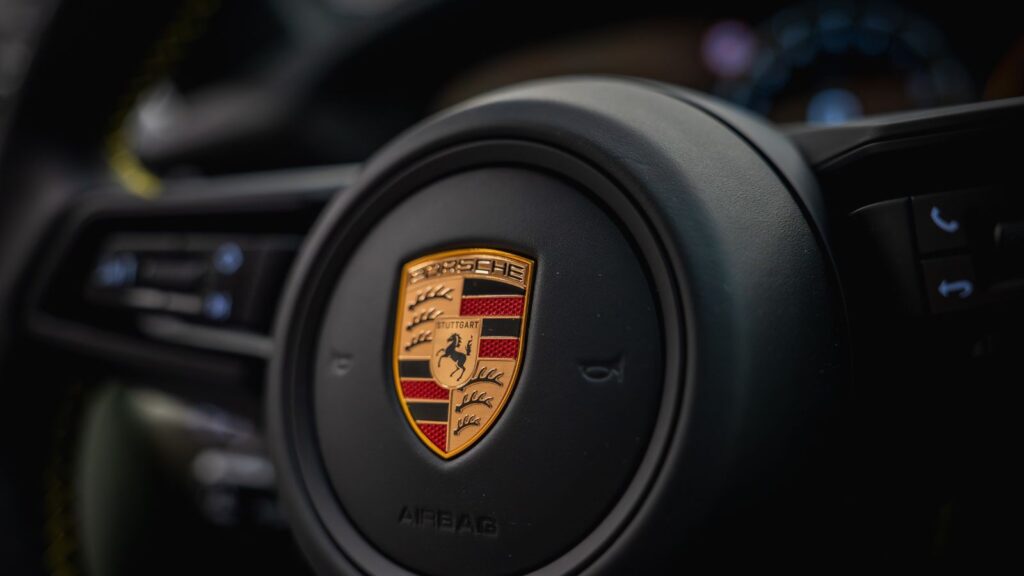
For years, the manual transmission has been disappearing from new-car showrooms, pushed aside by faster automatics, tightening efficiency requirements and increasingly electrified powertrains. Porsche is now moving in the opposite direction. For 2027, the automaker is bringing a six-speed manual back to the 911 Carrera S through a new MT Package available exclusively in the United States and Canada.
The decision stands out because the latest 992.2-generation Carrera S originally arrived with Porsche’s eight-speed PDK dual-clutch transmission as its only gearbox. North American customers kept asking for another choice. Porsche listened, creating a rear-wheel-drive Carrera S that sacrifices some acceleration for greater driver involvement while adding a substantial collection of performance equipment. At a time when several manufacturers are retiring their remaining stick shifts, Porsche is effectively making three pedals part of the Carrera S’s special appeal again.
The Manual Carrera S Is Back—but Only in North America
The 2027 911 Carrera S with MT Package represents an unusual regional exception in Porsche’s global model strategy. Porsche is offering the six-speed configuration specifically in Canada and the United States, with both Coupé and Cabriolet versions available. The regular Carrera S remains available with the eight-speed PDK, meaning Porsche is not replacing its faster automatic transmission. Instead, it has created a second interpretation of the same 473-horsepower sports car aimed squarely at drivers who still want to operate a clutch and gear lever themselves.
That distinction matters because the 992.2 Carrera S initially arrived without a manual option at all. When Porsche launched the refreshed Carrera S, the company positioned its PDK as the sole transmission. North American demand ultimately changed that plan. Rather than treating the manual as an outdated piece of hardware that happened to survive another product cycle, Porsche has turned it into the central feature of a specifically configured model. That makes the Carrera S unusual in a market where manual availability is generally contracting rather than expanding.
Porsche Has Switched From Seven Manual Gears to Six
The previous 992-generation Carrera S used a seven-speed manual gearbox when Porsche introduced that option for the 2020 model year. At the time, customers could choose it instead of the eight-speed PDK at no extra charge, and Porsche paired the manual with the Sport Chrono Package. The new Carrera S takes a different approach. Its transmission has six forward gears and is shared with the current 911 Carrera T, a model specifically developed around lightweight construction and greater driver involvement.
Dropping from seven gears to six may sound like a backward step in an industry accustomed to adding ratios, but maximum efficiency is not the purpose of this configuration. Porsche describes the gearbox as having sporty ratios and short shift travel, and the Canadian model information lists a switchable automatic rev-matching function. A laminated, open-pore walnut shift knob provides another intentionally old-school touch. The result is a Carrera S designed around the physical process of changing gears rather than simply providing another transmission choice on the order sheet.
The Manual Gives Up Acceleration Without Giving Up Power
Both versions of the 2027 Carrera S use a 3.0-litre twin-turbocharged flat-six producing 473 horsepower. They also share a listed top track speed of 308 km/h in Canada. Where the two cars separate is acceleration. Porsche lists the PDK-equipped Carrera S at 3.5 seconds from zero to 100 km/h, while the manual MT Package requires 4.1 seconds. In other words, selecting the clutch pedal means knowingly giving away six-tenths of a second in one of the specifications traditionally used to sell high-performance cars.
Porsche is not attempting to disguise that trade-off. The company has explicitly positioned the manual model around driving enjoyment rather than maximum acceleration. Modern dual-clutch gearboxes can change gears far faster than a driver operating a conventional clutch, making the PDK the logical choice when elapsed time matters most. The manual serves a different purpose. A downshift approaching a corner, matching engine speed and choosing exactly when to engage the next gear become part of the experience instead of tasks delegated to software and hydraulics.
The MT Package Adds Much More Than a Clutch Pedal
Porsche did not simply remove the PDK and install a six-speed gearbox. The Carrera S MT Package receives rear-axle steering, the Sport Chrono Package and PASM Sport suspension that lowers the car by 10 millimetres. It also receives unique exhaust tuning, a SportDesign front fascia, four-way Sport Seats Plus and titanium exhaust outlets with black trim. Centre-lock wheels are standard for the first time on a Carrera S and save more than seven kilograms compared with the wheels fitted to the conventional Carrera S.
Those changes help explain why Porsche treats this as a package rather than a standalone transmission option. The Coupé weighs 1,509 kilograms, only about five kilograms more than the less powerful Carrera T Coupé despite the Carrera S carrying a 473-horsepower engine and additional chassis equipment. Porsche also retains serious braking hardware: 408-mm front and 380-mm rear cast-iron discs are standard, while Porsche Ceramic Composite Brakes remain optional. Buyers can therefore configure the manual Carrera S as something considerably more focused than simply a slower version of the PDK car.
North American Customers Helped Force the Decision
The manual Carrera S was not part of Porsche’s original plan for the current generation. Porsche Cars North America CEO Timo Resch told Car and Driver that the regional organization had to gather enough evidence to persuade colleagues in Germany that developing the North America-only version made business sense. Feedback came from several places, including comments from customers, conversations at Porsche events and information passed along by the company’s dealer network.
Porsche also had unusually strong evidence that its North American buyers actually use manual options when they are offered. Resch said roughly 80 percent of U.S. GT3 Touring customers choose a manual, while the figure for the regular GT3 is around half. Those are specialized enthusiast models rather than the entire 911 range, but they demonstrate a very different purchasing pattern from the mainstream market. For Porsche, the important question was therefore not whether manuals remain popular generally. It was whether enough Carrera S customers in this particular region still valued one enough to justify the engineering and certification work.
Canadian Buyers Get the Same Special Treatment
For Canadians, the regional exclusivity means the manual Carrera S is not another enthusiast model that stops at the U.S. border. Porsche Canada opened ordering for the 2027 Carrera S with MT Package at a starting price of C$177,500 for the Coupé and C$191,800 for the Cabriolet. Porsche said deliveries were expected to begin by the end of 2026, putting Canadian customers on essentially the same launch schedule as buyers south of the border.
The specifications also make the Carrera S an interesting middle ground within the manual 911 family. The Carrera T offers the same basic six-speed concept with 388 horsepower, while the GT3 family moves into substantially more specialized territory. The Carrera S provides 473 horsepower from its twin-turbo flat-six while retaining the everyday character traditionally associated with the Carrera range. For a Canadian owner facing a long highway trip one weekend and a favourite backroad the next, that combination may be more usable than a track-focused flagship while providing considerably more performance than the Carrera T.
Porsche Is Adding a Manual as Other Brands Remove Theirs
The timing makes Porsche’s decision particularly striking. MINI says its current generation of vehicles produced from November 2023 onward is offered exclusively with automatic transmissions. Volkswagen has confirmed that the 2026 Jetta GLI is its final manual-transmission model in North America; the 2027 GLI becomes DSG-only after the Golf GTI and Golf R had already lost their manuals. Honda has also confirmed that production of the Civic Si and manual-equipped Acura Integra A-Spec will pause after the 2026 model year, although both are expected to return.
None of those decisions means the manual transmission disappears immediately. Cars including the Mazda MX-5, Subaru WRX, Honda Civic Type R, Toyota GR models and several BMW M cars continue to keep three pedals available. The direction of travel, however, is clear: manufacturers increasingly concentrate manuals in a small collection of performance models. Porsche is participating in that same specialization, but with an unusual twist. Rather than merely preserving an existing gearbox, it persuaded headquarters to put one back into a model that had already gone automatic-only.
Manual Demand Is Small Overall—but Porsche Buyers Are Different
The broader U.S. market illustrates how niche the manual has become. J.D. Power data reported in 2023 showed manuals accounting for roughly 1.7 percent of new-vehicle sales that year, up from 1.2 percent in 2022 and a low of 0.9 percent in 2021. The small rebound was notable, but it never came close to challenging automatic transmissions. For most buyers, improved automatics, commuting convenience and the changing economics of vehicle production have removed the traditional reasons for choosing a stick shift.
Enthusiast cars tell a very different story. Porsche’s reported GT3 take rates show that buyers can overwhelmingly choose the manual when a car is designed around emotional involvement rather than transportation efficiency. Manufacturer data collected by Motor1 for 2025 similarly showed high manual take rates among several specialist vehicles, including Porsche, Subaru and selected BMW M cars. That helps explain why three pedals can disappear from ordinary hatchbacks while surviving in expensive sports cars: the overall market is tiny, but demand becomes highly concentrated among buyers who specifically seek the experience.
Hybrid Technology Could Make Future Manuals Harder to Engineer
The Carrera S also exposes an engineering divide developing inside the 911 family. Porsche’s Carrera GTS now uses the T-Hybrid system, which combines a 3.6-litre flat-six with an electrically assisted turbocharger, a high-voltage battery and an electric motor integrated directly into the eight-speed PDK. That architecture is fundamentally different from the conventional 3.0-litre twin-turbo drivetrain used by the Carrera S and helps explain why simply attaching an existing manual gearbox to every future 911 is not straightforward.
Resch has acknowledged that Porsche’s current T-Hybrid configuration and the manual transmission used by the Carrera S are not compatible. He nevertheless said Porsche intends to continue offering manuals while customer demand and regulations allow. That leaves the company with a familiar sports-car problem presented in a new technological form: increasingly sophisticated powertrains deliver faster performance and lower emissions, but they can make traditional mechanical interfaces more difficult to retain. The Carrera S works partly because Porsche still has a non-hybrid platform where a conventional clutch and gearbox can be engineered without redesigning the entire propulsion system.
The Stick Shift Has Become a Premium Experience
Perhaps the biggest change is economic. Decades ago, a manual transmission was often the cheaper choice. Even Porsche offered the seven-speed manual on the 2020 Carrera S as a no-cost alternative to PDK. The 2027 strategy is almost the reverse. In the United States, Porsche lists the automatic Carrera S at US$156,200 before delivery, while the Carrera S with MT Package starts at US$167,100. The roughly US$10,900 difference also buys substantial extra chassis and performance equipment, so it cannot be treated simply as the price of the gearbox.
That packaging reveals where the manual transmission now sits in the market. Porsche is not preserving it because customers need a less expensive way to buy a 911 or because a human can change gears faster than modern electronics. It is selling something intentionally less automated because a meaningful group of customers values the physical interaction. In that sense, the Carrera S may represent the manual transmission’s most realistic future: rarer, more specialized and increasingly marketed as part of a premium driving experience rather than standard transportation technology.
