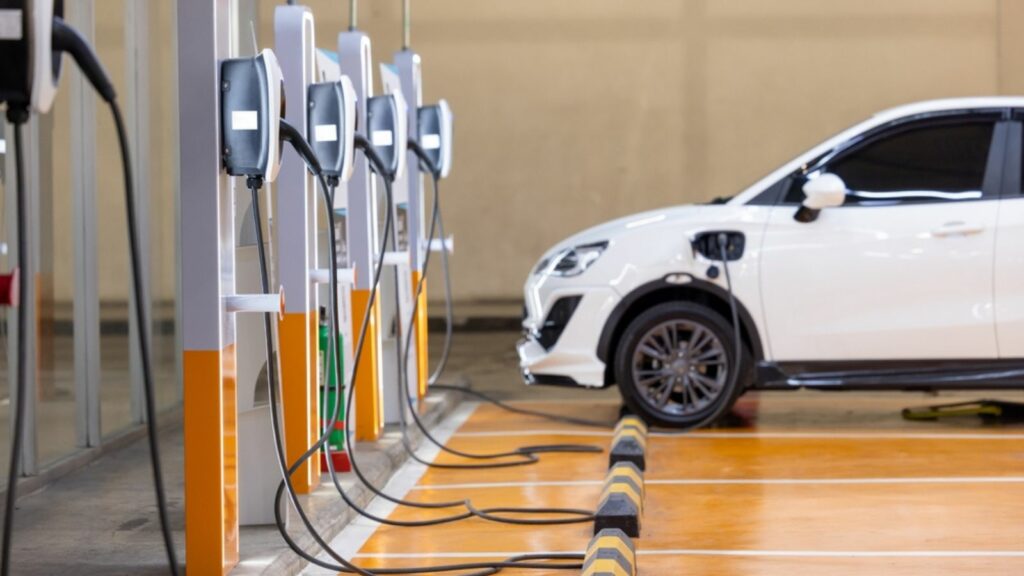
China’s electric-vehicle charging race has moved into territory that would have sounded extraordinary only a few years ago. Geely has begun rolling out its new Smart Charging C12 equipment in China, built around charging hardware rated for peak output of up to 2,250 kW. The company says specially equipped vehicles can recover most of their battery capacity in less than nine minutes.
The timing is notable for Canada. Ottawa has removed the 100% surtax previously applied to Chinese-origin EVs within a new controlled import quota, creating room for tens of thousands of vehicles annually at the normal 6.1% tariff. That does not mean Chinese megawatt chargers are headed to Canadian parking lots immediately. It does, however, highlight how quickly the technology accompanying China’s increasingly export-focused EV industry is developing.
Geely Has Moved Its 2,250-kW Charger From Announcement to Deployment
Geely unveiled its fifth-generation Smart Charging system in Ningbo on September 23, 2026, with a claimed peak charging capability of up to 2,250 kW. Less than a week later, reports from China said Smart Charging C12 installations had gone live in Hangzhou, Shanghai, Ningbo, Jiaxing and Xi’an. That rapid shift from unveiling to initial deployment is significant because ultra-high-power charging announcements often arrive well before consumers can encounter the equipment outside controlled demonstrations. In this case, the technology is beginning to appear in operating locations rather than remaining simply a laboratory or auto-show concept. Geely describes the system as part of a larger energy-management platform connecting the vehicle, battery, charger, cloud services, grid and on-site energy storage.
The headline figure requires some context. A charger capable of delivering 2,250 kW does not mean a vehicle plugged into it will continuously accept 2,250 kW. The battery, electrical architecture, temperature and state of charge determine how much power can actually flow. Testing reported around Geely’s launch showed a Lynk & Co 10 reaching approximately 1,093 kW at peak. Geely nevertheless demonstrated impressive overall charging times: compatible Lynk & Co 10 and Zeekr 001 vehicles equipped with its high-rate battery technology went from 10% to 70% in four minutes and 30 seconds, and from 10% to 97% in eight minutes and 40 seconds. Those figures better represent the consumer experience than the station’s maximum theoretical output alone.
Chinese Automakers Are Turning Charging Speed Into a New Competitive Battleground
Geely is not pursuing ultra-fast charging in isolation. BYD has been rapidly expanding its own flash-charging network using chargers capable of output of up to 1,500 kW per connector. The company says vehicles combining its second-generation Blade Battery with its latest charging technology can move from 10% to 70% in roughly five minutes and from 10% to 97% in about nine minutes under suitable conditions. By late September, BYD had already reached 2,000 highway flash-charging locations in China, completing that particular target roughly three months ahead of its original schedule. Its broader plan calls for tens of thousands of high-speed charging locations as the network expands.
Other Chinese manufacturers are attacking the same problem from different directions. Li Auto has paired vehicles with CATL batteries capable of adding hundreds of kilometres of claimed range during a short charging stop, while NIO continues investing heavily in battery swapping rather than relying exclusively on faster conventional charging. NIO had more than 4,000 swap stations according to recent reporting, and its deeper partnership with Geely is expected to expand cooperation on both charging and battery swapping. The competition is therefore moving beyond vehicle acceleration, screens and driving range. How quickly energy can be put back into the vehicle is becoming another important product differentiator in China’s crowded EV market.
The Hard Part Is Managing the Battery, Not Simply Building a Bigger Charger
Pushing more than a megawatt into a passenger vehicle creates challenges that cannot be solved by installing a larger electrical cabinet. Fast charging increases heat generation and can accelerate undesirable reactions inside lithium-ion cells. Research has repeatedly identified issues such as lithium plating, uneven temperature distribution and accelerated degradation when high charge rates are poorly controlled. More recent academic work argues that extreme fast charging has to be treated as a complete systems-engineering problem involving cell chemistry, cooling, charging software and mechanical design rather than as a competition over one peak-power figure. That helps explain why modern ultra-fast systems devote so much engineering to temperature management.
Geely says its approach uses an AI-based system called Xingrui PowerMind to predict battery-temperature changes as much as 30 seconds ahead and adjust charging behaviour dynamically. The company says its system is designed to keep average battery temperature around or below 55°C while limiting peak temperatures to below 65°C. It also uses liquid cooling at several points across the charging chain. Geely further claims its charging and lithium-ion restoration technologies can improve battery cycle life by more than 20%, although that longevity figure is a manufacturer claim rather than an independently established result for every operating condition. Independent battery research nevertheless supports the broader principle: precise thermal control can make extremely fast charging considerably more practical and reduce some of the degradation mechanisms that otherwise emerge at high charging rates.
China Has Built the Infrastructure Scale Needed to Experiment at This Level
The 2,250-kW chargers stand out, but most Chinese charging connectors operate at far lower power. That contrast demonstrates why China’s advantage is about scale as much as peak performance. China’s National Energy Administration reported 24.223 million EV charging connectors at the end of August 2026, up 39.6% from a year earlier. Of those, about 5.16 million were public connectors and 19.063 million were private. The average rated power of China’s public connectors was approximately 50.69 kW, showing that multi-megawatt installations remain a specialized high-performance end of an enormous and diverse network rather than the everyday norm.
That massive installed base gives manufacturers opportunities to introduce faster equipment gradually while still serving vehicles that cannot use the newest technology. It also allows charging companies to experiment with battery storage, grid management and intelligent power allocation at a scale that smaller EV markets cannot easily reproduce. The electrical demand is substantial: a location serving several vehicles simultaneously at megawatt-level rates can create a very different grid connection problem from a conventional parking lot filled with slower chargers. China’s manufacturers are increasingly pairing charging sites with energy storage and software designed to manage those peaks. In practical terms, the charger itself is becoming only one component in a much larger energy system.
Canada Has Opened a Controlled Door to More Chinese-Origin EVs
Canada’s policy toward Chinese-made electric vehicles changed substantially in 2026. As part of a preliminary Canada-China trade arrangement announced in January, Ottawa established an initial annual quota of 49,000 Chinese-origin EVs that can enter under Canada’s 6.1% most-favoured-nation tariff. The previous 100% surtax was removed for eligible vehicles under the quota when the new system took effect March 1. The quota is scheduled to increase by 6.5% annually. Ottawa has also established an affordability component that is intended to grow over time, eventually reserving 50% of the quota for vehicles with a free-on-board import price of C$35,000 or less by the fifth year.
The government describes the arrangement as managed market access rather than unlimited entry. The initial 49,000 vehicles represent less than 3% of Canada’s new-vehicle market according to the regulatory analysis accompanying the change. Importers also require shipment-specific permits, and vehicles must still satisfy applicable Canadian safety, environmental and regulatory requirements. Official utilization figures show the system is being used but had considerable capacity remaining in late September. As of September 25, 15,763 vehicles had been counted against the first-year 49,000-unit quota, leaving 33,237 units available. Those figures show that Chinese-origin vehicles are already moving through the new framework, but Canada has not suddenly opened its market without quantitative limits.
Canada’s Charging Network Is Growing, but 2.25-MW Passenger-Car Charging Is a Different Scale
Transport Canada’s dashboard showed 39,220 public light-duty EV chargers across the country as of March 2026. Of those, 30,741 were classified as Level 2 chargers and 8,479 as Level 3 fast chargers. Canada had more than one million light-duty plug-in vehicles in operation and a national ratio of approximately 27 EVs for every public charger. Ottawa has also continued funding new installations, including projects intended to expand charging access in communities, workplaces and travel corridors. Those numbers represent meaningful infrastructure growth, but they should not be interpreted as evidence that the Canadian network is prepared to deliver the maximum speeds now being demonstrated in China.
The critical point is that a powerful charger and a powerful charging vehicle must arrive together. A Chinese-built EV capable of unusually high charging speeds would still be limited by whatever compatible charger it encounters in Canada. Likewise, installing a 2,250-kW charging unit would provide little benefit if the vehicles using it could accept only a fraction of that power. Battery voltage, current limits, connector design, communication protocols, thermal systems and grid capacity all have to line up. For Canadian drivers, this means the first practical benefit of newer Chinese EV technology could be improved charging performance on existing fast chargers rather than immediate access to four- or five-minute charging stops.
More Chinese EVs Do Not Automatically Mean Geely’s Fastest Technology Is Coming to Canada
Canada’s quota is based on vehicle origin, not on one Chinese automaker or one charging technology. The government’s published utilization information also categorizes imports by customs classification rather than providing a public brand-by-brand breakdown. There is therefore no basis to assume that every additional Chinese-origin EV entering Canada will come from Geely, BYD or another high-profile domestic Chinese brand. Chinese-built vehicles sold under multinational brands can also fall within the relevant origin rules. Similarly, Geely has not announced that its new 2,250-kW Smart Charging C12 network will be duplicated in Canada. The five-city deployment reported in late September remains a Chinese rollout.
What the development does provide is a preview of the technology Canadian automakers and charging companies may increasingly have to compete with or accommodate. China is moving beyond inexpensive EV manufacturing and investing heavily in batteries, charging software, thermal management and energy infrastructure. Canada, meanwhile, has created a policy framework capable of admitting tens of thousands of Chinese-origin EVs annually while retaining quotas, permits and vehicle-certification requirements. For Canadian consumers, the near-term story is therefore broader than whether a charging stop can eventually take five minutes. More vehicle choices, different price points and steadily improving charging capability could arrive first, while the most extreme multi-megawatt infrastructure remains a glimpse of where the technology may eventually be heading.
