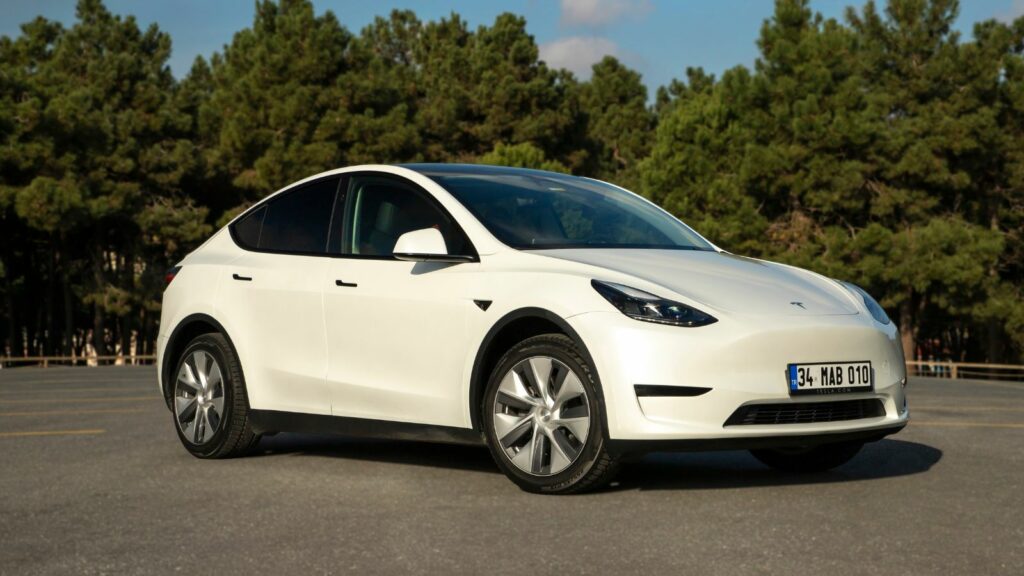
For a few hours, Tesla’s Canadian Model Y lineup appeared to gain a genuinely useful new trick: the ability to turn the vehicle’s high-voltage battery into a portable 120-volt power source. Then the wording vanished. Tesla had briefly listed Vehicle-to-Load capability for the Model Y Premium All-Wheel Drive and Model Y Performance, describing power output through the charge port with an Outlet Adapter. By the next day, that specification was gone from the Canadian website.
The reversal is more than a minor website edit because Tesla is expanding the broader Powershare technology in the United States. Canadian buyers are now left with a mismatch between what briefly appeared on Tesla’s Model Y specifications, what Tesla currently says in its Canadian documentation, and what the company offers south of the border.
The Feature Appeared and Disappeared in Less Than a Day
The change happened quickly. On Thursday evening, October 8, screenshots captured by Drive Tesla showed Tesla’s Canadian Model Y pages listing Vehicle-to-Load capability for both the Premium All-Wheel Drive and Performance variants. The wording described “Vehicle to load (120V 20A AC) with charge port and Outlet Adapter.” By Friday afternoon, October 9, the line had been removed. Drive Tesla updated its original report at 4:15 p.m. Pacific Time and later reported that the feature had disappeared from both variants, putting the entire episode inside a window of less than 24 hours.
As of October 10, Tesla’s current Canadian Model Y page does not advertise Vehicle-to-Load in the published specifications for the Premium AWD or Performance. The page still lists the vehicles’ normal range, acceleration, charging, dimensions and warranty details, but the power-export feature is absent. Tesla has not published a Canadian explanation for why the wording appeared and was then removed. That leaves the central question unresolved: whether the listing was premature, simply erroneous, or connected to market-specific hardware or availability that Tesla was not yet prepared to support in Canada.
What Tesla Briefly Listed for Canadian Buyers
The deleted specification was unusually specific, which is one reason the change attracted attention. Tesla’s Canadian page was reported as describing a 120-volt, 20-amp AC output through the Model Y charge port when used with the company’s Outlet Adapter. Tesla’s own Canadian accessory listing gives the same electrical ceiling for that adapter: 120 volts, 20 amps and 2.4 kilowatts of maximum power. In practical terms, the feature would have allowed energy stored in the traction battery to be used by external electrical equipment instead of serving only to propel the vehicle.
Tesla describes the Outlet Adapter as capable of powering devices such as lights and laptops, as well as appliances including refrigerators, heaters and power tools, provided the connected load stays within the system’s limits. This is not an ordinary household socket permanently installed somewhere inside the Model Y. Tesla’s implementation uses the exterior charge port and compatible Tesla hardware to create an AC power source. That distinction matters because actual use depends on more than software. The vehicle needs the necessary power-sharing capability, and the owner also needs the correct adapter and, depending on the configuration, a compatible Gen 3 Mobile Connector.
Tesla’s Current Canadian Pages Now Say Something Else
Tesla’s own Canadian documentation currently points in the opposite direction from the short-lived Model Y listing. The Canadian Model Y owner’s manual contains a section explaining how devices can be powered through the charge port, but its wording says the Tesla Outlet Adapter is available for Model Y Performance while specifically excluding Canada. Tesla’s Canadian Powershare page is even clearer. It currently states that Powershare is available for Cybertruck only and says the technology is not available for Model S, Model 3, Model X or Model Y in Canada.
The Canadian Tesla Shop reinforces that message. Its Outlet Adapter page lists a retail price of C$110 and specifies 120V, 20A and 2.4kW maximum output, but says the product is currently available only with Cybertruck. The same Canadian store page was also displaying the adapter as out of stock when checked. Taken together, those official pages create a much clearer picture than the temporary specification did: Tesla’s current Canadian consumer information does not establish that Model Y owners can use their charge port as a 120-volt external power source today. Until Tesla changes that documentation or provides a Canadian clarification, the removed specification should not be treated as an active feature.
This Was Not the Model Y’s Existing Low-Voltage Outlet
The phrase “power outlet” can create some confusion because the Model Y already offers lower-voltage accessory power inside the vehicle. Tesla’s Canadian owner’s manual describes a low-voltage outlet in the centre-console compartment and another in the rear trunk, where equipped. Those outlets are intended for accessories requiring up to 12 amps continuously, with a 16-amp peak. The vehicle also includes USB connections and wireless phone charging, meaning Canadian owners already have several ways to supply relatively modest amounts of electricity to personal electronics and automotive accessories.
The deleted Vehicle-to-Load capability was substantially different. Rather than relying on the vehicle’s low-voltage accessory system, it would allow compatible equipment to tap energy from the high-voltage traction battery through the exterior charge port and receive standard 120-volt AC power. Tesla’s Outlet Adapter is rated at up to 2.4kW, giving it far greater usefulness for household-style devices than a conventional automotive accessory socket. That is why the brief Canadian listing was significant. It suggested the Model Y was gaining a new energy-export capability that could be useful while camping, working away from an electrical outlet or dealing with a local power interruption—not merely another place to charge a phone.
The Required Adapter Is Still a Canadian Problem
Even during the brief period when Tesla’s Canadian Model Y page reportedly showed Vehicle-to-Load capability, the accessory situation did not line up neatly. Tesla’s Canadian Outlet Adapter is priced at C$110 and is designed to use energy from a compatible vehicle through its charge port. However, the current Canadian store labels the product as available only with Cybertruck. Tesla also says it works only with the Gen 3 Mobile Connector. Simply seeing V2L listed on a Model Y specification page therefore would not have meant that a Canadian owner could immediately purchase all the required Tesla hardware and begin using the feature.
The contrast with Tesla’s American store is notable. The U.S. Outlet Adapter is listed at US$80, and Tesla identifies several Model Y configurations and production periods as compatible. Tesla’s current American listing includes Model Y Performance and Model Y Premium vehicles produced after specified dates, along with newer Model 3 and Model Y configurations. Both Canadian and American adapter pages advertise the same 120V, 20A and 2.4kW electrical output. The major difference is Tesla’s compatibility language. In one market, Model Y support is explicitly described; in Canada, the accessory page still points only to Cybertruck. That makes the removal from Tesla’s Canadian vehicle page more consequential than a simple wording change.
The U.S. Model Y Is Moving in the Opposite Direction
While the Canadian Model Y specification disappeared, Tesla has been expanding Powershare support in the United States. Tesla’s current U.S. Powershare page says the technology is available on all new Model 3 and Model Y vehicles ordered on or after October 1, 2026, as well as on Cybertruck. The company also gives owners a vehicle-level way to check compatibility: opening Software and then Additional Vehicle Info on the touchscreen should display “Powershare Support: Enabled” on vehicles equipped for the technology.
The U.S. expansion goes considerably beyond running a lamp or power tool. Tesla says compatible Model 3 and Model Y vehicles can also work with Powershare Home Backup when paired with the required Tesla home-energy equipment. The company identifies PCS2 Lite as the bidirectional inverter used in Model 3 and Model Y and estimates that eligible vehicles can extend home backup by more than two days under its stated assumptions. Those claims should not be carried over to Canada. Tesla’s Canadian Powershare page continues to say Model Y is unsupported. Canadian and U.S. customers are therefore being presented with materially different capability statements for related vehicles at the same time.
Existing Canadian Owners Still Lack a Clear Answer
The website removal does not automatically prove that every Canadian Model Y lacks the necessary hardware, just as the temporary specification did not prove that every already-delivered vehicle supported the feature. Tesla itself warns Canadian owners that feature availability can vary according to market region, vehicle configuration, purchased options, firmware and software. The company also states that the presence of a feature in an owner’s manual does not guarantee that the function is available on a particular vehicle. That disclaimer becomes especially important when hardware and features are being introduced at different times across different factories and markets.
For Canadian owners, the unanswered question is whether some current Model Y vehicles already contain compatible power-conversion hardware, whether certain vehicles could gain support through a future update, or whether Canada will remain excluded until another hardware or market change occurs. Tesla has not provided a public Canadian explanation addressing those possibilities in the pages reviewed. In the United States, Tesla publishes an on-screen Powershare-support check and lists production periods for compatible Outlet Adapter use. Its Canadian information does not currently provide equivalent Model Y guidance. Until that changes, owners should not assume that an over-the-air update alone will eventually unlock the feature on a vehicle delivered without confirmed Powershare capability.
V2L Is Already Becoming a Competitive Feature in Canada
Vehicle-to-Load is no longer an obscure specification reserved for experimental EVs. Hyundai Canada advertises an available 110-volt V2L outlet on the IONIQ 5 and promotes it for powering home appliances, camping equipment and laptops. Kia Canada offers V2L capability on the EV9 and says the system can provide up to 1,900 watts of AC power, giving owners a way to supply electricity at campsites, worksites and outdoor gatherings. Those examples help explain why Tesla’s Canadian listing generated interest even though it appeared for such a short period.
The concept extends beyond electric crossovers. Ford Canada markets Pro Power Onboard on the F-150 with as much as an available 7.2kW of usable power and multiple outlets integrated into the truck bed. These systems are not directly identical to Tesla’s charge-port implementation, and their maximum outputs differ considerably. They do show, however, how stored vehicle energy is increasingly becoming part of the practical value proposition of electrified vehicles. For people who camp, operate tools, work remotely or want access to electricity when the grid is unavailable, an EV battery can serve a second purpose while the vehicle is parked. Tesla’s temporary Canadian V2L listing therefore touched a real competitive feature rather than a technical detail most buyers would never use.
What Canadian Model Y Shoppers Should Take From the Reversal
For now, the safest reading is straightforward: Tesla Canada does not currently advertise charge-port Vehicle-to-Load capability on the Model Y, and the company’s other Canadian pages continue to point away from support. Tesla’s current Model Y page lists the Premium AWD with an EPA-estimated 542 kilometres of range and the Performance with 494 kilometres, together with their acceleration, charging and warranty specifications, but no V2L line appears. The Canadian Powershare page says Model Y is unsupported, while the Canadian Outlet Adapter page says the accessory is currently available only with Cybertruck.
None of that establishes that V2L will never reach Canadian Model Y vehicles. Tesla changes vehicle features and software frequently, and its own documentation says feature availability depends on market, vehicle configuration, options and software. What the episode does demonstrate is why buyers should distinguish between a briefly published specification and a capability that Tesla currently documents as supported. Anyone considering a Model Y specifically because external power is important should verify the function on the exact Canadian configuration rather than relying on U.S. specifications, overseas vehicles or screenshots captured before the wording disappeared. Until Tesla provides a formal Canadian update, the deleted listing is evidence of an unresolved rollout—not confirmation of a feature buyers can count on.
