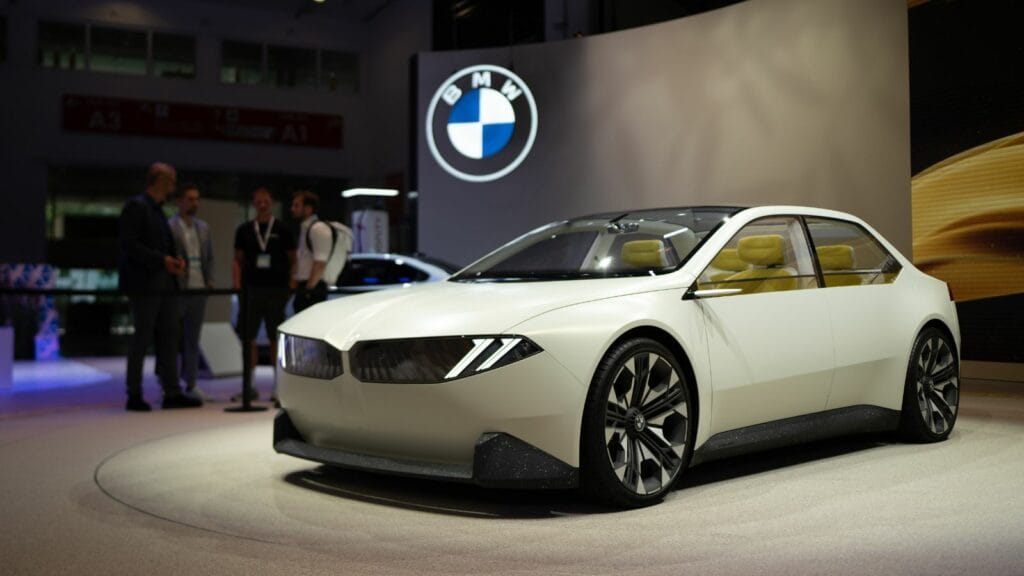
BMW’s hydrogen ambitions are moving from an experimental fleet toward something much more consequential: a vehicle customers are actually supposed to be able to buy. The company has set 2028 as the planned start of series production for the BMW iX5 Hydrogen, an X5-based fuel-cell electric vehicle being developed with technology shared with Toyota.
That timing gives the project particular relevance in Canada. Ottawa has just reshaped its automotive policy around more technology-neutral emissions rules while continuing to support both battery-electric and hydrogen fuel-cell vehicles. Hydrogen remains tiny beside battery EVs on Canadian roads, however, and refuelling infrastructure is still scarce. The iX5 therefore raises a bigger question than whether BMW can build an appealing hydrogen SUV: whether Canada’s evolving zero-emission strategy can realistically accommodate more than one electric-vehicle pathway.
BMW Has Put a 2028 Date on Its Hydrogen X5
BMW’s hydrogen program is no longer built around an indefinite demonstration project. The company says the next-generation iX5 Hydrogen is scheduled to become its first hydrogen-powered model to enter series production in 2028. That represents a meaningful change from the earlier iX5 Hydrogen pilot fleet, which BMW used for real-world testing in different markets. Production preparation is already becoming more concrete: BMW says prototypes of its third-generation hydrogen drive are being produced in Munich and Steyr, while Plant Steyr is preparing for eventual series production of the fuel-cell systems.
The vehicle is also being integrated into a much broader X5 manufacturing strategy. BMW plans to offer the coming X5 generation with several propulsion choices, including battery-electric, plug-in hybrid, gasoline, diesel and hydrogen fuel-cell variants, depending on market. That matters because hydrogen is not being developed as a completely separate low-volume vehicle architecture. BMW is trying to fit it into the same broader product family. For an automaker, sharing platforms and production processes can reduce some of the financial risk attached to a technology whose future sales volumes remain uncertain.
The Production Model Is Targeting 750 Kilometres of Range
BMW is giving the upcoming model specifications intended to make hydrogen feel less experimental. The company is targeting a driving range of up to 750 kilometres on the WLTP cycle and a hydrogen refuelling time of less than five minutes. It has also said the production-oriented iX5 will retain all-wheel drive, towing capability and an M Sport package. Those characteristics are important because BMW is not presenting the fuel-cell SUV as an efficiency-focused science project. It is being positioned to perform many of the same jobs buyers expect from a conventional premium X5.
A major part of the improvement comes from BMW’s new flat hydrogen storage arrangement. Instead of depending on the packaging used by the pilot vehicle, BMW has developed several parallel high-pressure tank units housed within a structural frame. The company says the system occupies roughly the installation space assigned to a Gen6 high-voltage battery in its flexible vehicle architecture. Meanwhile, the third-generation fuel-cell system jointly developed with Toyota is described as 25 per cent more compact than its predecessor, while also becoming more powerful and efficient. Those packaging gains are crucial in an SUV, where losing passenger space or cargo capacity to bulky hydrogen tanks would make the technology much harder to sell.
Toyota Gives BMW a Much Longer Hydrogen Runway
BMW is not trying to commercialize fuel cells alone. Its relationship with Toyota is one of the reasons the 2028 plan deserves more attention than many previous hydrogen-car announcements. The two automakers expanded their fuel-cell collaboration in 2024, agreeing to jointly develop a new generation of powertrain technology while using shared components to improve scale and reduce development costs. The third-generation fuel-cell system destined for the iX5 Hydrogen is one result of that partnership.
Toyota also brings something BMW lacks: years of experience selling a production hydrogen passenger vehicle. The 2026 Toyota Mirai remains available in Canada, although only in British Columbia and Quebec, with Toyota advertising an estimated range of up to 647 kilometres. That does not mean the Mirai has established hydrogen as a mainstream Canadian fuel. It has not. But its presence demonstrates that fuel-cell cars can operate within pockets of Canadian infrastructure. BMW’s challenge will be turning that limited proof of concept into something suitable for a larger, more expensive SUV. Sharing development with Toyota makes that task technically less isolated, even if neither company can solve the infrastructure problem by itself.
Canada Has Shifted Toward a More Technology-Neutral Auto Policy
The timing of BMW’s project coincides with a major Canadian policy reset. In February 2026, the federal government announced a new automotive strategy that included plans to repeal the Electric Vehicle Availability Standard and replace it with stronger greenhouse-gas emissions standards for model years 2027 through 2032. Ottawa said the new approach would give manufacturers more flexibility in the technologies they use while putting Canada on a path toward a stated goal of 75 per cent EV sales by 2035 and 90 per cent by 2040.
Hydrogen vehicles are explicitly included within that broader definition of electrification. Canada’s new five-year Electric Vehicle Affordability Program provides incentives of up to $5,000 in 2026 for qualifying battery-electric and hydrogen fuel-cell vehicles, while plug-in hybrids qualify for lower amounts. The federal government has also increased support for the Canada Infrastructure Bank’s Charging and Hydrogen Refuelling Infrastructure Initiative to $1.5 billion. That combination matters. Ottawa is still overwhelmingly dealing with a market dominated by battery EVs and plug-in hybrids, but the policy architecture does not require fuel cells to disappear. A production BMW hydrogen SUV arriving in 2028 would enter a Canadian market whose federal rules are deliberately leaving room for competing low-emission technologies.
Canada’s Hydrogen Station Network Is Still the Biggest Obstacle
The gap between policy eligibility and practical usability remains enormous. Transport Canada reported that, using infrastructure data through March 31, 2026, Canada had only eight publicly available hydrogen refuelling stations: six in British Columbia and two in Ontario. The same federal dashboard recorded 39,220 public Level 2 and Level 3 EV chargers. For a battery-electric driver, charging may still involve inconvenience in some regions, but the network already spans the country. For a hydrogen-car owner, entire provinces can effectively be off limits.
Even established hydrogen markets remain vulnerable to individual station changes. HTEC, which operates much of British Columbia’s passenger-vehicle hydrogen network, permanently closed its Granville Street Vancouver station at the end of July 2026 after the site lease was not renewed. Its September station-status information continued to list locations in Burnaby, North Vancouver, Vancouver, Victoria and Kelowna, among others, illustrating how concentrated the network remains. Ottawa has substantially bigger ambitions: Natural Resources Canada has established a target associated with deploying 45 hydrogen refuelling stations by March 2029. But building stations creates a classic chicken-and-egg problem. Operators need enough vehicles to justify expensive infrastructure, while customers are reluctant to buy vehicles until that infrastructure reliably exists.
The Climate Case Depends Heavily on Where the Hydrogen Comes From
Fuel-cell vehicles themselves have a straightforward local-emissions advantage. Hydrogen reacts electrochemically with oxygen inside the fuel cell to generate electricity, and the vehicle produces water vapour and warm air rather than harmful tailpipe exhaust. But that does not automatically make every kilogram of hydrogen low-carbon. The emissions created while producing and distributing the fuel can change the climate equation dramatically.
The International Energy Agency reported that global hydrogen production was still dominated by fossil fuels in 2024, with low-emissions hydrogen accounting for less than one per cent of total production. An International Council on Clean Transportation life-cycle study published in 2025 demonstrates why the distinction matters. In its European modelling, a fuel-cell car running on natural-gas-derived hydrogen produced estimated life-cycle emissions of 175 grams of CO₂-equivalent per kilometre, compared with 235 grams for a gasoline car. When renewable-electricity-based hydrogen was used, the fuel-cell figure dropped to about 50 grams. The numbers are specific to the study’s European assumptions rather than Canadian driving, but the lesson transfers: an iX5 Hydrogen is only as compelling environmentally as the hydrogen supply behind it.
The Bigger Canadian Opportunity May Not Start With Passenger SUVs
Canadian hydrogen policy itself suggests that passenger vehicles may not be the first place the fuel reaches meaningful scale. Natural Resources Canada identifies long-range and energy-intensive transportation as potentially strong hydrogen applications and points specifically to trucking, rail, marine and aviation. Centralized commercial fleets can also make refuelling infrastructure easier to justify because many vehicles repeatedly return to the same depot or transportation hub. That is a far simpler infrastructure problem than expecting private motorists to find hydrogen pumps scattered across thousands of kilometres of highway.
British Columbia is already providing an example. In June 2026, HTEC opened a 700-bar commercial heavy-duty hydrogen station on Tsawwassen First Nation land, intended initially to support 12 Class 7 and Class 8 fuel-cell trucks involved in regional freight and port-related projects. Passenger vehicles such as the iX5 could benefit if those broader hydrogen corridors eventually grow, but BMW will still be entering an exceptionally small Canadian segment. Transport Canada counted just 346 light-duty fuel-cell vehicles in operation as of April 1, 2026, compared with 758,853 battery-electric vehicles and 318,604 plug-in hybrids.
That disparity is why the iX5 Hydrogen should not yet be viewed as a replacement for Canada’s battery-EV transition. Its importance is as a test of whether the transportation system eventually benefits from several zero-emission technologies serving different needs. A hydrogen SUV offering long range and rapid refuelling could be attractive in theory, particularly for drivers who tow, travel long distances or cannot easily charge at home. But before those advantages matter, fuel must be available, low-carbon hydrogen production must expand and station economics must become credible.
BMW has given itself until 2028 to move the iX5 Hydrogen from development toward showrooms. Canada has roughly the same window to demonstrate whether its broader, technology-neutral strategy can turn hydrogen from a policy category into an option ordinary drivers can realistically use. The engineering challenge is moving quickly. The infrastructure challenge is still playing catch-up.
