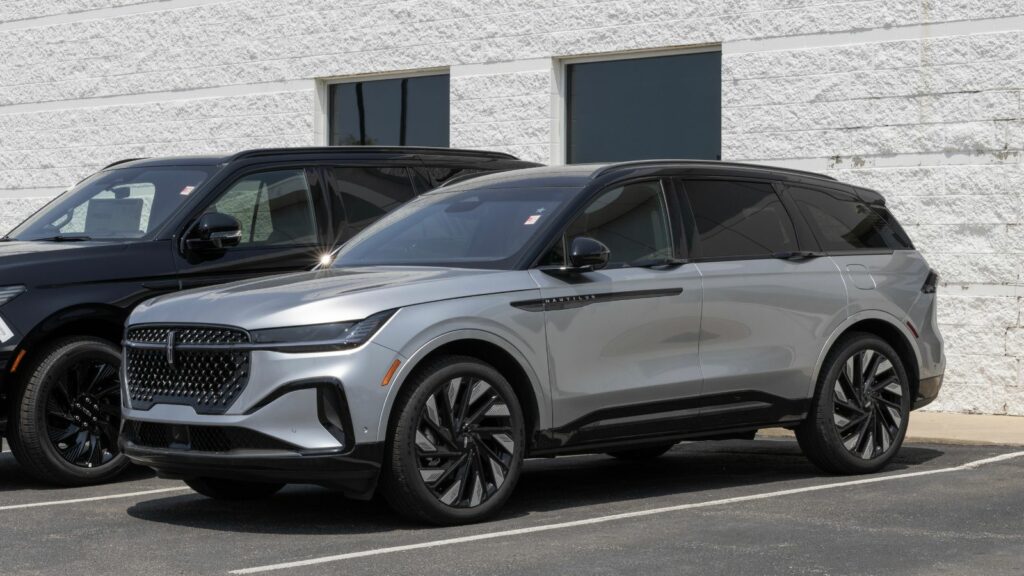
Canada’s new opening for electrified vehicles from China is beginning to show up in the import numbers, but not quite in the way many expected. Federal data show that 259 non-plug-in hybrid SUVs and passenger vans from China entered the country in July under a tariff category for vehicles valued above $35,000. At almost the same moment, Ford Canada confirmed that the Chinese-built Lincoln Nautilus Hybrid was returning to Canadian dealerships after an extended absence.
The timing is striking, although the government data do not identify individual manufacturers or models. That makes the Nautilus connection a strong inference rather than an official confirmation. Even so, the 259 vehicles offer an early glimpse at how Canada’s dramatically revised China auto policy could reshape dealership inventories, consumer choice and North American automotive supply chains.
The 259-Vehicle Figure Comes Directly From Ottawa
Global Affairs Canada’s quota-utilization records provide unusually specific insight into what has crossed the border. During July, 259 vehicles were recorded under tariff classification 8703409090, covering non-plug-in hybrid SUVs and passenger vans powered by a spark-ignition engine and valued above $35,000. There had been zero imports in that category during March, April, May and June, making July the first month in which conventional hybrids appeared under the new system.
That sudden arrival makes the number noteworthy even though 259 vehicles is small relative to Canada’s overall auto market. It also illustrates an easily missed feature of the new China arrangement: Ottawa’s definition of eligible “EVs” extends beyond fully battery-powered cars. Certain conventional hybrids and plug-in hybrids fall under the quota as well. For Canadian dealerships, that means the policy can affect familiar gasoline-electric vehicles, not merely new Chinese battery-electric brands trying to establish themselves in the country.
Ottawa Has Not Said Those Vehicles Are Lincolns
The most important qualification is that Global Affairs Canada does not publish a brand or model beside the 259 vehicles. The federal database identifies their origin, tariff classification, propulsion category and quantity, but it does not say “Lincoln Nautilus.” Describing every vehicle as a confirmed Nautilus would therefore go beyond what Ottawa’s public data establish.
There is nevertheless compelling circumstantial evidence. Ford Canada confirmed in early August that its first shipment of 2026 Nautilus Hybrids had arrived in Canada and that vehicles were heading toward dealerships. The Nautilus is built in China, fits the government’s relevant hybrid-SUV classification and is priced comfortably above the $35,000 customs-value threshold associated with the category. Automotive reporting has also noted that Volvo was the other company previously importing Chinese-built conventional hybrids and had not shifted its Canadian sourcing back to China. Taken together, the evidence makes the Nautilus the leading explanation for the 259-unit entry.
The Nautilus Hybrid Had Essentially Been Tariffed Out
The return marks a sharp reversal from the policy environment that existed less than two years ago. Canada imposed a 100 per cent surtax on Chinese-made electric vehicles on October 1, 2024. Despite the shorthand name, the measure covered more than pure EVs. Certain hybrid passenger vehicles, trucks, buses and delivery vans were included, with the surtax added on top of the existing 6.1 per cent most-favoured-nation tariff.
That created an obvious problem for the Chinese-built Nautilus Hybrid. Canadian reporting indicates imports of the hybrid version stopped around the time the surtax came into force, while the conventional gasoline Nautilus remained available. A luxury SUV already carrying a price well above $60,000 becomes extremely difficult to position competitively when a 100 per cent border surtax is layered onto its import cost. Its reappearance therefore demonstrates how quickly a trade-policy change can alter which powertrains an automaker considers commercially viable in Canada.
Canada Replaced the 100% Surtax With a Managed Quota
The policy changed again following a Canada-China trade arrangement announced in January 2026. Ottawa agreed to permit an initial 49,000 qualifying Chinese electrified vehicles annually at the standard 6.1 per cent tariff. The quota took effect March 1, and the 100 per cent China EV surtax was repealed at the same time. Rather than leaving the market entirely open, the government created a controlled channel through which qualifying vehicles can enter.
During the first six months, from March through August, only 24,500 vehicles are available under the quota. Importers require shipment-specific permits, and the initial allocation has been administered on a first-come, first-served basis. This setup creates a very different commercial calculation for a company such as Ford. A Chinese-built hybrid that was effectively uneconomic under a 100 per cent surtax can potentially return under a 6.1 per cent tariff, provided it qualifies for quota access and the importer secures the necessary permit.
The Hybrid Brings a Meaningful Efficiency Advantage
For buyers, the change is not merely about where the Nautilus is assembled. The hybrid fills an important gap in the Canadian model range. The 2026 Nautilus offers a 2.0-litre turbocharged hybrid powertrain using an electric motor and a power-split continuously variable transmission. Published Canadian specifications put combined output at 285 horsepower and 295 pound-feet of torque, with all-wheel drive.
The efficiency difference is more noticeable than the badge on the tailgate might suggest. Natural Resources Canada figures reported for the model put the hybrid at approximately 7.9 litres per 100 kilometres combined. The conventional 2.0-litre turbo Nautilus is rated around 9.9 L/100 km combined. For a household driving 20,000 kilometres annually, that two-litre-per-100-kilometre gap would translate into roughly 400 fewer litres of fuel used under comparable rated conditions. Real-world consumption varies, but the numbers help explain why the hybrid can be attractive even to luxury buyers who are not ready for a plug-in vehicle.
This Is Also a Story About Canadian Auto Manufacturing
The Nautilus has an unusual connection to Canada because previous generations were assembled at Ford’s Oakville complex in Ontario. Production of the redesigned model shifted to China beginning with the 2024 generation, turning a nameplate with a Canadian manufacturing history into an imported vehicle. That change now places the Nautilus directly in the middle of debates about Chinese manufacturing, tariffs and the future shape of North American auto production.
Oakville itself has gone through repeated changes in Ford’s industrial plans. The company initially intended to transform the site around new electric vehicles before revising those plans and committing billions of dollars to add Super Duty pickup production. The result is an unusual contrast: Canadian customers can once again buy a hybrid Nautilus assembled in China, while the Ontario factory that once produced the nameplate is being repositioned around some of Ford’s largest combustion-powered trucks. Modern automotive supply chains rarely fit neatly into a single political narrative.
The 259 Hybrids Are Still a Small Piece of the Quota
The July hybrids may attract attention because they appear to correspond with the Nautilus comeback, but they represent only a fraction of the vehicles entering under the China quota. Global Affairs Canada reported that 12,513 vehicles had used the first-half allocation when its utilization report was run on August 7. The maximum available quantity for March through August is 24,500, meaning just over half of that initial allocation had been used at that point.
The 259 conventional hybrids account for only about 1.1 per cent of the first-half quota and roughly 0.5 per cent of the full 49,000-vehicle annual allowance. Battery-electric passenger vehicles make up the overwhelming majority of the recorded imports so far. That perspective matters. The Nautilus may be one of the first recognizable legacy-brand vehicles to illustrate how the agreement can be used, but hundreds of hybrids do not represent a sudden flood of China-built vehicles. The larger market impact will depend on what arrives later.
Ottawa Is Trying to Balance Competition With Protection
Canada’s China arrangement was designed as managed market access rather than a wholesale reversal of its industrial strategy. Ottawa says the 49,000-vehicle annual limit amounts to less than three per cent of Canada’s new-vehicle market. The federal government has also said that the share of the quota reserved for vehicles with an import price of $35,000 or less is supposed to rise to 50 per cent by 2030.
That makes the returning Nautilus an interesting early case because it occupies the opposite end of the pricing spectrum. It is a premium SUV, not the low-cost Chinese EV that many consumers may imagine when they hear about the quota. Ottawa has argued that the arrangement can eventually create more affordable choices while encouraging Chinese joint-venture investment and preserving a predictable ceiling on imports. Whether those industrial benefits materialize remains uncertain, but the Nautilus shows that established Western automakers with Chinese factories can also take advantage of the new trade architecture.
Canada and the United States Are Moving in Different Directions
The Nautilus also highlights a growing policy split between Canada and the United States. While Canada has lowered the effective tariff barrier for a limited number of Chinese-built electrified vehicles, Washington continues to place substantial pressure on automakers to reduce dependence on Chinese production. Ford confirmed to Reuters in August that the U.S. tariff on the China-built Nautilus stands at 52.5 per cent.
Ford now plans to move production of some Lincoln vehicles from China to the United States beginning in 2030. The company has also had to navigate American connected-vehicle restrictions affecting Chinese-linked software and hardware. That creates an unusual near-term arrangement in North America: essentially the same China-built luxury SUV can face dramatically different political and tariff environments depending on which side of the Canada-U.S. border it enters. For automakers accustomed to treating North America as an integrated market, those diverging rules add another layer of supply-chain complexity.
The Next Import Reports Will Tell a Bigger Story
For now, the most defensible conclusion is relatively narrow. Canada recorded 259 Chinese-built conventional hybrid SUVs and passenger vans in July, and Ford separately confirmed that China-built Nautilus Hybrids had arrived and were moving toward Canadian dealers. The available evidence strongly connects those developments, but Ford has not publicly confirmed that its vehicles account for all 259 imports or that the shipment entered specifically through the new quota.
That uncertainty makes the next few months important. Ottawa must administer another 24,500 vehicles for the second half of the quota year, plus any unused quantity carried forward from the first six months. More manufacturers could begin using the program as products receive Canadian certification and distribution plans mature. What now looks like a small statistical curiosity could therefore become an early marker of a broader shift: Chinese manufacturing returning to Canadian showrooms not only through Chinese brands, but through familiar North American and European badges whose global production networks increasingly cross political boundaries.
