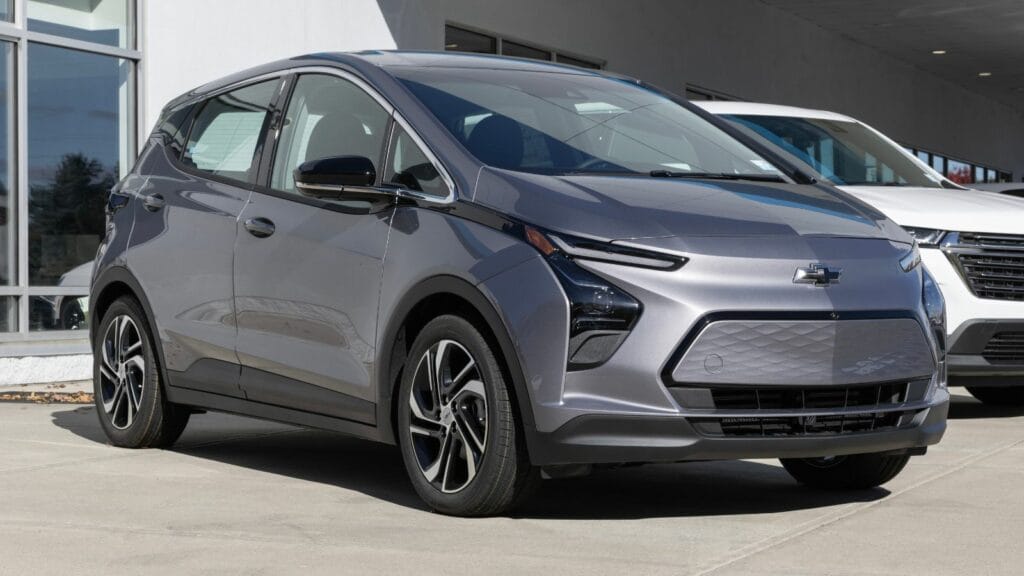
Canada’s newest Chevrolet Bolt presents an unusual snapshot of how complicated the electric-vehicle supply chain has become. The 2027 Bolt is assembled in Kansas and officially qualifies for Canada’s Electric Vehicle Affordability Program, giving eligible buyers access to a federal incentive of up to $5,000 in 2026. Yet U.S. parts-origin information for the vehicle reports that 51% of its parts content by value comes from China, while only 17% is attributed to the United States and Canada.
There is no contradiction in the rules themselves. Canada’s current rebate program primarily looks at where an EV is made, its final transaction value and several other eligibility conditions. It does not impose a separate limit on how much Chinese content can be inside an otherwise qualifying vehicle. The Bolt shows how that distinction can produce results that look surprising at first glance.
The Bolt Is Officially on Canada’s Rebate List
Transport Canada currently lists both the 2027 Chevrolet Bolt LT and RS as eligible battery-electric vehicles under the Electric Vehicle Affordability Program, commonly called EVAP. For a purchase or a lease lasting at least 48 months, the maximum federal incentive in 2026 is $5,000. Shorter eligible leases receive a prorated amount. That puts the Bolt among the relatively small group of vehicles that can receive the program’s maximum battery-electric incentive.
The Bolt clears several important conditions. It is a new highway-capable battery-electric vehicle assembled in the United States, which has a free-trade agreement with Canada. Its Canadian pricing also places typical configurations below the program’s $50,000 final-transaction-value ceiling. Chevrolet Canada publicly advertises EVAP eligibility for the Bolt, although eligibility ultimately depends on the individual transaction. The result is straightforward from a consumer perspective: despite its complicated international parts mix, an eligible Canadian Bolt purchase can receive federal support.
The Reported 51% Figure Measures Something Different
The figure attracting attention comes from U.S. vehicle parts-content information rather than Canadian rebate documentation. A 2027 Chevrolet Bolt window sticker examined in the United States lists U.S./Canadian parts content at 17% and identifies China as the largest foreign source, accounting for 51%. Automotive News Canada has also reported the 51% figure while examining the amount of Chinese technology embedded in EVs sold by established automakers.
That percentage should be interpreted carefully. U.S. parts-content labeling is calculated under the American Automobile Labeling Act and measures the value of equipment used in a vehicle carline. It is not simply a statement that 51% of the entire retail value of a particular Bolt was created in China. NHTSA notes that final assembly, distribution and other non-parts costs are excluded. The measurement therefore answers a different question from Canada’s EVAP rules, which helps explain why both figures can be accurate simultaneously.
Canadian Eligibility Does Not Set a Chinese-Parts Ceiling
Transport Canada’s published EVAP criteria require an eligible EV to be made in Canada or in a country with which Canada has a free-trade agreement. For vehicles built outside Canada, the final transaction value generally must be $50,000 or less. The rules also cover matters such as safety compliance, vehicle weight and whether the vehicle is new. What those criteria do not currently contain is a separate maximum percentage for components sourced from China.
That distinction matters enormously for the Bolt. The vehicle reaches final assembly at General Motors’ Fairfax plant in Kansas City, Kansas. Because the United States qualifies under Canada’s trade framework, Chinese batteries, motors or other components do not automatically make the completed vehicle ineligible. In practical terms, EVAP treats the Bolt as a U.S.-made qualifying EV rather than as a Chinese vehicle. That approach reflects how modern auto manufacturing works, with final assembly and component sourcing frequently spread across several countries.
Some of the Chinese Content Is Central to the Powertrain
The Chinese component share is not limited to inexpensive interior trim or minor electronics. The U.S. window sticker identifies China as the country of origin for the Bolt’s electric motor and electric drive unit. Separately, Reuters reported that General Motors planned to source lithium-iron-phosphate battery cells from Chinese battery giant CATL as a temporary arrangement for its affordable EV program. GM publicly described foreign LFP sourcing as a bridge until domestic production could be established.
That makes the Bolt an especially clear example of the difference between assembly location and technological sourcing. Workers in Kansas assemble the completed vehicle, yet major pieces responsible for storing energy and moving the car can originate thousands of kilometres away. The situation is not unique to GM, but the Bolt’s 51% figure makes the relationship unusually visible. Modern EV manufacturing involves batteries, power electronics, semiconductors, motors and raw materials whose supply chains often cross several national borders before a finished vehicle reaches a dealership.
LFP Batteries Help Make the Bolt’s Price Possible
The use of lithium-iron-phosphate technology is closely connected to the Bolt’s affordability strategy. Chevrolet says the 2027 model uses a 65-kWh LFP battery and offers as much as 422 kilometres of estimated driving range. It can accept up to 150 kW of DC fast charging, with GM estimating a 10%-to-80% charging session can take roughly 25 minutes under suitable conditions. The Bolt also produces 210 horsepower.
LFP has become increasingly attractive because it can significantly reduce battery costs. The International Energy Agency reported that average LFP battery packs were more than 40% cheaper per kilowatt-hour than nickel-manganese-cobalt alternatives in 2025, although chemistry, application and regional production costs vary. That matters because the battery remains one of an EV’s largest cost components. Chinese companies have built enormous scale around LFP technology, giving automakers attempting to sell lower-priced EVs a strong economic reason to use Chinese suppliers while alternative supply chains are developed.
Chevrolet Positioned the Bolt Directly Around Affordability
Chevrolet Canada introduced the 2027 Bolt LT with an MSRP of $39,999 and an estimated range of up to 422 kilometres. Those numbers place it comfortably within the part of the Canadian EV market EVAP was designed to support. The program does not technically use a simple MSRP ceiling for individual transactions; instead, Transport Canada looks at the final transaction value, including specified vehicle-related charges and discounts. For non-Canadian-made EVs, that value generally cannot exceed $50,000.
That system can make manufacturer and dealer discounts important. Transport Canada specifically allows qualifying discounts to reduce the final transaction value when determining eligibility. For the Bolt, the relatively low starting price creates considerable room before reaching the limit, even with some optional equipment. The federal incentive can then reduce the buyer’s effective cost further. That combination of a comparatively inexpensive vehicle, substantial range and a $5,000 maximum 2026 incentive helps explain why the Bolt occupies an unusually competitive position among new EVs sold in Canada.
Canada Treats Chinese-Built EVs Differently
The treatment of the Bolt becomes more striking when compared with vehicles actually manufactured in China. Canada changed its Chinese EV trade policy in 2026, replacing the previous 100% surtax with an initial annual quota of 49,000 Chinese EVs that can enter at Canada’s 6.1% most-favoured-nation tariff rate. The first-year quota began on March 1, 2026, with future volumes scheduled to increase.
Those vehicles still face a separate obstacle when it comes to EVAP. Transport Canada requires foreign-made rebate vehicles to originate in countries with which Canada has a free-trade agreement, and China does not meet that condition. A Chinese-assembled EV can therefore enter Canada under the new quota yet remain ineligible for EVAP. Meanwhile, a Kansas-built Chevrolet containing a reported 51% Chinese parts content can qualify. The contrast illustrates that Canada’s import policy, industrial policy and consumer-rebate rules measure vehicle origin in different ways rather than using one universal definition of Chinese content.
The Bolt Has Become a Major User of EVAP Funding
The Bolt is not merely technically eligible; Canadian buyers have been making significant use of the incentive. Industry reporting based on EVAP data found that 1,911 Bolt transactions generated federal rebate claims in August 2026, the highest total for any individual model that month. The cumulative number of Bolt claims since the program’s February eligibility date had reached 5,669 by the end of August.
That volume matters because EVAP has a finite budget. Transport Canada says the program received $2.275 billion over five years, with approximately $2 billion remaining as of September 1, 2026. It is scheduled to continue until March 31, 2031, unless the available funding is exhausted sooner. For Chevrolet, having an EV positioned around the program’s affordability requirements provides a meaningful advantage in a market where the upfront price of an electric vehicle remains important. For policymakers, the claims also show that sourcing rules can have significant financial consequences once thousands of transactions begin drawing incentives.
Replacing Chinese EV Components Is Harder Than Replacing a Badge
The Bolt’s sourcing makes more sense when viewed against the global battery industry. The International Energy Agency estimates that China accounted for more than 80% of global battery-cell production in 2025. Chinese producers represented roughly three-quarters of electric-car battery deployment worldwide, while production of important LFP cathode materials and precursors remained overwhelmingly concentrated in China. That scale was built over many years and cannot be recreated quickly simply by changing an eligibility rule.
Cost differences remain substantial as well. The IEA estimated that average battery-pack prices in China were about 30% lower than in North America in 2025. Automakers trying to deliver EVs at prices competitive with gasoline vehicles therefore face a difficult calculation: using mature Chinese supply chains can reduce costs today, while shifting to newer North American sources can strengthen regional manufacturing but potentially increase costs or create supply constraints during the transition. The Bolt sits directly in the middle of that trade-off.
The Bolt’s Supply Chain Could Look Very Different Within a Few Years
General Motors has already laid out plans to reduce its reliance on imported LFP batteries. Its Ultium Cells joint venture with LG Energy Solution is converting part of its Spring Hill, Tennessee, battery operation to manufacture LFP cells. GM has said full commercial production of those cells is targeted for late 2027. The company has described imported LFP batteries as a temporary solution intended to keep affordable EV production competitive while domestic capacity develops.
Canada’s incentive landscape is changing too. Chevrolet’s EVAP guidance says the maximum battery-electric incentive falls from $5,000 in 2026 to $4,000 beginning January 1, 2027, with further reductions scheduled later in the program. That means both sides of the Bolt equation are moving: its North American component share could increase as regional battery production grows, while the Canadian subsidy supporting its purchase will gradually shrink. For now, however, the 2027 Bolt demonstrates a defining reality of the EV transition — the nationality of the badge, assembly plant and underlying technology can be three very different things.
