Canada’s new China-EV quota is no longer just a trade-policy promise on paper. By late September, thousands of Chinese-built electric vehicles had already entered the country under the program, even before major Chinese brands such as BYD, Chery and Changan had fully established retail operations. The early volumes reveal an important twist: many of the vehicles counted so far are believed to be China-built models from established brands such as Tesla, because the quota is based on where a vehicle is made, not who owns the badge.
That is beginning to change. Chinese automakers are scouting dealerships, completing regulatory work, testing vehicles in Canadian conditions and, in Lotus’s case, already delivering China-built EVs. Canada has effectively created a controlled opening into one of North America’s most closely watched auto markets, with affordability, jobs, trade and competition all tied to what happens next.
Quota Use Has Moved Beyond the Experimental Stage
The clearest sign that the policy is already reshaping the market is the official utilization count. Global Affairs Canada reported that 15,763 vehicles had been counted against the first-year quota by September 25, 2026. Of those, 15,603 entered during the first six-month period from March through August, while another 160 were recorded in September. That means nearly one-third of the full 49,000-vehicle annual quota had already been used with five months still left in the quota year.
The first window alone is revealing. Ottawa initially made 24,500 places available from March 1 through August 31, and importers used roughly 64% of them. The unused portion rolled into the second period rather than disappearing. That left 33,397 spaces available beginning September 1 before September imports were counted. The numbers show that demand already exists even before several Chinese brands have completed Canadian launches, making the quota more than a hypothetical opening.
The Rules Changed Faster Than the Market Did
The surge follows one of the sharpest tariff reversals in Canada’s recent auto policy. Chinese-built electric vehicles had faced a 100% surtax on top of the normal tariff after October 1, 2024. Under the Canada-China arrangement announced in January 2026, that surtax was repealed effective March 1, and eligible vehicles inside the quota returned to the 6.1% most-favoured-nation tariff rate.
The opening is tightly controlled. Year one is capped at 49,000 vehicles, and the quota is scheduled to grow by 6.5% annually. Importers need shipment-specific permits from Global Affairs Canada, while the Canada Border Services Agency enforces the requirement at entry. The system remains first-come, first-served under the current notice, and permits stop once available volume is exhausted. Ottawa has therefore lowered the tariff barrier without creating an unlimited channel, giving automakers a predictable opening while preserving a hard ceiling on total Chinese-origin EV imports into Canada each year today.
Tesla Has Been the Early Proof of Concept
One important detail is that the quota does not belong only to Chinese brands. It applies to qualifying electric vehicles manufactured in China, which means a U.S.-headquartered automaker can use the same access. Tesla demonstrated that quickly. In early May, it began selling a Shanghai-built Model 3 in Canada at about C$40,000 after shifting supply away from expensive U.S.-built inventory.
That move helps explain why quota utilization rose quickly before BYD or Chery had Canadian dealer networks. Reuters reported that Tesla imported more than 44,000 China-built vehicles into Canada in 2023, before the 2024 surtax changed its sourcing strategy. The 2026 quota data do not identify brands, so it would be inaccurate to assign every imported vehicle to Tesla. Still, the timing, pricing and factory shift show how quickly an established company can use the lower tariff to reshape its Canadian lineup without waiting for a new brand launch today.
Cheap Imports Still Face an Incentive Gap
The quota is designed to become more focused on affordability over time, but low sticker prices do not automatically mean federal rebates. During the first six-month window, 7,805 imported battery-electric passenger vehicles were recorded at a free-on-board value of C$35,000 or less, while roughly the same number fell above that threshold. Starting in the second quota year, Ottawa plans to reserve 10% of the quota for vehicles at or below C$35,000, rising to 50% by year five.
Canada’s Electric Vehicle Affordability Program creates a separate hurdle. Transport Canada says eligible vehicles made outside Canada must come from a country with which Canada has a free-trade agreement. China does not meet that condition, so a China-built EV can enter under the 6.1% quota tariff and still miss the federal incentive of up to C$5,000 in 2026. That distinction could become crucial when shoppers compare headline prices with final purchase costs today.
BYD Is Laying Groundwork, Not Yet Declaring a Full Launch
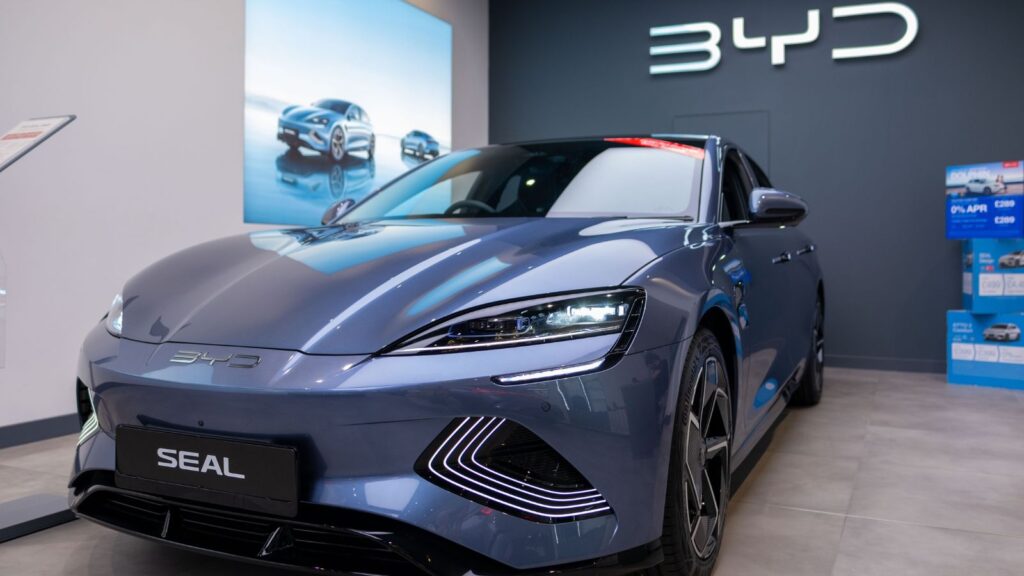
BYD is often associated with a potential wave of lower-cost Chinese EVs, but its Canadian status remains more measured than early headlines suggested. Reuters reported in June that an advisory firm scouting locations for BYD expected six Canadian dealerships, while regulatory records showed the company had begun compliance procedures for two passenger vehicles. BYD executive vice-president Stella Li also told Reuters that it was deciding which models to offer and would likely begin Canadian sales in 2027.
The company is examining Canada seriously. Bloomberg reported in March that BYD was studying the possibility of a Canadian factory, although no decision had been made, and Li said the company would prefer to own and operate any facility rather than use a joint venture. Ottawa has promoted the quota partly as a way to encourage investment. For now, BYD is building the foundations for entry rather than operating a national retail launch.
Chery, Lotus and Changan Are Moving Too
BYD is only one part of the incoming competition. Chery, China’s largest auto exporter, moved quickly after the January trade announcement, meeting Canadian dealers and later bringing about 20 representatives from Canadian retail groups to China to see its vehicles. Reuters reported that Chery was road-testing vehicles in Canada to understand cold-weather effects on warranty costs and was targeting a fourth-quarter 2026 launch at the time of its June report.
Lotus has moved from planning to physical imports. The Geely-owned brand began shipping China-built electric vehicles to Canada in July, with nearly 20 vehicles arriving in the first batch according to China’s embassy in Canada, while Reuters reported plans for roughly six Canadian dealerships. Changan has also had a team working on a Canadian launch. Chery’s Omoda and Jaecoo brands now operate a Canadian website advertising electric SUVs as coming soon, a clear sign that competition is becoming more concrete.
Canada Offers Chinese Automakers More Than Immediate Sales
Canada is a relatively small prize compared with the United States, which helps explain why the strategic value of entry may exceed near-term sales. Reuters reported that Canada sold about 1.9 million vehicles in 2025, compared with more than 16 million in the United States. Industry executives and analysts said Canadian consumer preferences and vehicle rules are close enough to the U.S. market to make Canada useful for learning about North American retail, service and regulatory expectations.
That opportunity arrives as Chinese automakers push outward at unprecedented scale. The International Energy Agency estimates that China produced nearly three-quarters of the world’s electric cars in 2025 and that Chinese automakers supplied 60% of global electric-car sales. Chinese electric-car exports doubled to more than 2.5 million vehicles that year. With domestic competition squeezing margins, overseas growth has become important, making even a controlled Canadian quota strategically significant for companies building international brands.
The Timing Meets a Canadian EV Market in Transition
Chinese-built vehicles are entering Canada while the domestic EV market recovers from a difficult 2025. Statistics Canada reported that new zero-emission vehicle registrations fell 34.7% last year and represented 9.5% of all new registrations, down from 14.6% in 2024. The agency linked part of that decline to changes in purchase incentives, including the pause in the former federal rebate program and reductions in Quebec support.
The picture improved in 2026. New zero-emission registrations rose from 43,113 in the first quarter to 58,811 in the second, the highest quarterly total since late 2024. That rebound creates a receptive environment for models, particularly if imports expand options near mainstream price points. Ottawa has emphasized affordability as one goal of the China arrangement, while keeping the initial quota below 3% of Canada’s new-vehicle market. The result is a controlled test of whether more supply can influence pricing and consumer choice without dominating sales.
Auto Jobs, Safety and Data Concerns Remain Central
The opening has drawn resistance from parts of Canada’s auto industry. The Canadian Vehicle Manufacturers’ Association, representing Ford, GM and Stellantis, warned that the quota could undermine the domestic auto sector and the integrated North American supply chain. Unifor has argued that China-made EV imports could put Canadian assembly and parts jobs at risk, if imported vehicles arrive without significant Canadian content.
The federal government presents a different objective. Ottawa says the arrangement is intended to encourage Chinese joint-venture investment, protect and create auto jobs and strengthen Canada’s EV supply chain. Imported vehicles still face Canadian compliance rules. The Canada Border Services Agency states that all vehicles must meet federal safety, environmental and emissions legislation, in addition to having the required import permit. Those requirements mean the quota is not blanket approval for any vehicle produced in China; manufacturers still must clear Canada’s regulatory system before retail sales can expand.
The Next Phase Will Be About Who Gets the Remaining Space
As of September 25, 33,237 vehicles remained available in the first quota year, which runs through February 28, 2027. The second period began with 24,500 new spaces plus 8,897 unused places carried forward from the first window. Only 160 vehicles had been recorded in September at the latest official update, so remaining capacity was large relative to the number of arriving Chinese brands.
The question is how that capacity gets used. Tesla and other established manufacturers can compete for the same quota as new entrants, while BYD, Chery and others must complete certification, establish dealers, stock parts and build service networks. Future quota years also add an affordability requirement, reserving a growing share for vehicles with free-on-board prices of C$35,000 or less. Canada has opened the door, but the quota, regulation and retail infrastructure will determine whether that opening becomes a broad new market or remains a tightly managed niche.
