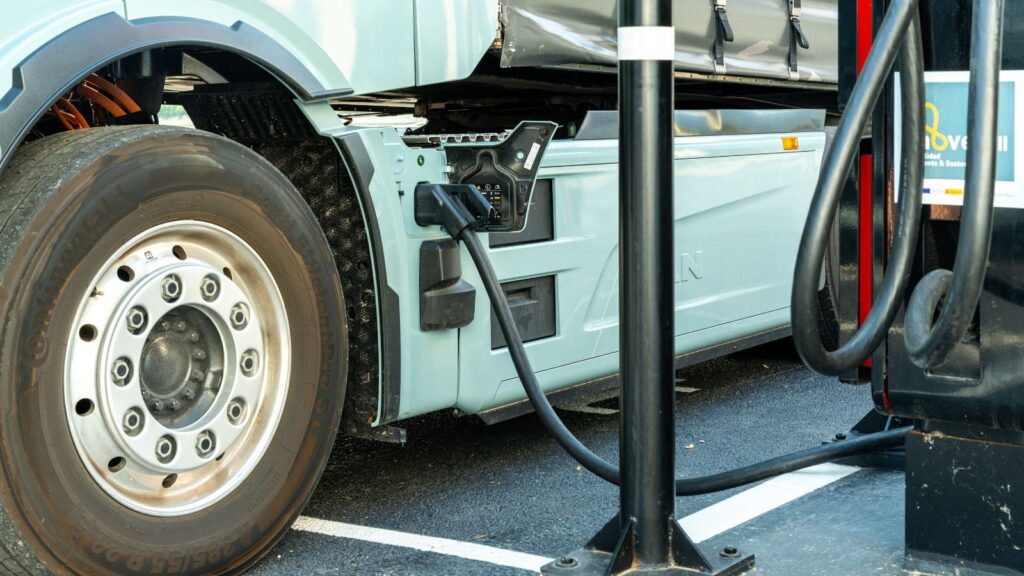
The economics of Europe’s trucking transition are shifting faster than many fleet operators expected. A new analysis from Transport & Environment finds that battery-electric trucks purchased in 2026 can now cost less to own and operate over five years than comparable diesel trucks in six major European Union markets: the Netherlands, Germany, Denmark, Sweden, France and Belgium.
Together, those countries account for 46% of EU heavy-truck registrations. The change is being driven by several forces at once, including higher diesel prices, cheaper electricity-based operation, road-toll policies and government support. The largest projected five-year savings reach €100,000 in the Netherlands, €85,000 in Germany and €69,000 in Denmark. In several markets, the higher initial purchase cost of an electric truck can now be recovered in roughly two years.
Netherlands: Five-Year Savings Can Reach €100,000
The Netherlands produces the largest headline saving in the new analysis. Transport & Environment estimates that an electric truck bought in 2026 can save an operator as much as €100,000 over five years compared with a diesel alternative. That is an important change for a sector where purchasing decisions are usually based less on showroom price than on total cost of ownership. A truck that costs substantially more upfront can still be the better investment if its energy, road charges and other recurring expenses are consistently lower over years of high-mileage operation.
Dutch policy is strengthening that calculation. A nationwide truck toll began on July 1, 2026, replacing the Eurovignette in the Netherlands and charging trucks according to weight and emissions. From September through the end of 2026, for example, an over-32-tonne Euro 6 truck in CO₂ class 1 is charged €0.156 per kilometre, while an equivalent-weight zero-emission vehicle in CO₂ class 5 is charged €0.030. Because commercial trucks can accumulate enormous annual mileage, seemingly modest per-kilometre differences can become major fleet expenses. The Netherlands was already one of Europe’s strongest electric-truck markets: ACEA reported electrically chargeable truck registrations there surged more than 200% in 2025.
Germany: An €85,000 Advantage Meets One of Europe’s Strongest Toll Incentives
Germany is especially important because of the sheer scale of its freight and truck market. Transport & Environment calculates that an electric truck bought in 2026 can deliver savings of up to €85,000 over five years compared with diesel. The higher purchase price can be recovered in roughly two years under the study’s current assumptions. That means an operator keeping a vehicle for a normal multi-year ownership cycle may spend much of that period benefiting from the lower operating-cost structure rather than simply trying to recover the initial premium.
Independent research supports the direction of the finding. The International Council on Clean Transportation calculated earlier in 2026 that, under Germany’s current road-toll policies, the five-year total cost of ownership of a model-year-2026 battery-electric truck was 10.1% lower than diesel for regional applications and 11.4% lower for long-haul use. One major reason is Germany’s LKW-Maut system: qualifying zero-emission vehicles are exempt from truck tolls until June 30, 2031. Germany is also becoming a critical battleground for vehicle prices. T&E estimates a Chinese-built electric truck at about €210,000 compared with roughly €265,000 for a European equivalent, calculating that the lower-priced vehicle could produce another €34,000 in five-year savings for a German operator.
Denmark: €69,000 in Savings Shows How Road Pricing Can Change the Calculation
Denmark ranks third among the countries for which Transport & Environment disclosed a specific savings figure, with an electric truck potentially costing €69,000 less than diesel over five years. Denmark is particularly useful for understanding why total cost of ownership can move so quickly. It is not simply a question of comparing the price of diesel with a kilowatt-hour of electricity. Road charges, vehicle utilization, charging strategy and environmental pricing can all change what appears on a fleet manager’s operating-cost spreadsheet.
Since January 2025, Denmark has operated a kilometre-based truck toll for vehicles weighing 12 tonnes or more, with the rate differentiated according to CO₂ emissions. The difference can be substantial. For trucks between 12,000 and 17,999 kilograms, the published rate outside a low-emission zone is DKK0.86 per kilometre for CO₂ class 1 and DKK0.13 for class 5. Denmark has also become one of Europe’s more mature electric-truck markets rather than simply a testing ground. Transport & Environment identified Denmark, Sweden, the Netherlands and Norway as European frontrunners in 2025, with electric trucks reaching roughly 16% to 18% of new-truck sales across those leading markets. That growing installed base gives fleet operators more real-world experience with charging, routing and maintenance.
Sweden: Electric Trucks Are Moving From Early Adoption Toward Normal Fleet Use
Sweden is one of the three additional markets where the new T&E analysis finds that electric trucks have moved below diesel on five-year ownership cost, although the Reuters summary of the analysis did not disclose a specific euro saving for the country. That result matters because Sweden already has one of Europe’s most developed heavy-duty electric vehicle markets. European Alternative Fuels Observatory data indicate that nearly 19% of newly registered heavy trucks in Sweden during 2025 were battery electric, representing 391 vehicles. By the end of that year, the country’s electric heavy-truck fleet had reached approximately 1,634 vehicles.
That level of adoption changes the conversation from whether electric trucks can function in commercial service to which routes and operating models make the most financial sense. Depot charging is particularly important. Trucks that return to a predictable base can often recharge at lower private electricity rates rather than relying heavily on expensive public rapid charging. ICCT research has repeatedly identified charging strategy, daily distance and battery utilization as major determinants of electric-truck economics. Sweden still presents challenges—the country continues to use a time-based vignette rather than a nationwide distance-based truck toll—but its relatively high level of electric-truck adoption suggests operators are already finding viable commercial use cases. Higher and more volatile diesel prices further improve that calculation.
France: Bigger Purchase Support Is Narrowing the Upfront Price Problem
France also appears among the six countries where Transport & Environment now finds a five-year cost advantage for electric trucks. The timing is notable because the French government has substantially increased support aimed at one of electrification’s biggest remaining obstacles: the initial vehicle price. Under measures introduced from June 1, 2026, assistance for qualifying electric road tractors can exceed €100,000, compared with support of about €60,000 in 2025. Eligibility for the enhanced support includes manufacturing requirements intended to favour vehicles produced within the European Economic Area.
The policy arrives as electric commercial-vehicle registrations are already accelerating. ACEA reported that electrically chargeable truck registrations in France rose 43.7% in the first half of 2026 compared with the same period a year earlier. France, Germany and the Netherlands together accounted for 74% of EU electrically chargeable truck registrations during that period. Infrastructure remains a significant part of the equation, particularly for operators running long-distance routes that cannot rely entirely on depot charging. The French government’s broader electrification strategy envisages roughly 8,000 heavy-truck charging points across about 560 locations on the national road network. For fleets, that combination of lower lifetime operating costs, larger purchase support and expanding charging coverage could make the investment case easier to justify.
Belgium: New CO₂-Based Tolling Adds Another Cost Advantage
Belgium completes the group of six markets identified by Transport & Environment. Here again, the economics are being affected by more than fuel alone. Belgium already operates a kilometre charge for heavy goods vehicles, but Flanders added a CO₂-based component to its charging structure on July 1, 2026. The system assigns zero-emission trucks to CO₂ class 5, while conventional vehicles are placed into other classes according to their emissions characteristics. For freight companies covering large annual distances, the resulting difference in road charges can materially influence total ownership costs.
The current Viapass rate table illustrates the scale. In Flanders, an over-32-tonne Euro 6 vehicle in CO₂ class 1 is charged €0.285 per kilometre, while a zero-emission vehicle in class 5 is charged €0.038. Belgium’s three regions do not apply identical charging structures, so actual savings depend on where trucks operate, but the Flemish differential is significant for fleets regularly travelling those roads. Belgium also demonstrates why the European electric-truck transition will remain uneven even as the overall economics improve. Charging availability, financing, route patterns and local policies differ from one fleet to another. Even so, T&E’s finding that electric trucks now beat diesel over five years in Belgium suggests the conversation is moving beyond environmental compliance toward straightforward operating economics.
